

Multiplication tables are organized lists of multiplication facts that help us perform calculations quickly and easily.
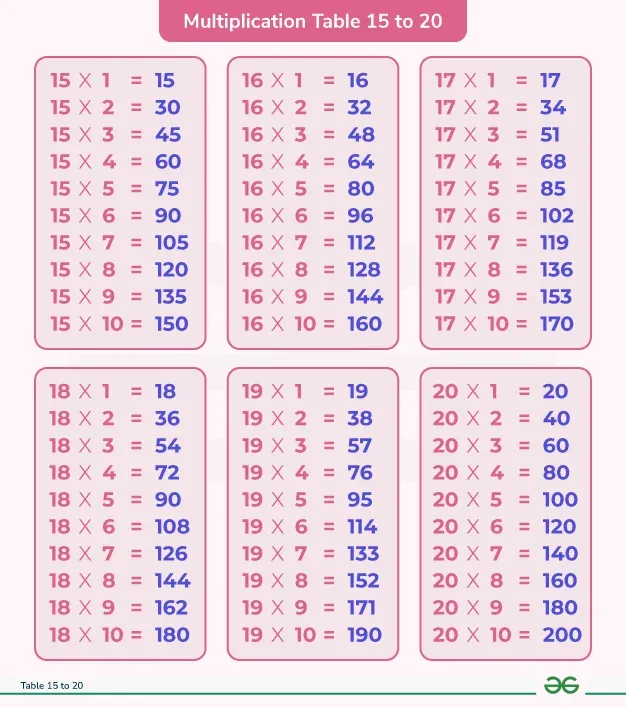
Learn the table 15 to 20 from the chart given below:
Tips to Learn
- To study the multiplication tables from 15 to 20, the students need to read them aloud as they write them. This helps in mastering them quicker.
- The students need to prepare a 15- to 20-table chart and paste it someplace where they can always see it without problems. This helps in revising them on every occasion they pass by way of.
- Students should examine and recognize the pattern of tables from 15 to 20. For example, in the table of 19, the unit place starts from 9 and goes till 0 in 190, and the tens and hundred places are consecutive odd numbers from 1 to 19.
Solved Examples
Example 1: Find the following products.
- 15 × 5 = ?
- 16 × 12 = ?
- 17 × 6 = ?
- 18 × 8 = ?
- 19 × 4 = ?
- 20 × 6 = ?
Solution:
- 15 × 5 = 75
- 16 × 12 = 192
- 17 × 6 = 102
- 18 × 8 = 144
- 19 × 4 = 76
- 20 × 6 = 120
Example 2: If a bakery sells 18 cookies in every box, and they have 15 boxes available, how many cookies do they have in total?
Solution:
Total cookies = 18 cookies/box × 15 boxes = 270 cookies.
Example 3: A lawn has sixteen rows of plant life, and each row has 20 plants. How much vegetation is there in the complete lawn?
Solution:
Total vegetation = 16 rows × 20 flowers/row = 320 vegetation.
Example 4: If an eating place serves 19 food items per step per table, and there are 17 tables occupied, how many items have been served?
Solution:
Total food served = 19 meals/table × 17 tables = 323 meals.
Example 5: A scholar studies 3 subjects day by day, and every challenge has 18 training sessions. How many lessons does the pupil take a look at in a week?
Solution:
Lessons studied in a week = 3 topics × 18 classes/subject = 54 classes.
Example 6: A manufacturing facility produces 20 gadgets of a product each hour, and they perform for sixteen hours in the afternoon. How many units do they produce in an afternoon?
Solution:
Total units produced in a day = 20 gadgets/hour × 16 hours = 320 devices.
Practice Questions
Question 1. Find the following products.
- 15 × 8 = ?
- 16 × 6 = ?
- 17 × 10 = ?
- 18 × 8 = ?
- 19 × 5 = ?
- 20 × 7 = ?
Question 2. The faculty has 18 lecture rooms, and each school room has 15 desks. How many desks are there in total?
Question 3. A delivery truck can deliver 20 containers of goods, and there are 16 trucks in a fleet. How many boxes can the fleet deliver in one journey?
Question 4. A bookstall gets 17 shipments of books, and each shipment incorporates 19 books. How many books did the book shop obtain in total?
Question 5. A farmer has 20 fields, and every field can yield 15 bushels of wheat. What is the total wheat yield from all the fields?
Question 6. A manufacturing facility produces sixteen devices of a product every 18 minutes. How many units does the manufacturing unit produce in a single hour?
