

A square number is the product of a number multiplied by itself. It is commonly represented using exponent notation:
a2= a × a
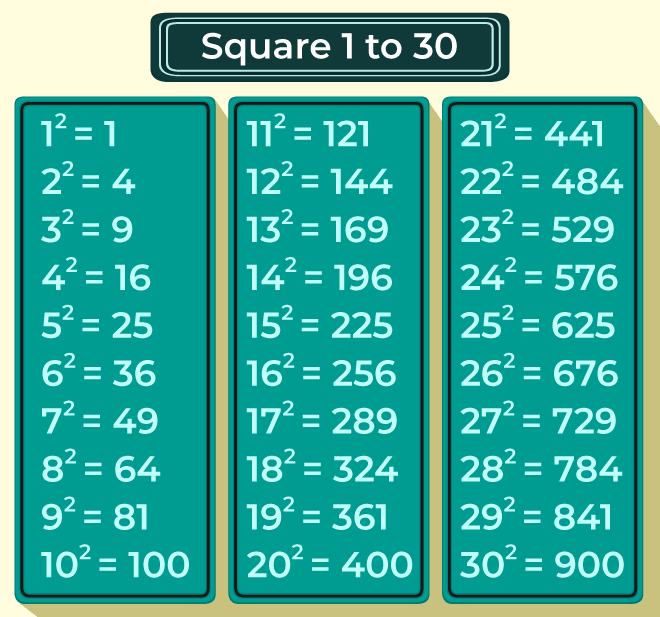
Square 1 to 30 Table
The squares of numbers from 1 to 30, i.e, the square of the first 30 natural numbers given in the image discussed below,
| Number | Square | Number | Square | Number | Square |
|---|---|---|---|---|---|
| (1)2 | 1 | (11)2 | 121 | (21)2 | 441 |
| (2)2 | 4 | (12)2 | 144 | (22)2 | 484 |
| (3)2 | 9 | (13)2 | 169 | (23)2 | 529 |
| (4)2 | 16 | (14)2 | 196 | (24)2 | 576 |
| (5)2 | 25 | (15)2 | 225 | (25)2 | 625 |
| (6)2 | 36 | (16)2 | 256 | (26)2 | 676 |
| (7)2 | 49 | (17)2 | 289 | (27)2 | 729 |
| (8)2 | 64 | (18)2 | 324 | (28)2 | 784 |
| (9)2 | 81 | (19)2 | 361 | (29)2 | 841 |
| (10)2 | 100 | (20)2 | 400 | (30)2 | 900 |
Squares from 1 to 30 (Even Numbers)
Even numbers from 1 to 30 are 2, 4, 6, 8, 10, 12, 14, 16, 18, 20, 22, 24, 26, 28, and 30. Learning the square of even numbers from 1 to 30 is very important. The following table contains the squares 1 to 30 for even numbers.
Even Numbers (1 to 30) | Squares of Even Numbers (1 to 30) |
|---|---|
2 | (2)2 = 4 |
4 | (4)2 = 16 |
6 | (6)2 = 36 |
8 | (8)2 = 64 |
10 | (10)2 = 100 |
12 | (12)2 = 144 |
14 | (14)2 = 196 |
16 | (16)2 = 256 |
18 | (18)2 = 324 |
20 | (20)2 = 400 |
22 | (22)2 = 484 |
24 | (24)2 = 576 |
26 | (26)2 = 676 |
28 | (28)2 = 784 |
30 | (30)2 = 900 |
Squares from 1 to 30 (Odd Numbers)
Odd numbers from 1 to 30 are 1, 3, 5, 7, 9, 11, 13, 15, 17, 19, 21, 23, 25, 27, and 29. Learning the squares of odd numbers from 1 to 30 is very important. The following table shows the values of squares from 1 to 30 for odd numbers.
Odd Numbers (1 to 30) | Squares of Odd Numbers (1 to 30) |
|---|---|
1 | (1)2 = 1 |
3 | (3)2 = 9 |
5 | (5)2 = 25 |
7 | (7)2 = 49 |
9 | (9)2 = 81 |
11 | (11)2 = 121 |
13 | (13)2 = 169 |
15 | (15)2 = 225 |
17 | (17)2 = 289 |
19 | (19)2 = 361 |
21 | (21)2 = 441 |
23 | (23)2 = 529 |
25 | (25)2 = 625 |
27 | (27)2 = 729 |
29 | (29)2 = 841 |
Square of Negative Numbers
The square of a negative number is always positive because multiplying two negative numbers results in a positive product.
The square of a negative number results in a positive value, as shown in the table below:
| Number | Square | Number | Square | Number | Square |
|---|---|---|---|---|---|
| (-1)2 | 1 | (-11)2 | 121 | (-21)2 | 441 |
| (-2)2 | 4 | (-12)2 | 144 | (-22)2 | 484 |
| (-3)2 | 9 | (-13)2 | 169 | (-23)2 | 529 |
| (-4)2 | 16 | (-14)2 | 196 | (-24)2 | 576 |
| (-5)2 | 25 | (-15)2 | 225 | (-25)2 | 625 |
| (-6)2 | 36 | (-16)2 | 256 | (-26)2 | 676 |
| (-7)2 | 49 | (-17)2 | 289 | (-27)2 | 729 |
| (-8)2 | 64 | (-18)2 | 324 | (-28)2 | 784 |
| (-9)2 | 81 | (-19)2 | 361 | (-29)2 | 841 |
| (-10)2 | 100 | (-20)2 | 400 | (-30)2 | 900 |
Calculating Squares 1 to 30
The squares 1 to 30 can easily be calculated using the two methods as discussed below:
Method 1: Multiplication by Itself
Multiplying by itself means to find the square of the number we multiply the number with itself, i.e. the square of any number a is (a)2 then it is calculated as (a)2 = a × a.
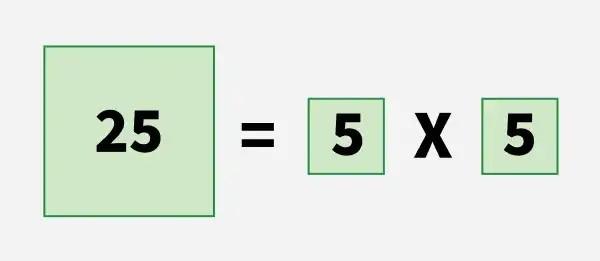
Square of some numbers between 1 to 30 using the multiplication by itself method is,
- (4)2 = 4 × 4 = 16
- (7)2 = 7 × 7 = 49
- (12)2 = 12 × 12 = 144
- (21)2 = 21 × 21 = 441, etc
This method works best for smaller methods, but for finding the square of the larger numbers, we use other methods, i.e., using Algebraic Identities.
Method 2: Using Algebraic Identities
As the name suggests, using algebraic identities uses the basic identities of the square, i.e., it uses
- (a + b)2 = a2 + b2 + 2ab
- (a - b)2 = a2 + b2 - 2ab
Now the given number "n" is broken according to these identities as,
n = (a + b) or n = (a - b) according to the number n, and then the square is found using the identities discussed above.
For example: To find the square of 28, we can express 28 in two ways,
Solution:
(20 + 8)
To find the square of 28 we use the algebraic identity,
(a + b)2 = a2 + b2 + 2ab
(20 + 8)2 = 202 + 82 + 2(20)(8)
= 400 + 64 + 320
= 784(30 - 2)
To find the square of 28 we use the algebraic identity,
(a - b)2 = a2 + b2 - 2ab
(30 - 2)2 = 302 + 22 - 2(30)(2)
= 900 + 4 - 120
= 784
This method is used to find the square of a large number very easily.
Tricks to Memorize Squares
Here are some helpful tricks to assist you in memorizing square roots:
- Squaring a number simply means multiplying it by itself.
- Start by memorizing the most common squares (from 1 to 9).
- For numbers ending in 5 (such as 5, 15, 25), use the equation: n(n + 1), followed by 25.
For example, for 25:
2 × (2 + 1) = 6, followed by 25, giving you 625. - Apply the algebraic tricks mentioned above to make it easier.
For example: (29)2:
(30 − 1)2 = 302 × 30 × 1 + 12
292 = 900 − 60 + 1 = 841
Also check: Squares 1 to 50
