

Probability is a measure of how likely an event is to happen. It is expressed as a number between 0 and 1, or equivalently as a percentage between 0% and 100%.
Check - Tricks to Solve Probability Questions
Question 1: There are 8 balls in a container; 4 are red, 1 is yellow, and 3 are blue. What is the probability of picking a yellow ball?
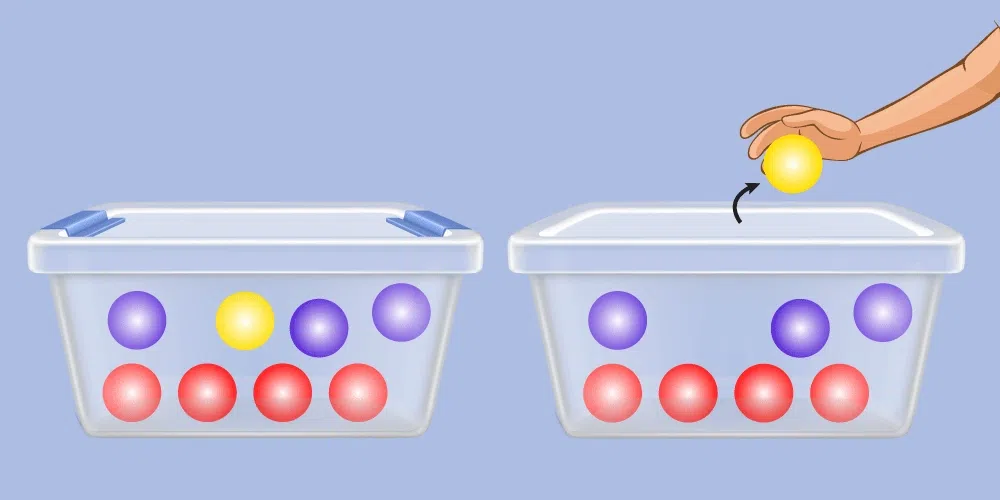
Probability of picking a ball
Solution:
Probability is equal to the number of yellow balls in the container divided by the total number of balls in the container, i.e. 1/8.
Question 2: A die is rolled. What is the probability that an even number has been obtained?
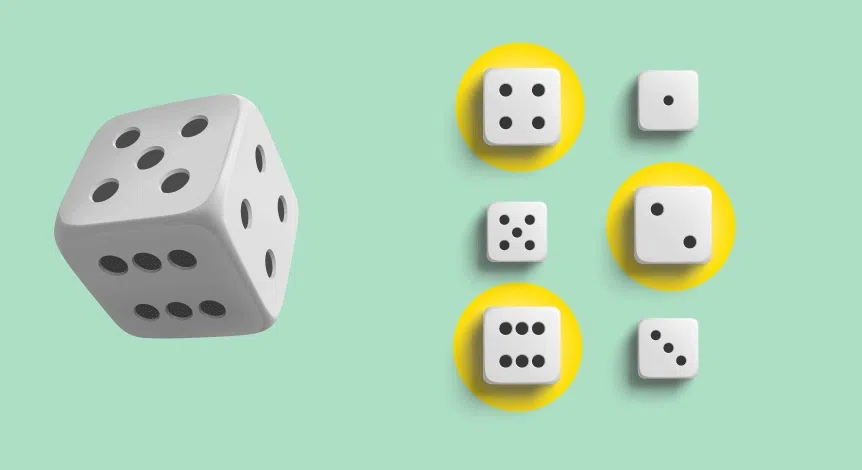
Probability of Rolling a Dice
Solution:
When fair six-sided dice are rolled, there are six possible outcomes: 1, 2, 3, 4, 5, or 6.
Out of these, half are even (2, 4, 6) and half are odd (1, 3, 5). Therefore, the probability of getting an even number is:
P(even) = number of even outcomes / total number of outcomes
P(even) = 3 / 6
P(even) = 1/2
Question 3: A fair six-sided die is rolled. What is the probability of rolling a number greater than 4?
Solution:
There are 2 favorable outcomes (5 and 6) out of 6 possible outcomes.
Probability = Number of favorable outcomes / Total number of outcomes.
= 2 / 6 = 1 / 3 ≈ 0.3333 or 33.33%.
Question 4: A jar contains 3 red, 4 blue, and 5 green marbles. What is the probability of randomly drawing a red marble?
Solution:
Total marbles = 3 (red) + 4 (blue) + 5 (green) = 12.
Probability of drawing a red marble = Number of red marbles / Total number of marbles.
= 3 / 12 = 1 / 4 = 0.25 or 25%.
Question 5: From a deck of 52 cards, what is the probability of drawing an ace or a king?
Solution:
There are 4 aces and 4 kings in the deck.
Total favorable outcomes = 4 (aces) + 4 (kings) = 8.
Probability = Number of favorable outcomes / Total number of outcomes.
= 8 / 52 = 2 / 13 ≈ 0.1538 or 15.38%.
Question 6: What is the probability of getting an even number when a fair six-sided die is rolled?
Solution:
There are 3 even numbers on a die (2, 4, 6).
Total outcomes = 6.
Probability of rolling an even number = Number of even numbers / Total outcomes.
= 3 / 6 = 1 / 2 = 0.5 or 50%.
Question 7: In a class of 20 students, 12 are girls. What is the probability of randomly selecting a boy?
Solution:
Total students = 20.
Number of boys = Total students - Number of girls = 20 - 12 = 8.
Probability of selecting a boy = Number of boys / Total students.
= 8 / 20 = 2 / 5 = 0.4 or 40%.
Question 8: A spinner with numbers 1 to 5 is spun once. What is the probability of getting an odd number?
Solution:
The number of favorable outcomes are: 1, 3, and 5.
Total outcomes = 5
Probability = Number of favorable outcomes / Total outcomes.
= 3/5 = 0.6 or 60%.
Question 9: What is the probability of not drawing a face card (Jack, Queen, King) from a standard deck of 52 cards?
Solution:
Total face cards in the deck = 12 (4 Jacks, 4 Queens, 4 Kings).
Total non-face cards = 52 - 12 = 40.
Probability of not drawing a face card = Number of non-face cards / Total cards.
= 40 / 52 = 10 / 13 ≈ 0.7692 or 76.92%.
Question 10: A jar contains 10 balls: 3 red and 7 black. What is the probability of drawing a red ball on a single draw?
Solution:
Probability of drawing a red ball and replacing it = 3/10.
Total probability = (3/10) =0.3 or 30%.
Question 11: In a class of 60 students, 30 are boys. If one student is randomly selected, what is the probability of selecting a girl?
Solution:
Total girls = 60 - 30 = 30.
Probability of chosen student being a girl = 30/60.
= 0.5 or 50%
Question 12: A fair six-sided die is rolled. What is the probability of rolling a number greater than 4?
Solution:
Total number of favorable outcome 5,6
Probability = 2/6 = 1/3
=0.333 or 33.33%.
Practice Problems
Question 1: A jar contains 6 balls: 2 are red, 1 is yellow, and 3 are blue. What is the probability of picking a blue ball?
Question 2: A fair six-sided die is rolled. What is the probability of rolling a number less than 3?
Question 3: A jar contains 4 red, 5 green, and 6 blue marbles. What is the probability of randomly drawing a green marble?
Question 4: From a deck of 52 cards, what is the probability of drawing a queen?
Question 5: A spinner with numbers 1 to 10 is spun once. What is the probability of spinning a number greater than 7?
Question 6: A bag contains 3 red marbles, 4 green marbles, and 3 blue marbles. What is the probability of drawing a green marble?
Question 7: In a class of 25 students, 10 are boys. What is the probability of randomly selecting a boy?
Question 8: A coin is flipped once. What is the probability of getting tails?
Question 9: A deck of 52 cards is shuffled. What is the probability of not drawing an ace?
Question 10: A fair six-sided die is rolled. What is the probability of rolling an odd number?
Question 11: A jar contains 9 balls: 3 are red, 2 are green, and 4 are yellow. What is the probability of drawing a yellow ball?
Question 12: In a group of 30 students, 18 like cricket and 12 like football. If one student is randomly selected, what is the probability that they like football?
Answer key
- Probability= 0.5 or 50%.
- Probability = 0.333 or 33.33%.
- Probability = 1/3 = 0.333 or 33.33%.
- Probability = 1/13 ≈ 0.0769 or 7.69%.
- Probability = 3/10 = 0.3 or 30%.
- Probability = 4/10 = 0.4 or 40%.
- Probability = 10/25 = 2.5 = 0.4 or 40%.
- Probability = 1/2 =0.5 or 50%.
- Probability = 48/52 = 12/13 ≈ 0.923 or 92.3%.
- Probability = 3/6 = 1/2 = 0.5 or 50%.
- Probability = 49 ≈ 0.444 or 44.44%.
- Probability = 12/30 = 25 = 0.4 or 40%.
