

A linear transformation is a function between two vector spaces that preserves the operations of vector addition and scalar multiplication. It transforms vectors while maintaining the algebraic structure of the vector space.
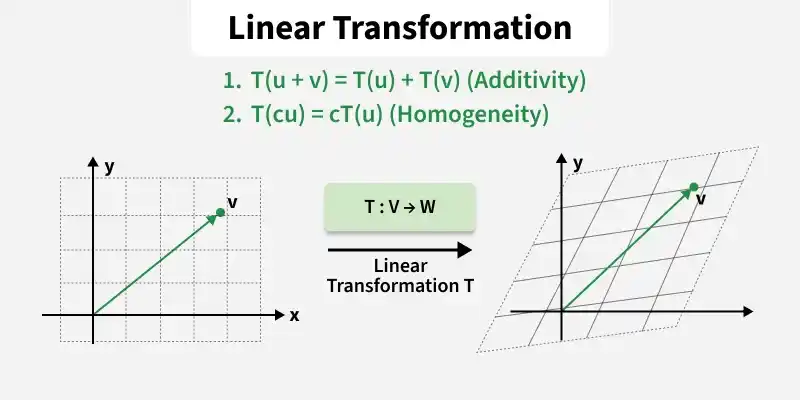
If V and W are vector spaces, then a function
T: V→W
It is called a linear transformation if it satisfies specific linearity conditions for all vectors in V.
Conditions for a Linear Transformation
A transformation T is linear if the following two properties hold.
Additivity Property: The image of the sum of two vectors equals the sum of their images.
T(u+v) = T(u) + T(v), where u and v are vectors.
Homogeneity Property: The image of a scalar multiple of a vector equals the same scalar times the image of the vector.
T(cv) = cT(v), where c is a scalar.
Both conditions can be written together as
T(au+bv) = aT(u) + bT(v), for any scalars a,b.
Matrix Representation
Every linear transformation between finite-dimensional vector spaces can be represented by a matrix.
For a matrix A, T(x) = Ax , where x is a vector.
Example Let
Then,
This defines a linear transformation.
Geometric Interpretation
Linear transformations can change the position, size, or orientation of vectors.
Scaling: T(x,y) = (2x,2y)
Doubles the length of every vector.
Rotation: Rotates vectors through a fixed angle about the origin.
Reflection: Flips vectors across a line or plane.
Shear: Slants the shape while preserving parallelism.
Kernel and Image of a Linear Transformation
Kernel (Null Space): The kernel consists of all vectors mapped to the zero vector.
ker(T) = {v: T(v) = 0}
Image (Range): The image is the set of all possible outputs.
Im(T) = {T(v): v ∈ V}
It describes all vectors obtainable through the transformation.
Properties
Property 1: Preservation of Addition
T(u+v) = T(u)+T(v)
Property 2: Preservation of Scalar Multiplication
T(cu) = cT(u)
Property 3: Zero Vector Property
T(0) = 0
Property 4: Identity Transformation is Linear
I(v) = v, is linear.
Property 5: Composition is Linear
If T and S are linear, then S∘T, is also linear.
Solved Example
Ques 1. Determine whether T(x,y) = (3x,3y) is linear.
Check additivity: T(x1,y1)+(x2,y2) = (3x1+3x2,3y1+3y2) = T(x1,y1)+T(x2,y2)
Check homogeneity: T(c(x,y)) = (3cx,3cy) = c(3x,3y)
Both properties hold therefore, T is linear.
Ques 2. Determine whether T(x,y)=(x2,y) is linear.
T((1,0)+(1,0)) = T(2,0) = (4,0)
But, T(1,0)+T(1,0) = (1,0) + (1,0) = (2,0)
Since (4,0) ≠ (2,0)
the additivity property fails.
Therefore, T is not linear.
Practice Problems
Ques 1. Verify whether T(x, y) = (5x, 5y) is linear.
Ques 2. Determine if T(x, y) = (x+1, y) is a linear transformation.
Ques 3. Find T(2, −1) for T(x, y) = (x−y, x+y)
Ques 4. Write the matrix representation of T(x, y) = (2x+y, x−y)
