

The end behavior of a function refers to the values that the function approaches as the input moves towards positive infinity
- Understanding end behavior helps predict the overall shape of a graph without plotting every point.
- It is particularly useful when analyzing polynomial, rational, and exponential functions.
If a function f(x) approaches a particular value or increases/decreases without bound, that behavior determines the appearance of the graph at its ends.
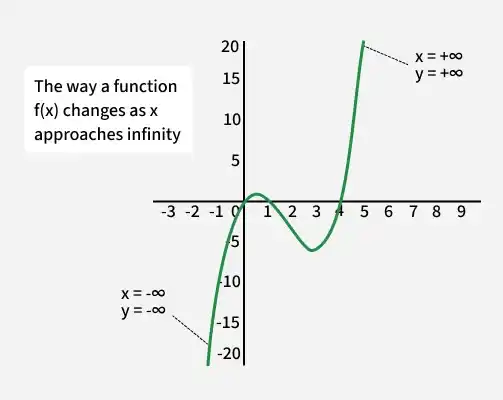
End behavior helps:
- Predict the overall shape of a graph.
- Identify whether a function rises or falls.
- Analyze polynomial and rational functions.
- Understand long-term trends in mathematical models.
- Sketch graphs quickly without calculating many points.
Determining the End Behavior
Steps to determine end behavior:
- Identify the highest power term (leading term).
- Note its coefficient.
- Ignore lower-degree terms because they become insignificant for very large values of x.
- Use the degree and sign of the leading coefficient to predict the graph's ends.
The method for finding end behavior varies slightly depending on the type of function.
For Polynomial Functions
The end behavior of a polynomial function depends on two factors: the degree of the polynomial and the sign of its leading coefficient. The degree determines whether the ends of the graph move in the same or opposite directions, while the leading coefficient determines whether the graph rises or falls.
1. Even Degree, Positive Coefficient: A polynomial with an even degree and a positive leading coefficient rises on both ends because the highest-power term is always positive for large values of x.
Example: f(x) = x4
- Left end rises.
- Right end rises.
2. Even Degree, Negative Coefficient: A polynomial with an even degree and a negative leading coefficient falls on both ends because the highest-power term is always negative for large values of x.
Example: f(x) = −x4
- Left end falls.
- Right end falls.
3. Odd Degree, Positive Coefficient: A polynomial with an odd degree and a positive leading coefficient has opposite end behaviors. The graph falls to the left and rises to the right.
Example: f(x) = x3
- Left end falls.
- Right end rises.
4. Odd Degree, Negative Coefficient: A polynomial with an odd degree and a negative leading coefficient also has opposite end behaviors, but in the reverse direction. The graph rises to the left and falls to the right.
Example: f(x) = −x3
- Left end rises.
- Right end falls.
| Degree | Leading Coefficient | Left End | Right End |
|---|---|---|---|
| Even | Positive | Up | Up |
| Even | Negative | Down | Down |
| Odd | Positive | Down | Up |
| Odd | Negative | Up | Down |
For Rational Functions
The end behavior of a rational function is determined by comparing the degrees of the polynomial in the numerator and denominator. As (x) becomes very large positive or negative, the highest-degree terms dominate the function and help determine the value that the graph approaches.
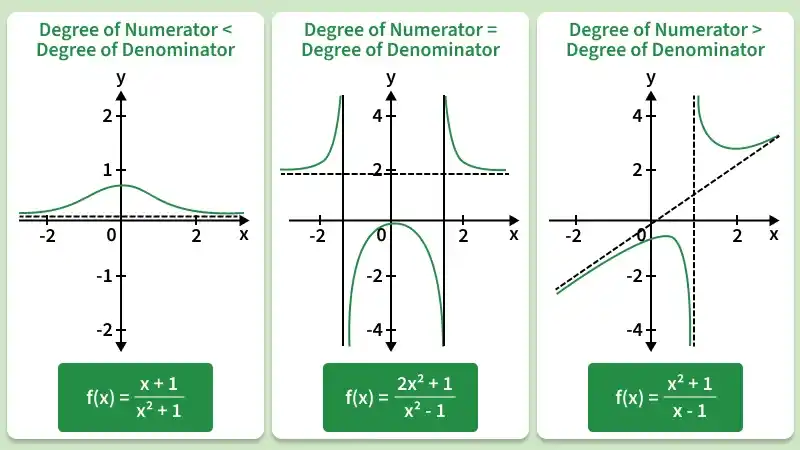
1. Degree of Numerator Less Than Degree of Denominator: Let the functione be:
Since the degree of the numerator (1) is less than the degree of the denominator (2), the function approaches 0 as (x) becomes very large.
End Behavior: The graph approaches closer to 0.
2. Degree of Numerator Equal to Degree of Denominator: Let the functione be:
Since both the numerator and denominator have degree 2, divide the leading coefficients: 2/1 =2 .
End Behavior: The graph approaches closer to 2.
3. Degree of Numerator Greater Than Degree of Denominator: Let the functione be:
Since the degree of the numerator (2) is greater than the degree of the denominator (1), the function does not have a horizontal asymptote. As (x) becomes very large, (\frac{1}{x}) approaches 0.
End Behavior: For very large positive and negative values of (x), the graph behaves like (y=x) and follows the same increasing pattern.
Solved Examples
Example 1: Determine the end behavior of:
Degree of numerator = 1, Degree of denominator = 2
Since the degree of the numerator is less than the degree of the denominator,
\lim_{x\to\infty}f(x)=0 \ \text{and}\ \lim_{x\to-\infty}f(x)=0 As x increases or decreases without bound, the function values get closer to 0.
Example 2: Determine the end behavior of: f(x)=\frac{3x^2-1}{x^2+4}
Degree of numerator = 2, Degree of denominator = 2
Since the degrees are equal, divide the leading coefficients: \frac{3}{1}=3
\lim_{x\to\infty}f(x)=3 \ \text{and}\ \lim_{x\to-\infty}f(x)=3 As x increases or decreases without bound, the function values get closer to 3.
Example 3: Determine the end behavior of:
Degree of numerator = 3, Degree of denominator = 3
Since the degrees are equal, divide the leading coefficients: 5/1=5
\lim_{x\to\infty}f(x)=5 \ \text{and}\ \lim_{x\to-\infty}f(x)=5 As x increases or decreases without bound, the function values get closer to 5.
Example 4: Determine the end behavior of:
Degree of numerator = 2 ,Degree of denominator = 1
Since the degree of the numerator is one more than the degree of the denominator, perform polynomial division: f(x)=x + 1/x
As x becomes very large,
\frac{1}{x}\to0 Therefore,
f(x)\approx x As x increases, the function increases and follows the line y=x. As x decreases, the function decreases and continues to follow the line y=x.
Example 5: Determine the end behavior of:
Degree of numerator = 3, Degree of denominator = 2
Perform polynomial division:
\frac{2x^3+x}{x^2+1}=2x-\frac{x}{x^2+1} As
(x\to\infty) or (x\to-\infty)\\[3pts]\frac{x}{x^2+1}\to0 Therefore, f(x)\approx 2x
As x increases, the function increases and follows the line y=2x. As x decreases, the function decreases and continues to follow the line y=2x.
Practice Problems
- Determine the end behavior of f(x) = x6 − 2x3 + 5.
- Determine the end behavior of f(x) = −2x7 + x.
- Determine the end behavior of f(x) = 4x8 − 9.
- Determine the end behavior of f(x) = −x4 + 6x.
- Determine the end behavior of f(x) = 3x3 − 2x2 + 1.
