

Three-dimensional (3D) shapes are solid objects that have length, breadth, and height. Unlike two-dimensional shapes, they occupy space and have volume.
A cube and a cuboid are both three-dimensional (3D) shapes made up of flat rectangular faces.
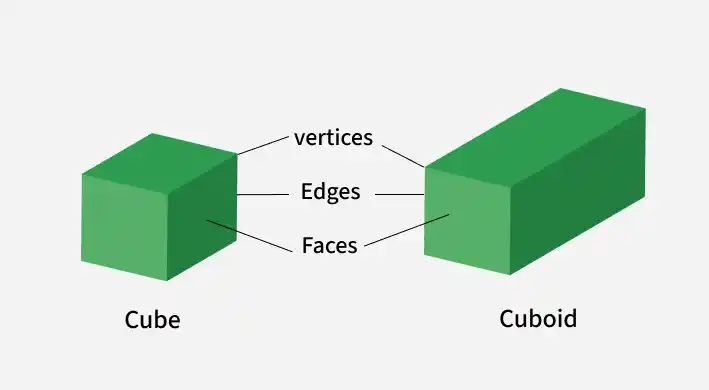
- Cube: A three-dimensional solid in which all six faces are equal squares. A cube consists of 6 faces, 12 edges, 8 vertices, 12 face diagonals, and 4 space diagonals.
- Cuboid: A three-dimensional shape with 6 rectangular faces. Opposite faces are equal. A cuboid consists of 6 faces, 12 edges, 8 vertices, 12 face diagonals, and 4 space diagonals.
The main difference between cube and cuboid is tabulated below:
| Feature | Cube | Cuboid |
|---|---|---|
| Lateral Surface Area (LSA) | 4a2 | 2h(l+b) |
| Total Surface Area (TSA) | 6a2 | 2(lb+lh+bh) |
| Volume | a3 | |
| Face Diagonal | ||
| Body Diagonal | ||
| Dimensions | All sides have equal length (a) | Length (l), breadth (b), and height (h) |
