

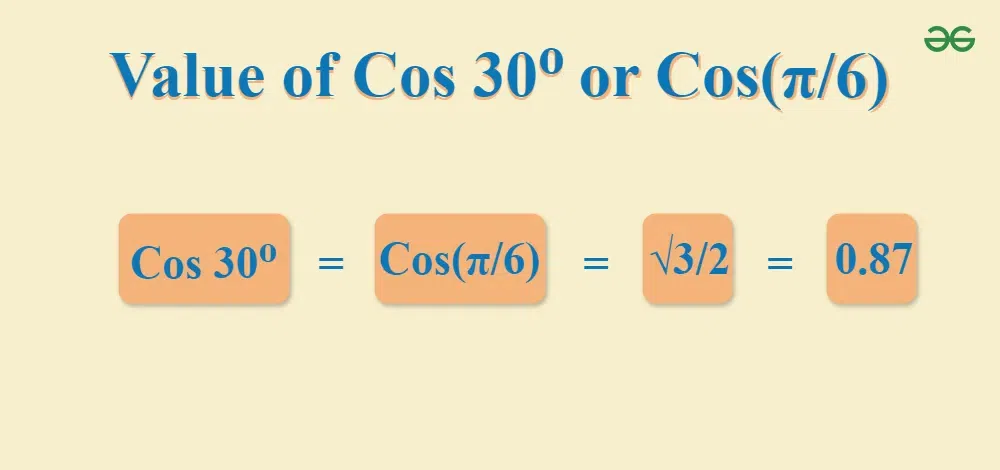
Cos 30 Degrees: The value of cos 30 degrees in trigonometry is √3/2. In a right-angled triangle, cosine is the ratio of the base and hypotenuse. When the angle of the right-angled triangle is 30°, cos 30° is required. In fraction form, cos 30° is √3/2; in decimal form, the value is 0.8660.
Let's understand how the value of cos 30° is obtained with examples.
Table of Content
What is the Value of Cos 30 Degrees?
The value of cos 30 degrees in decimals is 0.8660. Converting degree to radian, that is, θ in radians = θ × π/180° or θ × Pi/180°. Therefore, converting cos 30° in radians will give cos (30 × π/180°), and the final value in radians will become cos(π/6) or cos (0.5235). Following are the values of cos 30° in different forms,
- Cos 30° in decimal = 0.8660
- Cos 30° in radians = cos(π/6) or cos (0.5235)
- Cos 30° in fraction = √3/2
- Cos (-30°) = 0.8660
How to Find the Value of Cos 30 Degrees?
In order to find the value of cos 30 degrees, the unit circle is taken into account. While looking at the unit circle, it is noticed that the value of cos 30° in the first quadrant is positive and is given as 0.8660. There are two ways to find out the value of cos 30°. The methods are mentioned below:
- Using Trigonometric Functions
- Using Unit Circle
Cos 30 Degrees - Methods to Find
Cos 30 Degrees in Terms of Trigonometric Functions
Trigonometric functions are also called circular functions or trigonometric ratios. The relationship between angles and sides is represented by these trigonometric functions.
The representation of the value of cos 30° using trigonometric functions are:
- Cos 30° = ± √(1 - sin2 30°)
- Cos 30° = ± 1/√(1 + tan2 30°)
- Cos 30° = ± cot 30°/√(1 + cot2 30°)
- Cos 30° = 1/sec 30°
Cos 30 Degrees Using Unit Circle
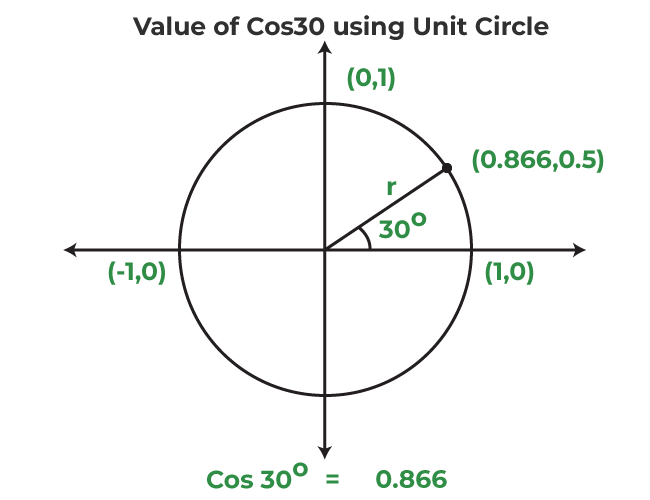
In order to find the value of cos 30 degrees using a unit circle, the following steps are required to be followed:
- Rotate the 'r' from 0 degrees to 30 degrees in the unit circle.
- The value of 'r' will be 0.8660 in the x-coordinate and 0.5 in the y-coordinate.
- Therefore, the value of cos 30° = x = 0.8660.
Cos 30 Degrees Proof
There are two approaches to deriving the value of cos 30 degrees, they are:
- Theoretical approach
- Practical approach
Theoretical Approach
In the theoretical approach, the value of cos 30 degrees is obtained by observing the sides of the right-angled triangle and using Pythagoras theorem. It can be seen that if the angle of the right angle triangle is 30, we can find out the length of the opposite side, which will be half the length of the hypotenuse, but in order to find the value of cos 30, we require the length of the adjacent side as well (base of the triangle).

Applying Pythagoras theorem:
OA2 = OB2 + AB2
⇒ d2 = OB2 + (d/2)2
⇒ d2 = OB2 + d2/4
⇒ OB2 = d2 - d2/4
⇒ OB2 = 3d2/4
⇒ OB = √3d/2
The value of cosine can be found by finding the ratio of the base to its hypotenuse; therefore, in this case, cos 30 degrees will be:
Cos 30° = OB/OA
⇒ Cos 30° = √3d/2 × 1/d
⇒ Cos 30° = √3/2
Practical Approach
The value of cos 30 degrees can also be observed using the practical approach. In the practical approach, the right-angled triangle is drawn, making an angle of 30 degrees, and then the value of cos 30° is observed. Following are the steps to draw the triangle:

- Take a point O and draw and line.
- Using the line as the baseline, make a 30-degree angle from the protector.
- Draw a line from that angle found. Take any random length and draw an arc to decide where the line shall stop. Name it, Point A.
- Draw the perpendicular (Vertical line) to the base from the intersection formed by the arc and the line. They will meet at B.
Conclusion
Cos 30 degrees is important in both math and real-world applications. The value of cos 30 degrees is √3/2, and it helps us solve problems involving right triangles, trigonometric functions, and various calculations in physics and engineering. By knowing this fundamental trigonometric value, we can easily tackle many problems and gain a deeper appreciation for the role of trigonometry in our daily lives.
People Also Read:
Solved Examples on Cos 30 Degrees
Example 1: In a right-angled triangle, the base to the angle of 30° is 9m. Find the length of the Hypotenuse.
Solution:
Given: Base = 9m
Cos = √3/2
⇒ B/H = √3/2
⇒ 9/H = √3/2
⇒ H = (9 × 2) / √3
⇒ H = 6√3m
Example 2: In a right-angled triangle, the hypotenuse is 16m. and one angle is 30°, find the other two sides of the triangle.
Solution:
Given, Hypotenuse = 16, angle = 30°
Cos 30 = B/H
⇒ B/H = √3/2
⇒ B/16 = √3/2
⇒ B = 8√3m
Third side is calculated using Pythagoras theorem.
P2 + B2 = H2
⇒ P2 + (8√3)2 = 162
⇒ P2 + 192 = 256
⇒ P2 = 64
⇒ p = 8m
Sides of triangle are - 8m, 8√3m, 16m.
Example 3: Find the value of 4cos 30°/sin 30°.
Solution:
The value of cos 30° in fractions is √3/2, and the value of sin 30 in fractions is 1/2. Therefore, it can be written as,
4 cos 30°/sin 30° = 4[√3/2 × 2] = 4 × √3 = 4√3
Example 4: Find the value of sin 60° multiplied by cos 30°.
Solution:
The value of cos 30° in fractions is √3/2, and the value of sin 60° in fractions is √3/2. Therefore, it can be written as,
sin 60° × cos 30° = [√3/2 × √3/2]
⇒ sin 60° × cos 30° = 3/4
Practice Problems on Cos 30 Degrees
Problem 1: Evaluate 5⋅cos(30°)+3.
Problem 2: Simplify 2cos(30°)⋅cos(60°).
Problem 3: Find the value of cos(30°)/sin(60°).
Problem 4: Simplify cos2(30°)+sin2(30°)
Problem 5: Evaluate 4cos(30°)−2sin(30°)
Problem 6: Find the value of : cos(30°) x tan(30°)
Problem 7: SImplify: [cos(30°)/ cos(60°)]
Problem 8: Evaluate: 10⋅cos(30°)- 4⋅sin(30°)
Problem 9: Using the unir circle, Find the value of : cos(150°)
Problem 10: Determine the value of cos(330°)
Problem 11: Evaluate cos(30°) +cos(330°)
Problem 12: Express cos(30°) in terms of cot(30°)
Problem 13: Simplify cos2(30°) - sin2(30°)
Problem 14: Find the adjacent side of a triangle where the hypotenuse is 10m and one angle is 30°
Problem 15: Find cos (30°) using the unit circle's coordinates.
