

Complex roots in mathematics typically arises when solving polynomial equations that don't have real solutions. A complex number is composed of a real part and an imaginary part and is generally written in the form a+bi where a and b are real numbers, and i is the imaginary unit with the property i2=−1.
.png)
Complex roots refer to the solutions of equations that take the form of complex numbers, occurring when the discriminant of a quadratic equation is less than zero. These roots, which are also known as imaginary roots, are expressed in the format α = a + ib and β = c + id, where each root comprises a real component and an imaginary component.
In this article, we will learn about complex roots, arithmetic operations on complex roots, methods to find complex roots of a quadratic equation, and some practice problems based on them.
Table of Content
- Complex Roots
- Complex Roots of a Quadratic equation
- Operations on Complex Roots
- Addition Of Complex Roots
- Subtraction of Complex Roots
- Multiplication of Complex Roots
- Division Of Complex Roots
- Properties Of Complex Roots
- How to Find Complex Roots of a Quadratic Equation?
- Complex Roots Examples
- Practice Problems on Complex Roots
Complex Roots
Complex Roots are the imaginary roots of equations. The roots of any function/equation are those input values which when substituted into the function/equation yield zero as the output. Quadratic roots having discriminant less than zero have complex roots.
Complex Roots Definition
Complex numbers which when substituted in a functional expression as an input yield zero as output are called as complex roots of the function.
Mathematically
Let a complex number is represented as z = a + ib and f(z) = 0, then z would be called a complex root of the function f(x).

Complex Roots of a Quadratic equation
A quadratic equation is a polynomial equation where the highest exponent of the variable is 2. It is represented as ax2 + bx + c = 0. This equation has imaginary or complex roots when the discriminant (D = b2-4ac) is less than zero.
Complex roots of a quadratic equation always occur in pairs, i.e. if α and β are complex roots of a quadratic equation, then they are of the form (c + id) and (c - id), where 'c' and 'd' are real numbers and 'i' denotes the square root of -1 called as iota.
Operations on Complex Roots
Various arithmetic operations such as addition, subtraction, multiplication and division are applicable on complex roots. Each operation on complex roots is discussed in brief as follows.
Addition Of Complex Roots
A complex root has a real part and an imaginary part as discussed above. In addition of two complex roots, corresponding parts of the complex numbers are added to each other, i.e. real part of one is added to the real part of the other and imaginary part of one is added to the other to obtain the result of addition. For example, two complex roots represented as α = a + ib, and β = c + id, would be added as,
α + β = (a + c) + i(b + d)
Properties such as commutativity, associativity, and distributivity follow here too as in the case of addition of real numbers.
Subtraction of Complex Roots
Subtraction of complex roots is similar to the addition of complex roots, i.e. in subtraction of two complex numbers, real part of one is subtracted from the real part of the another and the imaginary part is subtracted from the imaginary part of the another. For example, two complex roots are represented as α = a + ib, and β = c + id, then (α - β) would be obtained as follows:
α - β = (a - c) + i(b - d)
Subtraction of complex roots follows closure and distributive property but it is non-commutative and non-associative.
Multiplication of Complex Roots
Unlike addition and subtraction of complex roots, multiplication of complex roots is slightly different from that of real numbers. Let us understand this operation on complex roots with an example. Let α and β be the complex numbers represented as α = a + ib and β = c + id, they would be multiplied as follows,
α × β = (a + ib) × (c + id)
α × β = (ac + iad + ibc + i2bd)
Substituting i2 = -1 we get,
α × β = (ac + iad +ibc -bd)
α × β = (ac-bd) + i(ad+bc)
The multiplication of complex roots follows all the properties such closure property, commutative property, associative property, and distributive property in the same way as real numbers do.
Division Of Complex Roots
Divison of complex roots is similar to division of fractional numbers in a way, i.e. if a complex root z1 is to be divided by another complex root z2, then we multiply the reciprocal of z2 with z1 to obtain the result of division. For example, let α and β be the complex numbers represented as α = a + ib and β = c + id. Then,
α/β = (a+ib) × 1/(c+id)
α/β = (a+ib) × (c-id)/(c2+d2)
α/β = [(ac+bd) + i(bc-ad)]/(c2+d2)
Properties Of Complex Roots
Various properties of complex roots are explained under various heading that includes:
Magnitude of Complex Roots:
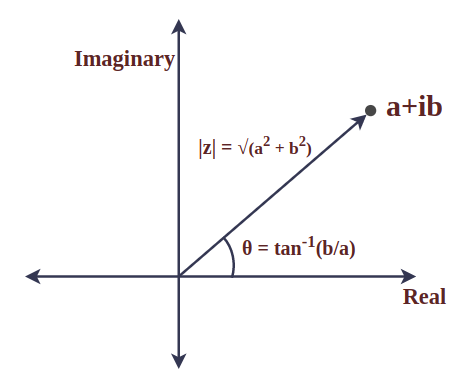
For any equation which have complex root then its roots always occurs in complementary pairs, that is complex roots are α = a ∓ ib and in arguand plane it is represented as, (a, ∓ b). Now magnitude of the complex root is the distance of this point form the origin (0, 0) and its value is given using the distance formula and its value is, r = |√(a2 + b2)|(represented as r).
Argument of Complex Roots:
W know that complex roots (α = a ∓ ib) are represented in the argand plane as a point, andsuppose the line joining this point with the origin, makes an angle θ with the positive x-axis in the argand plane, then θ is called the argument of the complex root and its value is given as,
Argz (θ) = tan-1(b/a)
Polar Representation of Complex Roots:
Comple roots (α = a ∓ ib) can easily be represented in polar form as, α = r(Cosθ + iSinθ).
where,
- r is Modulus of Complex Root
- θ is Argument of Complex Root
Here,
r = |√(a2 + b2)| and θ = tan-1(b/a)
Reciprocal of Complex Roots:
Reciprocal of a complex root α = a + ib is given by:
α-1 = 1/(a + ib)
α-1 = 1/(a + ib)×(a - ib)/(a - ib)
α-1 = (a - ib)/{a2 - (ib)2}
α-1 = (a - ib)/{a2 + b2}
α-1 = a/{a2 + b2} + i(-b)/{a2 + b2}
How to Find Complex Roots of a Quadratic Equation?
Quadratic equation is an equation which can be represented as ax2+bx+c=0, where a ≠ 0. The values of the unknown variable x which satisfy the above equation are called as solutions or roots of the equation. Determination of roots of a quadratic equation is done with help of discriminant (D = b2 - 4ac). The roots of a quadratic equation depend upon the value of discriminant as follows:
- D > 0, real roots
- D = 0, equal real roots
- D < 0, imaginary or complex roots
Here, our focus is on complex roots, so we will consider a case in which D<0 for the quadratic equation. Let a quadratic equation is represented as ax2 + bx + c = 0 and D = b2 - 4ac, then by quadratic formula, we have roots of the quadratic equation as follows,
α, β = (-b ± √D)/2a
Now as 'D' is a negative number, let us manipulate it in terms of 'i' to calculate its square root,
We can write, D = -(-D)
As i2 = -1, we get,
D = -(i2D)
Note that, -D is a positive number as D is a negative number, so square root of -D can be found d easily.
Thus, complex roots of the quadratic equation would be given as,
α, β = (-b ± √(-i2D))/2a
α, β = (-b ± i√(-D))/2a
Hence, we have determined the complex roots of a quadratic equation having D < 0
People Also Read: | |
|---|---|
Following are some solved examples based on finding complex roots of various functions.
Conclusion of Complex Roots
Complex roots are special types of solutions to equations that appear as complex numbers, particularly when dealing with quadratic equations whose discriminant is negative. complex roots consist of a real part and an imaginary part, represented as α = a + ib and β = c + id, where "i" is the square root of -1. In the realm of quadratic equations, such as ax2 + bx + c = 0, complex roots always come in pairs and exhibit symmetry around the real axis.
The article explores arithmetic operations on complex roots and their properties, such as magnitude and argument. It also discusses finding complex roots of quadratic equations using the discriminant and quadratic formula, with a method involving the imaginary unit "i" for negative discriminants, providing a clear pathway to determining complex solutions.
Complex Roots Examples
Example 1: Find the roots of the quadratic equation represented as x2 - 4x + 13 = 0.
Solution:
We have equation as x2-4x+13 = 0
Comparing with ax2+bx+c, we get, a = 1, b = -4 and c = 13
We know that, D = b2-4ac = (-4)2 - 4(1)(13) = 16 - 52 = -36
Now, we get √(-36) = i√(36) = 6i
Using the quadratic formula to find roots,
α, β = (-b ± √D)/2a
α, β = (-(-4) ± √(-36))/2 = (4 ± 6i)/2 = 2 ± 3i
Hence, the complex roots of the equation are 2 ± 3i
Example 2: Find the quadratic equation which has its roots as 3 ± 4i.
Solution:
Given that, roots of the quadratic equation are 3 ± 4i, we can write the equation as,
(x - (3+4i)*(x - (3-4i)) = 0
x2 - (3+4i)x - (3-4i)x + (3+4i)(3-4i) = 0
x2 - (3+4i+3-4i)x + (32 + 42) = 0
x2 - 6x + 25 = 0
Thus, we have obtained the quadratic equation as x2 - 6x + 25 = 0 whose roots are given by 3 ± 4i
Practice Problems on Complex Roots
P1: Find the roots of the equation: x3 - 1 = 0.
P2: The roots of a quadratic equation are given as 4 ± 3i, find its equation.
P3: Find the quadratic equation whose roots are +2i and -2i, where, i = √-1.
P4: Find the roots of the quadratic equation represented as x2-3x+15=0.
P5: Solve the equation: x2- 5x + 12=0.
