

By the early 1990s, India faced a severe economic crisis as its foreign exchange reserves had dwindled to barely three weeks’ worth of imports, while inflation was rising, industrial growth was slowing, and the government was struggling with a large fiscal deficit caused by high spending and low revenue. The existing development model, based on centralized planning, import substitution, and extensive state control, had become increasingly inefficient. Excessive government intervention, complex licensing requirements, and restrictions on private enterprise limited competition and investment, while public sector enterprises were often inefficient and overstaffed. These factors contributed to slow economic growth, stagnant exports, and growing dependence on external borrowing, pushing the country into a major balance-of-payments crisis
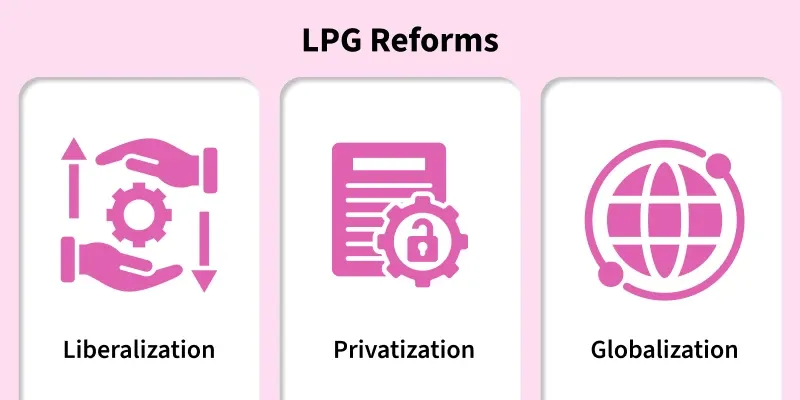
To overcome this crisis and revive growth, the Government of India introduced a comprehensive policy package in 1991, known as the New Economic Policy (NEP). This policy, based on the three pillars of Liberalisation, Privatisation, and Globalisation (LPG), aimed to make India’s economy more open, efficient, and globally competitive. It marked a decisive shift from a state-controlled system to a market-oriented economy, laying the foundation for India’s economic transformation in the decades to come.
Background of the 1991 Economic Crisis
Before 1991, India followed a mixed economy system where both the public and private sectors operated under strict government regulation. Although this system helped in building a strong industrial base and achieving self-reliance in food grains, it also created inefficiency and slow growth over time. By the late 1980s, the economy began to face multiple pressures that eventually led to a severe crisis.
Rising Fiscal Deficit: Government expenditure consistently exceeded its income, leading to heavy borrowing and a growing fiscal deficit. This made the economy financially unstable.
Balance of Payments Deficit: India’s import payments far exceeded its export earnings. By mid-1991, foreign exchange reserves had fallen so low that they could barely cover three weeks of imports.
Mounting Inflation: Prices of essential goods were increasing rapidly, reducing the purchasing power of people and worsening living conditions, especially for the poor.
Inefficient Industrial Structure: The license-permit system restricted private initiative and discouraged competition. As a result, industries became inefficient and technologically outdated.
Rising External Debt: To meet rising expenses, India borrowed heavily from abroad, increasing dependence on external sources and worsening the debt burden.
Collapse of Investor Confidence: Due to growing instability and poor performance, both domestic and foreign investors lost confidence in the Indian economy, further slowing growth.
To overcome this crisis, the government approached the International Monetary Fund (IMF) for assistance. In return, the IMF advised India to implement structural reforms, which became the foundation of the New Economic Policy of 1991.
Need for Economic Reforms
The 1991 economic crisis exposed the weaknesses of India’s earlier economic policies. The government realized that without major structural changes, it would be impossible to sustain growth or restore stability. The New Economic Policy was therefore introduced to open up the economy and make it more competitive.
Achieving Rapid Economic Growth: India’s growth rate before 1991 was slow and often referred to as the “Hindu rate of growth.” Economic reforms aimed to accelerate industrial and agricultural development by encouraging efficiency and investment.
Reducing Government Control: The license and permit system restricted private enterprise and created delays and corruption. Reforms aimed to reduce unnecessary regulation so that businesses could operate freely and respond better to market needs.
Encouraging Foreign Investment: India needed modern technology and capital, which could be obtained by inviting foreign companies to invest and operate in India. This was seen as vital for improving productivity and competitiveness.
Improving Efficiency in Public Sector: Many public sector enterprises were running into losses due to bureaucratic management. Reforms encouraged greater autonomy and accountability to make them more efficient and profit-oriented.
Correcting Balance of Payments Deficit: The growing trade deficit had made India dependent on external borrowing. By boosting exports and attracting foreign investment, reforms aimed to stabilize the external sector.
Integrating with the Global Economy: India had remained relatively isolated from world markets. Economic reforms sought to integrate India with the global economy, allowing it to benefit from trade and international cooperation.
Features of the New Economic Policy
The New Economic Policy (NEP) of 1991 marked a turning point in India’s economic history. It introduced three major reforms — Liberalisation, Privatisation, and Globalisation (LPG), to overcome the crisis and make the economy more competitive and efficient.
Liberalisation: Liberalisation meant freeing the economy from excessive rules and restrictions. Industrial licensing was abolished for most industries, import duties were reduced, and private firms were given more freedom to start or expand businesses. By encouraging competition and innovation, this reform helped increase productivity and reduce bureaucratic delays.
Privatisation: Privatisation involved transferring ownership or management of public sector enterprises (PSEs) to private hands, either partially or fully. Many government-run firms were inefficient and loss-making due to overstaffing and lack of accountability. Allowing private participation improved efficiency, profitability, and customer service while reducing the financial burden on the government.
Globalisation: Globalisation sought to integrate India with the global economy. It opened the country to international trade, technology, and investment, making Indian industries more competitive worldwide. By lowering trade barriers and promoting export-oriented growth, globalisation helped India connect with world markets and modernize its production base.
Foreign Direct Investment (FDI): Several industries were opened to foreign investors, often with relaxed ownership limits. FDI brought modern technology, managerial expertise, and global business practices, while also creating jobs and boosting exports.
Financial Sector Reforms: The banking and financial systems were modernized to make them more efficient and market-oriented. Interest rates were deregulated, new private and foreign banks were allowed entry, and the role of the Reserve Bank shifted from direct control to regulation and supervision.
Tax Reforms: The taxation system was restructured to make it simpler and fairer. The government focused on reducing tax rates, removing unnecessary exemptions, and expanding the tax base to improve compliance and transparency.
Trade Policy Reforms: Import and export restrictions were gradually removed to encourage international trade. Customs duties were reduced, and exporters received more incentives. These steps aimed to promote exports, attract foreign exchange, and make Indian goods competitive in the global market.

Positive Impacts of the LPG Reforms
Higher Economic Growth: After the reforms, India’s GDP growth rate increased significantly compared to the pre-1991 period. Liberal policies encouraged entrepreneurship, private investment, and industrial expansion, making India one of the fastest-growing economies in the developing world.
Rise in Foreign Investment: Foreign Direct Investment (FDI) and Foreign Institutional Investment (FII) increased as global companies saw India as an attractive destination. This brought in advanced technology, managerial skills, and capital, which helped modernize industries and create employment opportunities.
Improvement in Foreign Exchange Reserves: Trade liberalisation and increased exports helped India build strong foreign exchange reserves. The country moved from a severe balance of payments crisis in 1991 to a stable position with comfortable reserves.
Expansion of the Service Sector: The reforms led to the rapid growth of the service sector, particularly in IT, telecommunications, and finance. India became a global hub for software and outsourcing services, contributing significantly to GDP and employment.
Increase in Consumer Choices: With the entry of private and foreign firms, markets became more competitive. Consumers benefited from better-quality goods, improved services, and a wider variety of products at competitive prices.
Improved Efficiency and Productivity: Reduced government interference and greater competition forced industries to become more efficient and adopt modern technology. This improved overall productivity across sectors.
Integration with the Global Economy: India became more closely linked with global markets through trade, investment, and technology. This integration helped Indian firms expand internationally and increased the country’s influence in the world economy.
Negative Impacts of the LPG Reforms
Unbalanced Growth: The industrial and service sectors grew rapidly after reforms, but agriculture lagged behind. This created an imbalance in sectoral growth and widened the rural–urban divide.
Rising Income Inequality: The benefits of growth were concentrated in urban areas and among higher-income groups. The gap between the rich and the poor widened as rural and low-skilled workers did not benefit equally.
Neglect of Agriculture: Reforms mainly focused on industrial and service sectors, leaving agriculture relatively neglected. Farmers faced issues like low investment, poor infrastructure, and price instability.
Problems for Small-Scale Industries: Smaller industries struggled to compete with large domestic and foreign firms. Many faced losses or were forced to shut down due to lack of technology and capital.
Unemployment and Job Insecurity: Privatisation and modernisation led to downsizing in several public sector enterprises, causing job losses and insecurity among workers.
Dependence on Foreign Capital: Increased reliance on foreign investment and technology made the economy more vulnerable to global market fluctuations.
Trade Imbalance: Although exports increased, imports grew even faster in some years, leading to a widening trade deficit.
Environmental Concerns: Rapid industrialisation and urbanisation under liberalisation policies contributed to pollution, deforestation, and other environmental problems.
