

Machine learning is a branch of Artificial Intelligence that focuses on developing models and algorithms that let computers learn from data without being explicitly programmed for every task. In simple words, ML teaches systems to think and understand like humans by learning from the data.
Module 1: ML Fundamentals
This section introduces the core concepts of machine learning and explains how ML relates to AI and Deep Learning.
Module 2: Python for ML
Python is widely used in machine learning because of its simple syntax and powerful libraries.
- Introduction
- Variables
- Data Types
- Operators
- Conditional Statements
- Loops
- Functions
- Lists
- Dictionary
- Libraries: NumPy, Pandas, Matplotlib, Seaborn, Scikit-learn
Module 3: Mathematics for ML
A basic understanding of mathematics helps explain how machine learning algorithms learn from data and optimize their performance.
Probability
Statistics
Linear Algebra & Calculus
Module 4: Data Preparation
Real-world data is often incomplete or inconsistent and needs to be prepared before modeling. This section covers data cleaning, splitting, scaling and feature preparation techniques.
- Introduction
- Data Cleaning
- Missing Values
- Outliers
- Splitting Data
- Feature Selection
- Feature Scaling
- Feature Engineering
- Feature Extraction
- Imbalanced Data
Module 5: Exploratory Data Analysis
EDA helps understand data by finding patterns, relationships and unusual observations. This section covers analysis and visualization techniques for exploring datasets.
Module 6: Supervised Learning
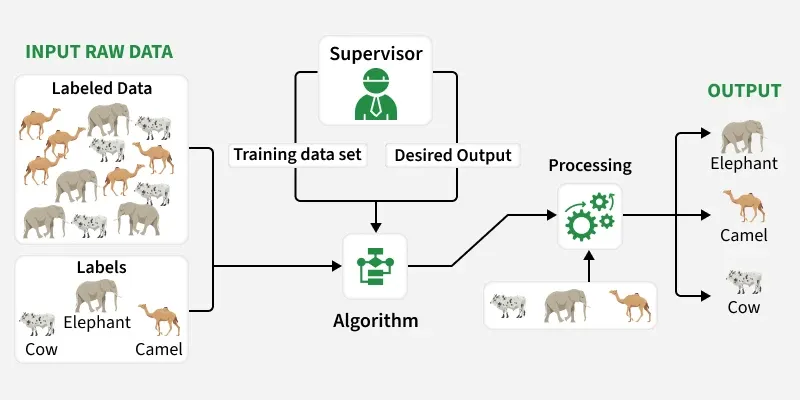
Supervised Learning uses labeled data to make predictions on new data. This section covers common algorithms for classification and regression tasks.
1. Linear Regression
2. Logistic Regression
3. Decision Trees
- Decision Tree in Machine Learning
- Types of Decision tree algorithms
- Decision Tree Regression (Implementation)
- Decision Tree Classification (Implementation)
4. k-Nearest Neighbors (k-NN)
5. Naïve Bayes
6. Support Vector Machines (SVM)
7. Ensemble Learning
8. Random Forest (Bagging Algorithm)
Module 7: Model Evaluation & Optimization
Evaluating a model helps determine how well it performs and whether it can generalize to new data. This section covers techniques for assessing and improving model performance.
- Confusion Matrix
- Precision, Recall & F1-Score
- AUC-ROC Curve
- Regression Metrics
- Cross-validation
- Overfitting & Underfitting
- Bias-Variance Tradeoff
- Regularization
- Hyperparameter Tuning
- Model Selection
Module 8: Unsupervised learning
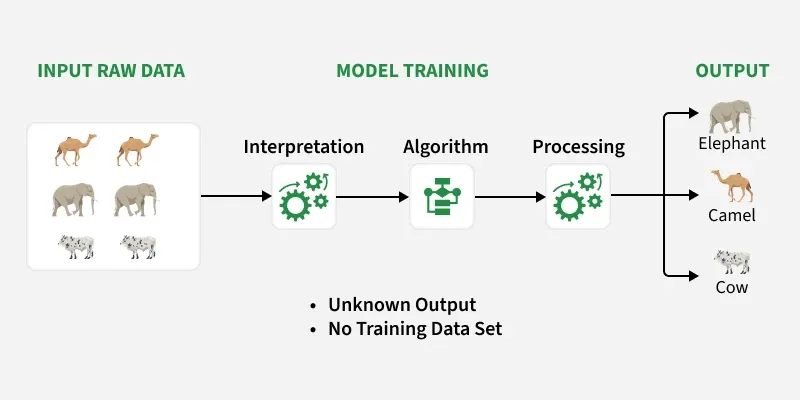
Unsupervised Learning helps uncover useful patterns and relationships in unlabeled data. This section introduces the main techniques used to analyze and organize such data.
1. Clustering
Centroid-based Methods:
Connectivity based methods:
Density Based methods:
Distribution-based Methods:
2. Dimensionality Reduction
- Principal Component Analysis (PCA)
- t-distributed Stochastic Neighbor Embedding (t-SNE)
- Non-negative Matrix Factorization (NMF)
- Independent Component Analysis (ICA)
- Isomap
3. Anomaly Detection & Association Rule Mining
Module 9: Reinforcement Learning
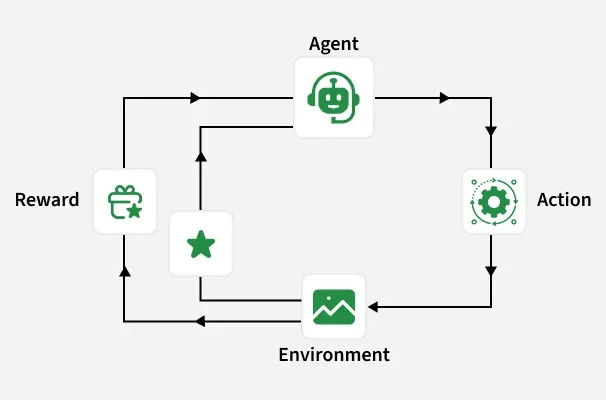
Reinforcement Learning is a type of machine learning in which an agent interacts with an environment and learns to make decisions by receiving rewards or penalties for its actions.
1. Fundamental Methods
2. Model-Free Methods
3. Policy-Based Methods
Module 10: Semi-Supervised & Self-Supervised Learning
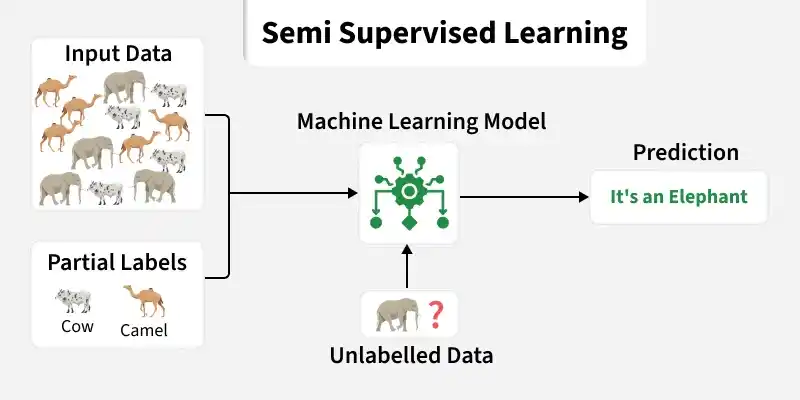
It uses a mix of labeled and unlabeled data making it helpful when labeling data is costly or it is very limited.
Module 11: Time Series & Forecasting
Forecasting models analyze past data to predict future trends, commonly used for time series problems like sales, demand or stock prices.
Module 12: Deployment & MLOps
The trained ML model must be integrated into an application or service to make its predictions accessible.
- Machine learning deployment
- ML Applications: Streamlit, Gradio
- ML APIs: Flask, FastAPI
- MLOps
- CI/CD in MLOps
- End-to-End MLOps
Module 13: Projects & Practice
Projects help reinforce machine learning concepts by applying them to practical problems. This section provides projects and interview resources for hands-on practice.
After machine learning and have hands on experience in it we can start with deep learning from here: Deep Learning Tutorial
