

HR interviews can be challenging, but proper preparation can make them easier. They help employers assess a candidate’s communication skills, personality, interpersonal abilities, and cultural fit. Whether you are a fresher or an experienced professional, preparing for commonly asked HR interview questions can help you answer confidently and make a strong impression.
General HR Interview Questions
1. Tell me about yourself.
I’m a [job role] with experience in [key area/skill]. I have a background in [education/field], where I developed a strong foundation in [relevant skills].
I’ve worked on [projects/work experience] that helped me strengthen my [technical/professional skills] and gain practical experience. I enjoy [problem-solving/teamwork/learning new technologies], and I’m now looking for an opportunity where I can contribute my skills, take on new challenges, and continue growing professionally.
2. What are your strengths?
My key strengths are problem-solving, communication, and adaptability. I enjoy breaking complex problems into smaller, manageable parts and finding efficient solutions. I’m also comfortable collaborating with both technical and non-technical teams, and I’m always open to feedback and learning new skills.
3. What are your weaknesses?
One weakness I’m working on is that I sometimes take on too many tasks at once. I like to make sure everything is done well, so I can sometimes overcommit. I’ve been improving this by prioritizing tasks, managing my time better, and focusing on what’s most important. This has helped me stay productive without compromising on quality.
4. Why do you want to work here?
I want to work here because I’m impressed by the company’s work, innovation, and growth opportunities. The role also matches my skills and interests, and I believe I can contribute positively to the team. I also value a collaborative environment where I can learn from others, take on new challenges, and grow professionally.
5. Where do you see yourself in five years?
In five years, I see myself as a skilled and experienced professional with deeper expertise in my field. I’d like to take on greater responsibilities, contribute to important projects, and potentially take on leadership or mentoring opportunities. Most importantly, I want to continue learning, deliver meaningful results, and grow along with the organization.
HR Interview Questions on Work Ethic and Work Style
6. How do you handle stress and pressure?
I handle stress and pressure by staying organized, maintaining a clear focus, and prioritizing tasks effectively. When I have a heavy workload, I break larger tasks into manageable steps and focus on those that are most urgent and important. I also keep track of deadlines to ensure steady progress. If I face a particularly challenging situation, I communicate with my team to discuss priorities and find an effective solution. Overall, I remain calm, focused, and committed to delivering quality work even under pressure.
7. Do you prefer working alone or in a team?
I’m comfortable working both independently and in a team. When working alone, I can stay focused and take full responsibility for my work. At the same time, I enjoy teamwork because sharing ideas and different perspectives often leads to better solutions. So, I’m flexible and choose whichever approach best suits the task or project.
8. What motivates you?
I’m mainly motivated by solving problems, learning new things, and seeing the impact of my work. I enjoy taking on challenging tasks because they help me improve my skills. I also feel motivated when I’m working with a team and contributing to achieving a common goal. Overall, continuous learning and personal growth keep me motivated.
9. How do you prioritize your tasks?
I prioritize my tasks based on urgency, importance, and deadlines. I usually break larger tasks into smaller steps and focus on high-impact tasks first. If something urgent comes up, I reassess my priorities and adjust my schedule accordingly. I also use a simple to-do list to stay organized and make sure everything is completed on time.
10. How do you handle failure?
I see failure as an opportunity to learn and improve. When something doesn’t go as planned, I try to understand what went wrong, identify the cause, and learn from the experience. I also take feedback from my team when needed. Most importantly, I make sure not to repeat the same mistake and use the experience to do better next time.
11. Can you describe a challenging work situation and how you overcame it?
In one of my previous projects, we had a tight deadline, and one team member left midway through the project. This increased the workload and put the deadline at risk.
We redistributed the tasks based on everyone’s strengths, and I took on some additional responsibilities. We also broke the remaining work into smaller tasks and focused on the most important ones first. By communicating regularly and working together, we were able to deliver the project on time.
This experience taught me the importance of teamwork, adaptability, and clear communication when working under pressure.
12. What did you like most about your last job?
What I liked most about my previous job was the opportunity to work on challenging projects and continuously learn new things. I also really enjoyed working with a supportive team where everyone could share ideas and help each other. The company also encouraged professional growth, which helped me improve both my technical and teamwork skills.
13. Why did you leave your last job?
I decided to leave my previous job because I was looking for more opportunities to grow and take on new challenges. I learned a lot from my previous role and really value that experience, but I wanted to work on more complex projects and continue developing my technical and professional skills. I believe this opportunity aligns better with my long-term career goals.
14. Describe your ideal work environment.
My ideal work environment is collaborative, supportive, and focused on continuous learning. I like working with a team where people can openly share ideas and help each other solve problems. I also value having some flexibility to focus on tasks independently when needed. Overall, I prefer an environment where I can learn, contribute to the team, and grow professionally.
Company-Specific HR Interview Questions
15. What do you know about our company?
From my research, I understand that your company has established a strong reputation in the industry, with a clear focus on innovation, quality, and customer satisfaction. I’m particularly interested in the work your organization is doing, as it aligns well with my skills and professional interests. I also appreciate the emphasis on teamwork, continuous improvement, and professional growth. I’m excited about the opportunity to contribute my skills, learn from the team, and grow with the organization.
Tip: Customize your answer by mentioning the company’s products, recent achievements, technologies, or values.
16. How can you contribute to our company?
I believe I can contribute through my technical skills, problem-solving ability, and teamwork. I can take responsibility for my tasks, deliver quality work on time, and work well with others to achieve team goals. I’m also a continuous learner, so I’m always willing to learn new technologies and improve my skills. My goal is to contribute to the team while growing along with the company.
17. What sets you apart from other candidates?
What sets me apart is the combination of my technical skills, problem-solving ability, and adaptability. I’m comfortable working under pressure and approaching challenges with a practical and solution-oriented mindset. I also communicate effectively with both technical and non-technical teams, which helps me collaborate efficiently. Most importantly, I’m committed to continuous learning, open to feedback, and always looking for ways to improve and add value to the team.
18. Are you willing to relocate/travel?
Yes, I’m open to both relocation and travel if the role requires it. I’m flexible and willing to adjust based on the company’s needs and the requirements of the position.
19. How do you align with our company's values?
From what I’ve learned about the company, I really value the focus on innovation, teamwork, and continuous improvement. These are also important to me because I enjoy learning, collaborating with others, and finding better ways to solve problems. I believe my approach to work aligns well with the company’s values, and I’d be happy to contribute to the team.
20. Why should we hire you?
You should hire me because I have a strong combination of technical skills, problem-solving ability, and a willingness to learn. I’m a responsible team player who can adapt to new challenges and take ownership of my work. I’m confident that I can contribute to the team, deliver quality results, and continue growing with the company.
Behavioral HR Interview Questions
21. Can you give an example of a time you showed leadership?
In one of my projects, we had to deliver an important feature within a tight deadline, but we faced some unexpected technical issues. I took the initiative to organize a quick team discussion and redistribute tasks based on everyone’s strengths.
I also kept the client updated and made sure the team stayed focused on the priorities. By communicating clearly and supporting the team, we were able to overcome the challenges and deliver the feature on time. This experience taught me that good leadership is about taking responsibility, staying calm, and helping the team move forward.
22. Describe a time when you resolved a conflict.
In one project, two team members had different opinions about how to implement a feature. One wanted to use a new technology, while the other felt it was too risky given the deadline.
I listened to both sides and discussed the pros and cons with them. We decided to build a small prototype to test the new technology before fully committing to it. The prototype worked well, so the team agreed on the approach and we moved forward. This experience taught me that listening carefully and finding a practical middle ground can help resolve conflicts effectively.
23. How do you handle constructive criticism?
I see constructive criticism as an opportunity to learn and improve. I try to listen carefully, understand the feedback, and work on the areas that need improvement. For example, during a code review, a senior developer suggested a more efficient approach for one of my functions. I took the feedback positively, learned the better approach, and improved my code. I believe feedback helps me identify my weaknesses and become better at my work.
24. What is the most significant achievement in your career?
One of my biggest achievements was successfully completing a challenging project within a tight deadline. I coordinated with the team, helped resolve technical issues, and made sure the project stayed on track. As a result, we delivered the project successfully and improved the application’s overall performance. This experience strengthened my problem-solving, teamwork, and leadership skills and gave me more confidence in handling challenging projects.
Tip: Whenever possible, mention measurable results, such as improved performance, reduced processing time, increased efficiency, or successful delivery within a specific deadline.
25. How do you stay updated with industry trends?
I stay updated by regularly following technology blogs, LinkedIn, and industry news. I also take online courses and explore new tools or technologies through small projects. Whenever I learn something useful, I try to apply it in my work. This helps me keep improving my skills and stay adaptable to changes in the industry.
Additional Tips for HR Interview
- Research the company to understand its mission, products, and culture.
- Prepare for common HR interview questions in advance.
- Highlight soft skills like communication, teamwork, and problem-solving, using specific examples.
- Be honest about your skills and experiences. If you don’t know something, express a willingness to learn.
- Prepare thoughtful questions about the company, role, or team culture.
- Be punctual, dress appropriately, and maintain good body language. Stay positive and avoid speaking negatively about past employers.
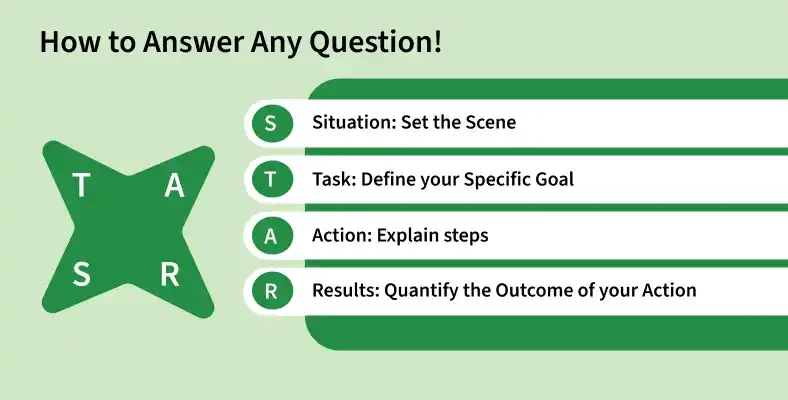
- Keep answers clear and concise. Use the STAR method for behavioral questions (Situation, Task, Action, Result).
- Show enthusiasm for the role and company.
- Be ready to discuss salary expectations, based on research of typical salaries for the role.
- Send a polite thank-you email after the interview to reinforce your interest in the position
