

In group theory, a group is a set equipped with a binary operation that satisfies the properties of closure, associativity, identity, and inverses.
Within a group, a subgroup is a subset that also forms a group under the same operation, while the order of a group is the total number of elements it contains.
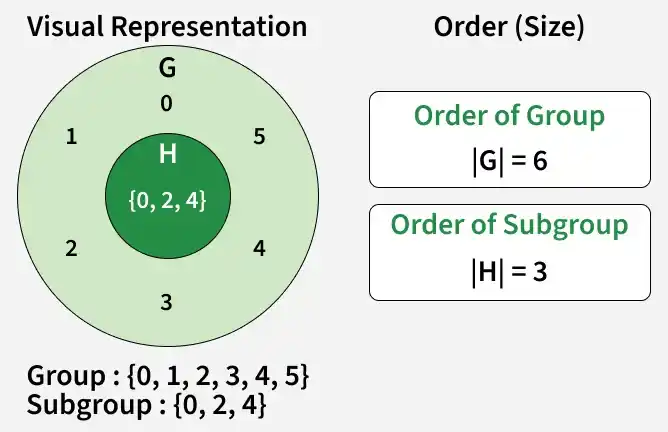
Subgroups
A subgroup is a subset of a group that itself forms a group under the same binary operation as the original group. If G is a group with operation ∗, then a subset H ⊆ G is called a subgroup of G if H satisfies all the group axioms using the operation ∗. This is denoted by H ≤ G.
A non-empty subset H of a group G is a subgroup if it satisfies the following conditions:
1. Closure: For any a, b ∈ H: a∗b ∈ H
This means that performing the group operation on any two elements of the subgroup produces another element that also belongs to the subgroup.
2. Identity Element: The identity element of the group must belong to the subgroup: e ∈ H
The identity element leaves every element unchanged under the group operation.
3. Inverse: For every element a ∈ H, a−1 ∈ H
This ensures that each element has an inverse within the subgroup itself.
Examples
- Integers under Addition (Z, +): The set of even integers is a subgroup of the group of all integers under addition.
- Modular Arithmetic: In modular arithmetic, the set of integers modulo n forms a group, and the set of integers that are multiples of a divisor d of n forms a subgroup.
Types of Subgroups
Some of the common types of subgroups are:
1. Trivial Subgroup: Every group has two trivial subgroups, the subgroup containing just the identity element and the group itself. These are the smallest and largest subgroups, respectively.
2. Proper Subgroup: A subgroup that is not equal to the group itself is called a proper subgroup. It contains at least one element other than the identity element.
3. Cyclic Subgroup: Generated by a single element of the group. If a is an element of a group G, then the cyclic subgroup generated by a, denoted ⟨a⟩, is the set {an : n∈Z}.
4. Normal Subgroup: A subgroup H of a group G is normal if gHg−1 = H for all g ∈ G. Normal subgroups play a crucial role in the theory of quotient groups
5. Cosets: Let H be a subgroup of a group G. If g ∈ G, the right coset of H generated by g is, Hg = { hg, h ∈ H }; and similarly, the left coset of H generated by g is gH = { gh, h ∈ H }
Order of Group
Order of a group is the number of elements in the group. Similarly, the order of a subgroup is the number of elements in that subgroup, which is always less than or equal to the order of the original group. It is denoted by |G|.
For finite groups, the order is simply the count of elements in the group. For example, if a group has 5 elements, its order is 5.
Order of an Element
The order of an element is the smallest positive integer n such that repeatedly applying the group operation to the element n times gives the identity element. It is denoted by ord(a).
For an element a in a group G, the order of a, is defined as:
an = e ,where e is the identity element of the group G.
If there is no such positive integer n, then the order of the element is considered infinite.
Lagrange’s Theorem
Statement of Lagrange’s theorem is:
If H is a subgroup of finite group G then the order of subgroup H divides the order o group G.
Consequences of Lagrange's Theorem
Lagrange's Theorem leads to several important results in group theory.
1. The Order of a Subgroup Divides the Order of the Group
2. The Order of Every Element Divides the Order of the Group.
3. Groups of Prime Order are Cyclic
4. The order of a subgroup can only be a divisor of the order of the group.
5. Finite Groups Have Limited Subgroup Orders.
➢Practice: Solved Examples
