

Nested quantifiers are quantifiers that are used together in a statement, where one quantifier is within the scope of another quantifier. They help describe relationships between different variables.
Types of Quantification or Scopes
- Universal (∀) - The predicate is true for all values of x in the domain.
- Existential (∃) - The predicate is true for at least one x in the domain.
Examples
1. For every natural number, there exists a larger natural number.
∀x ∈ N, ∃y ∈ N(y > x), which means for each natural number x, there exists a natural number y that is greater than x.
2. For every integer x, there exists an integer y such that x + y = 0.
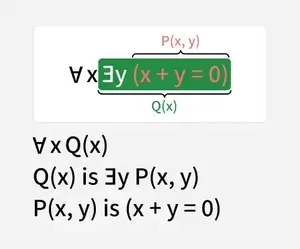
For example:
- If x = 5, then y = −5.
- If x = −3, then y = 3.
- If x = 0, then y = 0.
Hence, the statement is true over the set of integers.
Understanding the Scope of Nested Quantifiers
Two quantifiers are nested if one is within the scope of the other.
Example 1: ∀x ∃y (x + y = 5) Here '∃' (read as-there exists) and '∀' (read as-for all) are quantifiers for variables x and y.
The statement can be represented as ∀x Q(x) is ∃y P(x, y) Q(x)-the predicate is a function of only x because the quantifier applies only to variable x. P(x, y) is (x + y = 5) .
Example 2: ∀x ∀y ((x> 0)∧(y< 0) → (xy< 0)) (in English) For every real number x and y, if x is positive and y is negative, then xy is negative, again, ∀x Q(x) where Q(x) is ∀y P(x, y).
Converting Statements into Nested Quantifier
A statement in predicate logic is written using quantifiers and predicates.
- Quantifiers: ∀ (for all), ∃ (there exists).
- Predicate: a property or relation involving variables.
To convert a statement into a nested quantifier formula:
- Identify the variables
- Identify the predicate
- Attach suitable quantifiers
Example: “There is a student in this lecture who has taken at least one course in Discrete Mathematics.”
Let:
- x = Student
- y = Discrete Mathematics course
- P(x, y) = “x has taken y”
The statement becomes: “There exists a student x and there exists a course y such that x has taken y.”
Symbolically: ∃x ∃y P(x, y)
Theorems
Theorem 1: The order of nested existential quantifiers can be changed without changing the meaning of the statement.
∃x ∃y P(x, y) ≡ ∃y ∃x P(x, y)
Example: Statement: P(x, y): xy = 8
Domain: Integers
The statement means: “There exist integers x and y such that xy = 8.”
Changing the order of quantifiers gives the same meaning.
Hence, ∃x ∃y P(x, y) ≡ ∃y ∃x P(x, y).
Theorem 2: The order of nested universal quantifiers can also be changed without changing the meaning of the statement.
∀x ∀y P(x, y) ≡ ∀y ∀x P(x, y)
Example: Statement: ∀x ∀y (xy = yx)
Domain: Real Numbers
The statement means: “For all real numbers x and y, xy = yx.”
Changing the order of quantifiers gives the same meaning.
Hence, ∀x ∀y P(x, y) ≡ ∀y ∀x P(x, y).
Theorem 3: To negate nested quantifiers, replace each quantifier with its opposite type (∀ becomes ∃ and ∃ becomes ∀) and negate the predicate. Thus, the negation of ∀x ∃y P(x, y) is ∃x ∀y ~P(x, y).
Example: Statement: ∀x ∃y (x + y = 0)
Domain: Integers
The statement means: “For every integer x, there exists an integer y such that x + y = 0.”
Its negation is: ∃x ∀y (x + y ≠ 0)
which means: “There exists an integer x such that for every integer y, x + y ≠ 0.”
➢Practice: Solved Examples
