

Goldbach's Conjecture is one of the oldest unsolved problems in number theory. It states the following
Every even integer greater than 2 can be expressed as the sum of two prime numbers.
Mathematically it can be expressed as: For every even integer n≥4 there exist primes p and q such that:
n = p + q
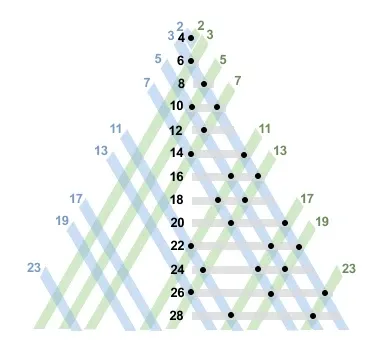
For Example:
- 4 = 2 + 2
- 6 = 3 + 3
- 8 = 3 + 5
- 10 = 5 + 5 or 7 + 3
Variants of Goldbach's Conjecture
Binary or Strong Goldbach's Conjecture:
Every even number > 2 is the sum of two Primes.
Ternary or Weak Goldbach's Conjecture:
Every odd number > 5 can be written as the sum of three Prime Numbers. (proved in 2013 by Harald Helfgott)
Related Conjectures: Levy’s Conjecture
While the Strong (Binary) and Weak (Ternary) Goldbach Conjectures focus on sums of primes, Levy’s Conjecture (1963) proposes a refinement:
"Every odd integer n ≥ 7 can be expressed as the sum of a prime p and twice another prime q, i.e.,
n = p + 2q "
Examples:
- 7 = 3 + 2 × 2
- 9 = 5 + 2 × 2
- 13 = 7 + 2 × 3
Attempts Done to Prove the Goldbach's Conjecture
- Chen’s Theorem (1966): Every sufficiently large even number is expressible as either:
p+q (sum of two primes), or p+(q×r) (sum of a prime and a semiprime). - Vinogradov’s Theorem (1937): Every sufficiently large odd integer is a sum of three primes.
- Computational Verification: The conjecture holds for all n ≤ 4×10¹⁸ (Oliveira e Silva, 2012).
Why Is It So Hard to Prove?
The conjecture has been confirmed to be true for all numbers smaller than 4×10¹⁸, but no one has been able to prove it completely, despite a lot of effort.
- Lack of a General Prime-Generating Formula: Primes are distributed unpredictably.
- No Known Algebraic Structure: Unlike other problems (e.g., Fermat's Last Theorem), Goldbach’s Conjecture lacks a clear connection to deep algebraic structures.
- Analytic Number Theory Limitations: Current methods (e.g., sieve theory) are insufficient for a full proof.
Applications of Golbach's Conjecture in Computer Science
Despite being unsolved, Goldbach’s Conjecture has inspired several computational and cryptographic applications:
Cryptography & Security
- RSA encryption relies on large primes. Goldbach-like decompositions could inspire new primality tests.
- Some cryptographic hashing schemes use prime properties for collision resistance.
Algorithm Design & Optimization
- Goldbach verification is can be used parallel computing, making it ideal for GPU computing.
- It can be used for Primality Testing. Algorithms like AKS and Miller-Rabin benefit from research on prime distributions.
Machine Learning & AI
- Using neural networks and machine learning (ML) to predict prime pairs (p,q) that sum to a given even integer n, it gives pattern recognition in prime distributions and hypothesis generation for theoretical work.
Computational Number Theory
- Studying Goldbach partitions helps understand prime spacing (e.g., Twin Prime Conjecture).
- In Quantum Computing, Shor’s algorithm could factorize large numbers, aiding in verifying Goldbach for extremely large n.
