

The problem is to find the shortest paths between every pair of vertices in a given weighted directed Graph and weights may be negative. We have discussed Floyd Warshall Algorithm for this problem. The time complexity of the Floyd Warshall Algorithm is Θ(V3).
Using Johnson's algorithm, we can find all pair shortest paths in O(V2log V + VE) time. Johnson’s algorithm uses both Dijkstra and Bellman-Ford as subroutines. If we apply Dijkstra's Single Source shortest path algorithm for every vertex, considering every vertex as the source, we can find all pair shortest paths in O(V*(V + E) * Log V) time.
So using Dijkstra's single-source shortest path seems to be a better option than Floyd Warshall's Algorithm , but the problem with Dijkstra's algorithm is, that it doesn't work for negative weight edge. The idea of Johnson's algorithm is to re-weight all edges and make them all positive, then apply Dijkstra's algorithm for every vertex.
How to transform a given graph into a graph with all non-negative weight edges?
One may think of a simple approach of finding the minimum weight edge and adding this weight to all edges. Unfortunately, this doesn't work as there may be a different number of edges in different paths (See this for an example). If there are multiple paths from a vertex u to v, then all paths must be increased by the same amount, so that the shortest path remains the shortest in the transformed graph. The idea of Johnson's algorithm is to assign a weight to every vertex. Let the weight assigned to vertex u be h[u].
We reweight edges using vertex weights. For example, for an edge (u, v) of weight w(u, v), the new weight becomes w(u, v) + h[u] - h[v]. The great thing about this reweighting is, that all set of paths between any two vertices is increased by the same amount and all negative weights become non-negative. Consider any path between two vertices s and t, the weight of every path is increased by h[s] - h[t], and all h[] values of vertices on the path from s to t cancel each other.
How do we calculate h[] values?
Bellman-Ford algorithm is used for this purpose. Following is the complete algorithm. A new vertex is added to the graph and connected to all existing vertices. The shortest distance values from the new vertex to all existing vertices are h[] values.
Algorithm:
- Let the given graph be G. Add a new vertex s to the graph, add edges from the new vertex to all vertices of G. Let the modified graph be G'.
- Run the Bellman-Ford algorithm on G' with s as the source. Let the distances calculated by Bellman-Ford be h[0], h[1], .. h[V-1]. If we find a negative weight cycle, then return. Note that the negative weight cycle cannot be created by new vertex s as there is no edge to s. All edges are from s.
- Reweight the edges of the original graph. For each edge (u, v), assign the new weight as "original weight + h[u] - h[v]".
- Remove the added vertex s and run Dijkstra's algorithm for every vertex.
How does the transformation ensure nonnegative weight edges?
The following property is always true about h[] values as they are the shortest distances.
h[v] <= h[u] + w(u, v)
The property simply means that the shortest distance from s to v must be smaller than or equal to the shortest distance from s to u plus the weight of the edge (u, v). The new weights are w(u, v) + h[u] - h[v]. The value of the new weights must be greater than or equal to zero because of the inequality "h[v] <= h[u] + w(u, v)".
Example: Let us consider the following graph.
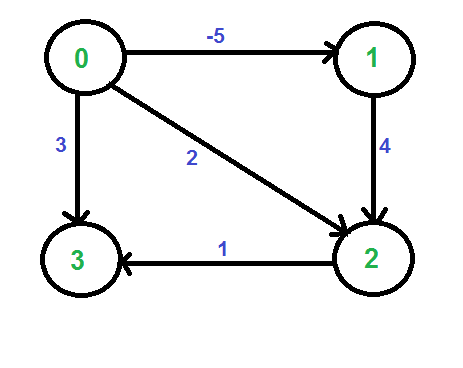
We add a source s and add edges from s to all vertices of the original graph. In the following diagram s is 4.
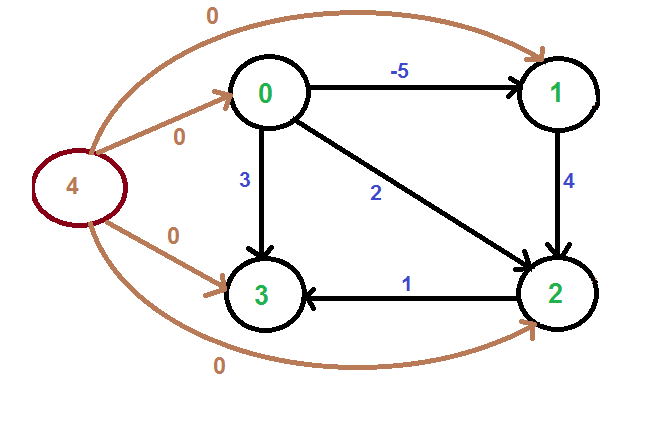
We calculate the shortest distances from 4 to all other vertices using Bellman-Ford algorithm. The shortest distances from 4 to 0, 1, 2 and 3 are 0, -5, -1 and 0 respectively, i.e., h[] = {0, -5, -1, 0}. Once we get these distances, we remove the source vertex 4 and reweight the edges using following formula. w(u, v) = w(u, v) + h[u] - h[v].
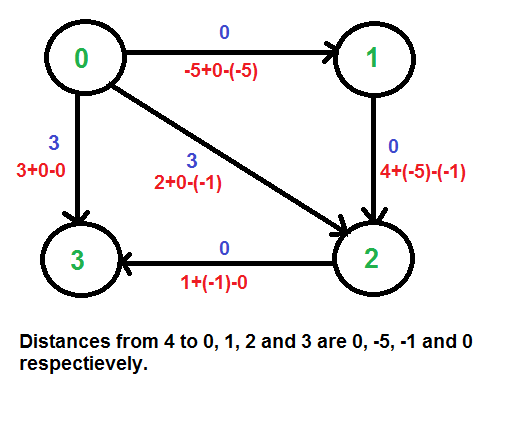
Since all weights are positive now, we can run Dijkstra's shortest path algorithm for every vertex as the source.
#include <iostream>
#include <vector>
#include <limits>
#include <algorithm>
#include <queue>
#include <iomanip> // For matrix formatting

using namespace std;

const long long INF = 1e15;

struct Edge {
    int to;
    int weight;
};

typedef pair<long long, int> pii;

// Dijkstra's algorithm for non-negative edge weights
vector<long long> Dijkstra(int V, const vector<vector<Edge>>& adj, int src) {
    vector<long long> dist(V, INF);
    priority_queue<pii, vector<pii>, greater<pii>> pq;

    dist[src] = 0;
    pq.push({0, src});

    while (!pq.empty()) {
        long long d = pq.top().first;
        int u = pq.top().second; // Fixed: added .top()
        pq.pop();

        if (d > dist[u]) continue;

        for (auto& edge : adj[u]) {
            if (dist[u] + edge.weight < dist[edge.to]) {
                dist[edge.to] = dist[u] + edge.weight;
                pq.push({dist[edge.to], edge.to});
            }
        }
    }
    return dist;
}

// Bellman-Ford to find h[] and detect negative cycles
vector<long long> BellmanFord(int V, const vector<vector<int>>& edges, bool& hasCycle) {
    vector<long long> h(V + 1, INF);
    h[V] = 0;

    vector<vector<int>> all_edges = edges;
    for (int i = 0; i < V; i++) all_edges.push_back({V, i, 0});

    for (int i = 0; i < V; i++) {
        for (auto& e : all_edges) {
            if (h[e[0]] != INF && h[e[0]] + e[2] < h[e[1]]) {
                h[e[1]] = h[e[0]] + e[2];
            }
        }
    }

    hasCycle = false;
    for (auto& e : all_edges) {
        if (h[e[0]] != INF && h[e[0]] + e[2] < h[e[1]]) {
            hasCycle = true;
            return {};
        }
    }

    h.pop_back();
    return h;
}

void JohnsonAlgorithm(int V, const vector<vector<int>>& edgeList) {
    bool hasCycle;
    vector<long long> h = BellmanFord(V, edgeList, hasCycle);

    if (hasCycle) {
        cout << "The graph contains a negative weight cycle. Algorithm cannot proceed." << endl;
        return;
    }

    // Reweight edges to be non-negative
    vector<vector<Edge>> adj(V);
    for (auto& e : edgeList) {
        int u = e[0], v = e[1], w = e[2];
        adj[u].push_back({v, (int)(w + h[u] - h[v])});
    }

    vector<vector<long long>> resultMatrix(V, vector<long long>(V));

    // Run Dijkstra for every vertex
    for (int s = 0; s < V; s++) {
        vector<long long> d_prime = Dijkstra(V, adj, s);
        for (int v = 0; v < V; v++) {
            if (d_prime[v] == INF) resultMatrix[s][v] = INF;
            else resultMatrix[s][v] = d_prime[v] + h[v] - h[s];
        }
    }

    // Display the Matrix
    cout << "Shortest Distance Matrix:\n";
    for (int i = 0; i < V; i++) {
        for (int j = 0; j < V; j++) {
            if (resultMatrix[i][j] >= INF/2) cout << setw(7) << "INF";
            else cout << setw(7) << resultMatrix[i][j];
        }
        cout << endl;
    }
}

int main() {
    int V = 4;
    vector<vector<int>> edgeList = {
        {0, 1, -5}, {0, 2, 2}, {0, 3, 3},
        {1, 2, 4},
        {2, 3, 1}
    };

    JohnsonAlgorithm(V, edgeList);
    return 0;
}
import java.util.*;

class Edge {
    int to;
    int weight;

    Edge(int to, int weight) {
        this.to = to;
        this.weight = weight;
    }
}

class Pair implements Comparable<Pair> {
    long dist;
    int vertex;

    Pair(long dist, int vertex) {
        this.dist = dist;
        this.vertex = vertex;
    }

    public int compareTo(Pair other) {
        return Long.compare(this.dist, other.dist);
    }
}

public class GFG {
    private static final long INF = 1000000000000000L;

    private static List<Long> dijkstra(int V, List<List<Edge>> adj, int src) {
        List<Long> dist = new ArrayList<>(Collections.nCopies(V, INF));
        PriorityQueue<Pair> pq = new PriorityQueue<>();

        dist.set(src, 0L);
        pq.add(new Pair(0, src));

        while (!pq.isEmpty()) {
            Pair p = pq.poll();
            long d = p.dist;
            int u = p.vertex;

            if (d > dist.get(u)) continue;

            for (Edge edge : adj.get(u)) {
                if (dist.get(u) + edge.weight < dist.get(edge.to)) {
                    dist.set(edge.to, dist.get(u) + edge.weight);
                    pq.add(new Pair(dist.get(edge.to), edge.to));
                }
            }
        }
        return dist;
    }

    private static List<Long> bellmanFord(int V, List<int[]> edges, boolean[] hasCycle) {
        List<Long> h = new ArrayList<>(Collections.nCopies(V + 1, INF));
        h.set(V, 0L);

        List<int[]> all_edges = new ArrayList<>(edges);
        for (int i = 0; i < V; i++) all_edges.add(new int[] {V, i, 0});

        for (int i = 0; i < V; i++) {
            for (int[] e : all_edges) {
                if (h.get(e[0])!= INF && h.get(e[0]) + e[2] < h.get(e[1])) {
                    h.set(e[1], h.get(e[0]) + e[2]);
                }
            }
        }

        hasCycle[0] = false;
        for (int[] e : all_edges) {
            if (h.get(e[0])!= INF && h.get(e[0]) + e[2] < h.get(e[1])) {
                hasCycle[0] = true;
                return new ArrayList<>();
            }
        }

        h.remove(h.size() - 1);
        return h;
    }

    public static void johnsonAlgorithm(int V, List<int[]> edgeList) {
        boolean[] hasCycle = {false};
        List<Long> h = bellmanFord(V, edgeList, hasCycle);

        if (hasCycle[0]) {
            System.out.println("The graph contains a negative weight cycle. Algorithm cannot proceed.");
            return;
        }

        List<List<Edge>> adj = new ArrayList<>();
        for (int i = 0; i < V; i++) adj.add(new ArrayList<>());
        for (int[] e : edgeList) {
            int u = e[0], v = e[1], w = e[2];
            adj.get(u).add(new Edge(v, (int)(w + h.get(u) - h.get(v))));
        }

        long[][] resultMatrix = new long[V][V];

        for (int s = 0; s < V; s++) {
            List<Long> d_prime = dijkstra(V, adj, s);
            for (int v = 0; v < V; v++) {
                if (d_prime.get(v) == INF) resultMatrix[s][v] = INF;
                else resultMatrix[s][v] = d_prime.get(v) + h.get(v) - h.get(s);
            }
        }

        System.out.println("Shortest Distance Matrix:");
        for (int i = 0; i < V; i++) {
            for (int j = 0; j < V; j++) {
                if (resultMatrix[i][j] >= INF / 2) System.out.printf("%7s", "INF");
                else System.out.printf("%7d", resultMatrix[i][j]);
            }
            System.out.println();
        }
    }

    public static void main(String[] args) {
        int V = 4;
        List<int[]> edgeList = Arrays.asList(
            new int[] {0, 1, -5},
            new int[] {0, 2, 2},
            new int[] {0, 3, 3},
            new int[] {1, 2, 4},
            new int[] {2, 3, 1}
        );

        johnsonAlgorithm(V, edgeList);
    }
}
import heapq

class Edge:
    def __init__(self, to, weight):
        self.to = to
        self.weight = weight

class Pair:
    def __init__(self, dist, vertex):
        self.dist = dist
        self.vertex = vertex

    def __lt__(self, other):
        return self.dist < other.dist

INF = 1000000000000000

def dijkstra(V, adj, src):
    dist = [INF] * V
    pq = []
    heapq.heappush(pq, Pair(0, src))
    dist[src] = 0

    while pq:
        p = heapq.heappop(pq)
        d = p.dist
        u = p.vertex

        if d > dist[u]:
            continue

        for edge in adj[u]:
            if dist[u] + edge.weight < dist[edge.to]:
                dist[edge.to] = dist[u] + edge.weight
                heapq.heappush(pq, Pair(dist[edge.to], edge.to))
    return dist

def bellmanFord(V, edges, hasCycle):
    h = [INF] * (V + 1)
    h[V] = 0

    all_edges = edges + [(V, i, 0) for i in range(V)]

    for _ in range(V):
        for u, v, w in all_edges:
            if h[u]!= INF and h[u] + w < h[v]:
                h[v] = h[u] + w

    hasCycle[0] = False
    for u, v, w in all_edges:
        if h[u]!= INF and h[u] + w < h[v]:
            hasCycle[0] = True
            return []

    del h[-1]
    return h

def johnsonAlgorithm(V, edgeList):
    hasCycle = [False]
    h = bellmanFord(V, edgeList, hasCycle)

    if hasCycle[0]:
        print('The graph contains a negative weight cycle. Algorithm cannot proceed.')
        return

    adj = [[] for _ in range(V)]
    for u, v, w in edgeList:
        adj[u].append(Edge(v, w + h[u] - h[v]))

    resultMatrix = [[INF] * V for _ in range(V)]

    for s in range(V):
        d_prime = dijkstra(V, adj, s)
        for v in range(V):
            if d_prime[v] == INF:
                resultMatrix[s][v] = INF
            else:
                resultMatrix[s][v] = d_prime[v] + h[v] - h[s]

    print('Shortest Distance Matrix:')
    for row in resultMatrix:
        print(' '.join('INF' if x >= INF // 2 else str(x) for x in row))

if __name__ == '__main__':
    V = 4
    edgeList = [
        (0, 1, -5),
        (0, 2, 2),
        (0, 3, 3),
        (1, 2, 4),
        (2, 3, 1)
    ]
    johnsonAlgorithm(V, edgeList)
'use strict';

class Edge {
    constructor(to, weight) {
        this.to = to;
        this.weight = weight;
    }
}

class Pii {
    constructor(d, u) {
        this.d = d;
        this.u = u;
    }
}

Pii.prototype.compareTo = function(other) {
    return this.d < other.d;
};

const INF = 1000000000000000;

function Dijkstra(V, adj, src) {
    let dist = new Array(V).fill(INF);
    dist[src] = 0;
    let pq = [new Pii(0, src)];
    while (pq.length > 0) {
        pq.sort((a, b) => a.d - b.d);
        let top = pq.shift();
        let d = top.d;
        let u = top.u;
        if (d > dist[u]) {
            continue;
        }
        for (let edge of adj[u]) {
            if (dist[u] + edge.weight < dist[edge.to]) {
                dist[edge.to] = dist[u] + edge.weight;
                pq.push(new Pii(dist[edge.to], edge.to));
            }
        }
    }
    return dist;
}

function BellmanFord(V, edges, hasCycle) {
    let h = new Array(V + 1).fill(INF);
    h[V] = 0;
    let all_edges = edges.slice();
    for (let i = 0; i < V; i++) {
        all_edges.push([V, i, 0]);
    }
    for (let i = 0; i < V; i++) {
        for (let e of all_edges) {
            if (h[e[0]]!== INF && h[e[0]] + e[2] < h[e[1]]) {
                h[e[1]] = h[e[0]] + e[2];
            }
        }
    }
    hasCycle[0] = false;
    for (let e of all_edges) {
        if (h[e[0]]!== INF && h[e[0]] + e[2] < h[e[1]]) {
            hasCycle[0] = true;
            return [];
        }
    }
    let result = h.slice(0, -1);
    return result;
}

function JohnsonAlgorithm(V, edgeList) {
    let hasCycle = [false];
    let h = BellmanFord(V, edgeList, hasCycle);
    if (hasCycle[0]) {
        console.log('The graph contains a negative weight cycle. Algorithm cannot proceed.');
        return;
    }
    let adj = new Array(V).fill(0).map(() => []);
    for (let e of edgeList) {
        let u = e[0], v = e[1], w = e[2];
        adj[u].push(new Edge(v, w + h[u] - h[v]));
    }
    for (let s = 0; s < V; s++) {
        let d_prime = Dijkstra(V, adj, s);
        console.log('\nShortest distances from vertex', s + 1, ':');
        for (let v = 0; v < V; v++) {
            if (d_prime[v] === INF) {
                console.log('To', v + 1, ': INF');
            } else {
                let actual_dist = d_prime[v] + h[v] - h[s];
                console.log('To', v + 1, ':', actual_dist);
            }
        }
    }
}

function main() {
    let V = 4;
    let edgeList = [
        [0, 1, -5],
        [0, 2, 2],
        [0, 3, 3],
        [1, 2, 4],
        [2, 3, 1]
    ];
    JohnsonAlgorithm(V, edgeList);
}

main();
class Edge {
    constructor(to, weight) {
        this.To = to;
        this.Weight = weight;
    }
}

class GFG {
    // Using a large value for INF that won't overflow during reweighting
    static INF = Number.MAX_SAFE_INTEGER / 4;

    // Dijkstra's Algorithm using JavaScript's PriorityQueue
    static Dijkstra(V, adj, src) {
        const dist = Array(V).fill(this.INF);
        const pq = new PriorityQueue();

        dist[src] = 0;
        pq.enqueue({ vertex: src, distance: 0 });

        while (!pq.isEmpty()) {
            const { vertex: u, distance: d } = pq.dequeue();

            if (d > dist[u]) continue;

            for (const edge of adj[u]) {
                if (dist[u] + edge.Weight < dist[edge.To]) {
                    dist[edge.To] = dist[u] + edge.Weight;
                    pq.enqueue({ vertex: edge.To, distance: dist[edge.To] });
                }
            }
        }
        return dist;
    }

    // Bellman-Ford to find h[] and detect negative cycles
    static BellmanFord(V, edges, hasCycle) {
        const h = Array(V + 1).fill(this.INF);
        h[V] = 0;

        const allEdges = [...edges];
        for (let i = 0; i < V; i++) allEdges.push([V, i, 0]);

        for (let i = 0; i < V; i++) {
            for (const e of allEdges) {
                if (h[e[0]]!== this.INF && h[e[0]] + e[2] < h[e[1]]) {
                    h[e[1]] = h[e[0]] + e[2];
                }
            }
        }

        hasCycle = false;
        for (const e of allEdges) {
            if (h[e[0]]!== this.INF && h[e[0]] + e[2] < h[e[1]]) {
                hasCycle = true;
                return null;
            }
        }

        return h.slice(0, V);
    }

    static JohnsonAlgorithm(V, edgeList) {
        let h = this.BellmanFord(V, edgeList, (hasCycle) => hasCycle);

        if (h === null) {
            console.log('The graph contains a negative weight cycle. Algorithm cannot proceed.');
            return;
        }

        const adj = Array.from({ length: V }, () => []);

        for (const e of edgeList) {
            const u = e[0], v = e[1], w = e[2];
            adj[u].push(new Edge(v, w + h[u] - h[v]));
        }

        const distanceMatrix = Array.from({ length: V }, () => Array(V).fill(this.INF));

        for (let s = 0; s < V; s++) {
            const dPrime = this.Dijkstra(V, adj, s);
            for (let v = 0; v < V; v++) {
                distanceMatrix[s][v] = dPrime[v] === this.INF ? this.INF : dPrime[v] + h[v] - h[s];
            }
        }

        // Print the Matrix without row/column numbering
        console.log('Shortest Distance Matrix:');
        for (let i = 0; i < V; i++) {
            let row = [];
            for (let j = 0; j < V; j++) {
                row.push(distanceMatrix[i][j] >= this.INF / 2? 'INF' : distanceMatrix[i][j]);
            }
            console.log(row.join(' ').padStart(8));
        }
    }
}

class PriorityQueue {
    constructor() {
        this.elements = [];
    }

    enqueue(item) {
        this.elements.push(item);
        this.elements.sort((a, b) => a.distance - b.distance);
    }

    dequeue() {
        return this.elements.shift();
    }

    isEmpty() {
        return this.elements.length === 0;
    }
}

// Main function
(function() {
    const V = 4;
    const edgeList = [
        [0, 1, -5],
        [0, 2, 2],
        [0, 3, 3],
        [1, 2, 4],
        [2, 3, 1]
    ];

    GFG.JohnsonAlgorithm(V, edgeList);
})();
Output
Shortest Distance Matrix:
      0     -5     -1      0
    INF      0      4      5
    INF    INF      0      1
    INF    INF    INF      0
Time Complexity: The main steps in the algorithm are Bellman-Ford Algorithm called once and Dijkstra called V times. Time complexity of Bellman Ford is O(VE) and time complexity of Dijkstra is O((V + E)Log V). So overall time complexity is O(V2log V + VE).
The time complexity of Johnson's algorithm becomes the same as Floyd Warshall's Algorithm when the graph is complete (For a complete graph E = O(V2). But for sparse graphs, the algorithm performs much better than Floyd Warshall's Algorithm.
Auxiliary Space: O(V2)
