

A data structure is a way of organizing and storing data in a computer so that it can be accessed and used efficiently. It refers to the logical or mathematical representation of data, as well as the implementation in a computer program.
Data structures can be classified into two broad categories:
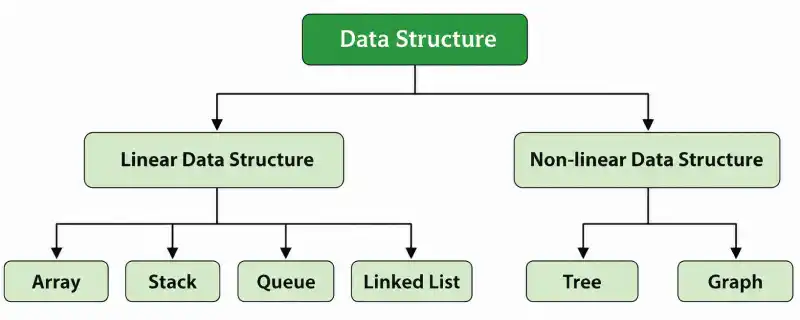
Linear Data Structure
A data structure in which data elements are arranged sequentially or linearly, where each element is attached to its previous and next adjacent elements, is called a linear data structure.
Array
An array is a collection of elements of the same data type stored in contiguous memory locations. It allows efficient access to elements using an index.
Linked List
A linked list is a linear data structure in which elements are stored as nodes, and each node contains data and a reference to the next node.
Stack
A stack is a linear data structure that follows the LIFO (Last In, First Out) principle. It allows elements to be added and removed only from one end, called the top.
Queue
A queue is a linear data structure that follows the FIFO (First In, First Out) principle. It allows elements to be inserted from one end, called the rear, and removed from the other end, called the front.
Non-linear Data Structure
Data structures where data elements are not placed sequentially or linearly are called non-linear data structures.
Tree
A tree is a non-linear, hierarchical data structure consisting of nodes connected through edges. It organizes data in a parent-child relationship, where each node can have zero or more child nodes.
Graph
A graph is a non-linear data structure consisting of vertices (nodes) and edges. It represents relationships or connections between different nodes.
Applications of Data Structures
Data structures are used in a wide range of computer programs and applications, including:
- Databases: Data structures are used to organize and store data in a database, allowing for efficient retrieval and manipulation.
- Operating systems: Data structures are used in the design and implementation of operating systems to manage system resources, such as memory and files.
- Computer graphics: Data structures are used to represent geometric shapes and other graphical elements in computer graphics applications.
- Artificial intelligence: Data structures are used to represent knowledge and information in artificial intelligence systems.
Advantages of Data Structures:
The use of data structures provides several advantages, including:
- Efficiency: Data structures allow for efficient storage and retrieval of data, which is important in applications where performance is critical.
- Flexibility: Data structures provide a flexible way to organize and store data, allowing for easy modification and manipulation.
- Reusability: Data structures can be used in multiple programs and applications, reducing the need for redundant code.
- Maintainability: Well-designed data structures can make programs easier to understand, modify, and maintain over time.
For more, refer to the DSA Tutorial.
