

Gray Code is a digital encoding system in which consecutive binary values differ by only one bit. This property helps reduce transition errors and improves reliability in digital circuits.
- Gray code can be converted to and from binary using simple XOR operations.
- It is a cyclic code, where the first and last code words also differ by only one bit.

Features
- Single-Bit Change: Only one bit changes between two consecutive Gray code values, reducing the chances of errors during transitions.
- Reflection Property: Gray code is generated by reflecting the previous sequence and adding a prefix bit. This method ensures that adjacent code words still differ by only one bit.
Types of Gray Codes
- Binary Reflected Gray Code (BRGC): The most common form of Gray code, where consecutive code words differ by only one bit. It is generated by reflecting the previous code sequence.
- Balanced Gray Code: A variation in which bit transitions are distributed as evenly as possible across all bit positions, making it useful in certain hardware applications.
- N-ary Gray Code: An extension of Gray code for number systems with more than two symbols instead of binary digits.
To Generate Gray Code
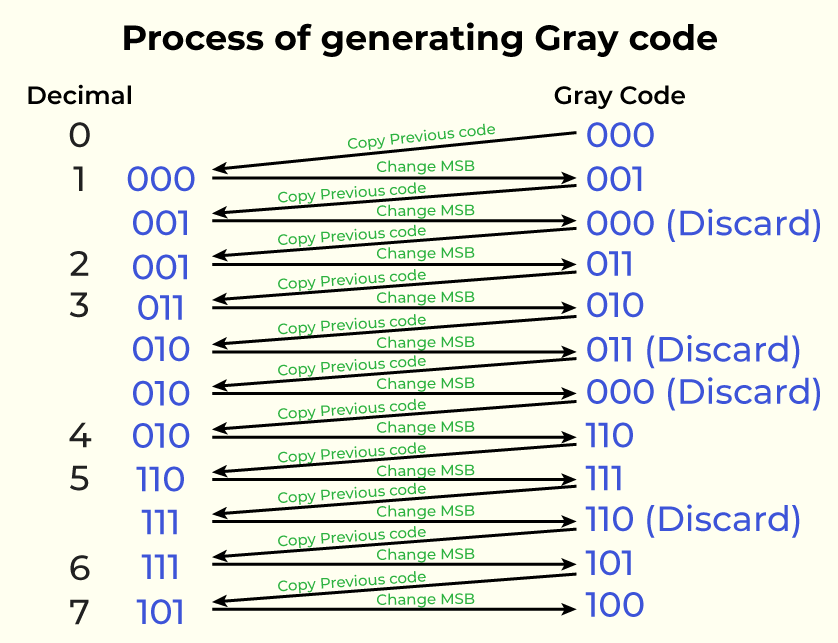
Gray code is generated using the reflect-and-prefix method. Starting with a 1-bit Gray code, the previous sequence is reflected and a new leading bit is added to create the next higher-bit Gray code.
Steps:
- Start with the 1-bit Gray code:
0,1. - Reflect the existing sequence.
- Prefix
0to the original sequence and1to the reflected sequence. - Repeat the process until the required number of bits is obtained.
Advantages
- Reduces Transition Errors: Since only one bit changes at a time, Gray code minimizes errors that can occur during state transitions.
- Improves System Reliability: The single-bit change makes digital systems more stable, especially when signals change rapidly.
- Prevents Ambiguous States: It reduces the chance of reading incorrect intermediate values while switching between consecutive numbers.
- Easy to Generate: Gray code can be generated from binary numbers using simple XOR operations.
Disadvantages
- Not Suitable for Arithmetic Operations: Gray code is designed for error reduction, not for performing addition, subtraction, or other arithmetic operations.
- Requires Conversion: Most digital systems process data in binary, so Gray code usually needs to be converted before computation.
- Extra Conversion Hardware: Systems that use Gray code often require additional logic circuits for binary-to-Gray and Gray-to-binary conversion.
- Less Practical for General Storage: Since standard processors and memory use binary, Gray code is mainly used only in specific applications.
Applications
- Rotary and Position Encoders: Helps measure angular position accurately by reducing transition errors.
- Analog-to-Digital Converters (ADCs): Minimizes incorrect readings while converting analog signals into digital values.
- Error-Resistant Digital Systems: Used where reliable state transitions are important, such as counters and control circuits.
- Communication Systems: Helps reduce bit errors during data transmission when signal transitions occur.
