

The difference between ACID and BASE database models is the way they deal with this limitation.
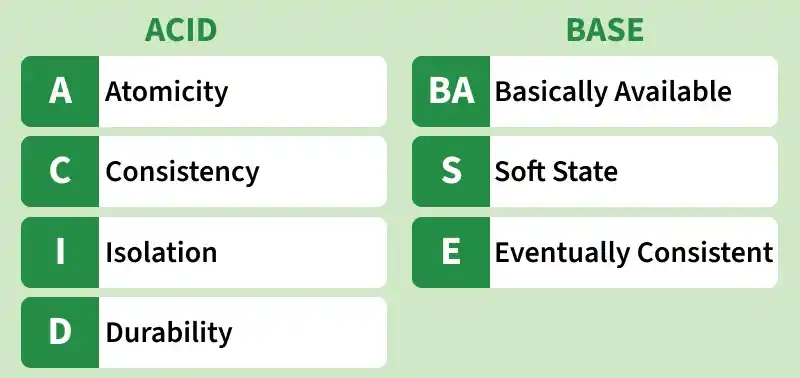
ACID vs BASE:
Criteria | ACID | BASE |
|---|---|---|
Simplicity | Simple | Complex |
Focus | Commits | Best attempt |
Maintenance | High | Low |
Consistency Of Data | Strong | Weak/Loose |
Concurrency scheme | Nested Transactions | Close to answer |
Scaling | Vertical | Horizontal |
Implementation | Easy to implement | Difficult to implement |
Upgrade | Harder to upgrade | Easy to upgrade |
Type of database | Robust | Simple |
Type of code | Simple | Harder |
Time required for completion | Less time | More time. |
Examples | Oracle, MySQL, SQL Server, etc. | DynamoDB, Cassandra, CouchDB, SimpleDB etc. |
Choosing Between ACID Model and BASE Model
Developers and data architects should evaluate consistency needs on a case-by-case basis rather than following industry trends or relying solely on previously used technologies. The choice between ACID Model and BASE Model depends on application requirements:
ACID model is preferred when:
- Strong data consistency is critical.
- Reliable transactions are required.
- Data integrity cannot be compromised.
- Applications involve banking, financial systems, payment platforms (e.g., PayPal), or inventory management.
BASE model is preferred when:
- High scalability and availability are the primary requirements.
- Eventual consistency is acceptable.
- Applications handle large-scale distributed data.
- Developers can carefully manage data consistency at the application level.
- Applications include social media, e-commerce, and real-time web services.
