

A decimal number uses base 10, while a hexadecimal number uses base 16 with digits 0–9 and A–F, where A–F represent values from 10–15. To convert a decimal number to hexadecimal, we repeatedly divide the number by 16 and use the remainders to form the hexadecimal representation.
- The remainders are stored and printed in reverse order to obtain the final hexadecimal number.
- Each remainder from 10 to 15 is represented using A to F.
Examples:
Input: 2545
Output: 9F1Input: 100
Output: 64
Algorithm for Decimal to Hexadecimal Conversion
The conversion can be performed using repeated division by 16.
1. Initialize a character array to store the hexadecimal digits.
2. While the decimal number is greater than 0:
- Find the remainder by taking n % 16.
- Convert the remainder into its corresponding hexadecimal character.
- Store the character in the array.
- Divide n by 16.
3. The remainders are obtained from right to left, so print the stored characters in reverse order.
For remainders from 0 to 9, use characters 0 to 9. For remainders from 10 to 15, use characters A to F.
#include <iostream>
using namespace std;

// Function to convert decimal to hexadecimal
void decToHexa(int n)
{
    // Array to store hexadecimal digits
    char hexaDeciNum[100];

    // Index for storing digits
    int i = 0;

    while (n != 0)
    {
        // Get the remainder after division by 16
        int remainder = n % 16;

        // Convert remainder to hexadecimal character
        if (remainder < 10)
            hexaDeciNum[i] = '0' + remainder;
        else
            hexaDeciNum[i] = 'A' + (remainder - 10);

        i++;

        // Reduce the number for the next iteration
        n /= 16;
    }

    // Remainders are stored in reverse order,
    // so print them from right to left
    for (int j = i - 1; j >= 0; j--)
        cout << hexaDeciNum[j];
}

int main()
{
    int n = 2545;

    decToHexa(n);

    return 0;
}
Output
9F1
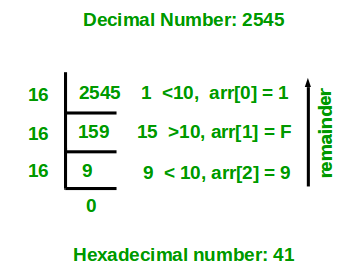
Explanation: For n = 2545, the program repeatedly divides the number by 16 and stores the remainders.
- 2545 ÷ 16 = 159, remainder 1 -> 1
- 159 ÷ 16 = 9, remainder 15 -> F
- 9 ÷ 16 = 0, remainder 9 -> 9
- The remainders are obtained as 1, F, 9, so they are printed in reverse order.
- Therefore, the hexadecimal equivalent of 2545 is 9F1.
2545₁₀ = 9F1₁₆
