

Digital evidence collection is the process of identifying, acquiring, preserving and documenting electronically stored information that may be relevant to a cybersecurity incident or investigation. Digital evidence may originate from computers, servers, mobile devices, cloud environments, network infrastructure, security tools or storage media.
Types of Digital Evidence
Digital evidence can be broadly categorized into several types.
- Volatile Evidence: Volatile evidence exists temporarily and should be collected immediately. Examples include RAM contents, Running processes, Active network connections, Logged-in users.
- Non-Volatile Evidence: Non-volatile evidence remains stored after system shutdown. Examples include Hard drive data, SSD contents, Log files, Databases, Archived records.
- Network Evidence: Network evidence captures communication occurring across systems. Examples include Packet captures, DNS records NetFlow data, Traffic logs.
- Cloud-Based Evidence: Cloud environments generate evidence distributed across multiple services and regions. Examples include Cloud audit logs, Access control records, Object storage metadata.
Sources of Digital Evidence
Digital evidence can be collected from multiple technological environments.
- Endpoint Systems: Workstations, laptops and desktop computers often contain valuable evidence such as User activity records, Browser history, Documents and files, Registry data, Security logs.
- Servers: Servers may provide information regarding Authentication events, System logs, Application logs, Database activity, Access records.
- Mobile Devices: Smartphones and tablets frequently contain Call records, Messages, Location information, Multimedia files.
- Network Infrastructure: Network devices can reveal attack behavior through Firewall logs, Router logs, Switch logs, VPN records, Network traffic captures.
- Cloud Environments: Cloud platforms generate evidence through Audit logs, Identity management records, Virtual machine snapshots, API access records.
- Security Monitoring Systems: Security tools continuously generate evidence relevant to investigations SIEM logs, IDS alerts, IPS alerts, EDR telemetry, Threat intelligence records.
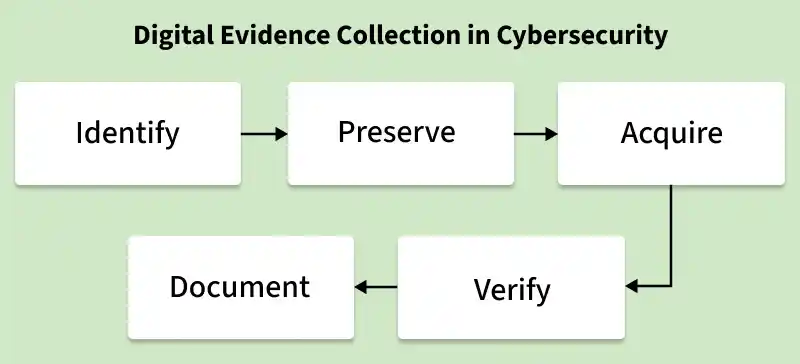
Digital Evidence Collection Process
A structured collection process ensures evidence remains reliable and admissible.
1. Identification
Investigators first determine potential evidence sources relevant to the incident.
- This stage involves Defining investigation scope, Identifying affected systems, Locating relevant data sources, Prioritizing volatile evidence.
- Accurate identification prevents the loss of critical information.
2. Preservation
Preservation protects evidence from modification or destruction.
- Common preservation techniques Isolating affected systems, Restricting unauthorized access, Creating forensic copies, Recording system states, Maintaining secure storage.
- The original evidence should remain untouched whenever possible.
3. Acquisition
Acquisition involves collecting evidence using forensically sound methods. Common acquisition approaches include:
- Disk Imaging: A bit-by-bit copy of storage media is created without modifying the original data.
- Memory Acquisition: Investigators capture RAM contents to preserve volatile information.
- Log Collection: Security, system, application and network logs are exported for analysis.
- Network Capture: Packet capture tools record network communications for investigation.
- Cloud Evidence Acquisition: Cloud logs, snapshots and audit records are collected from cloud providers.
4. Verification
Collected evidence must be validated to confirm integrity.
- Cryptographic hash functions such as MD5, SHA-1, SHA-256.
- Matching hash values confirm that evidence remains unchanged.
5. Documentation
Every collection activity must be recorded.
- Documentation typically includes Date and time of collection, Investigator information, Device identifiers, Collection methods, Evidence storage location.
- Proper documentation supports accountability and reproducibility.
Chain of Custody
The chain of custody is a documented record showing the movement and handling of evidence from collection to final disposition.
- It establishes Who collected the evidence, When collection occurred, Where evidence was stored, Who accessed it, What actions were performed.
- A complete chain of custody strengthens the credibility and legal admissibility of digital evidence.
Common Tools
Cybersecurity professionals use specialized forensic tools to acquire and preserve evidence.
- Disk Imaging Tools: FTK Imager, EnCase Forensic, dd, Guymager.
- Memory Acquisition Tools: Magnet RAM Capture, Belkasoft RAM Capturer, DumpIt.
- Network Collection Tools: Wireshark, tcpdump, NetworkMiner.
- Enterprise Investigation Platforms: Velociraptor, Microsoft Defender XDR, CrowdStrike Falcon, Splunk.
Challenges
Organizations face several challenges during evidence acquisition.
- Data Volume: Modern environments generate enormous amounts of data, making evidence identification difficult.
- Encryption: Encrypted devices and communications may limit access to critical evidence.
- Cloud Complexity: Evidence can be distributed across multiple geographic regions and service providers.
- Anti-Forensic Techniques: Attackers may attempt to hide, delete or manipulate evidence to obstruct investigations.
- Time Sensitivity: Volatile evidence can disappear quickly if not collected immediately. Addressing these challenges requires skilled investigators, proper procedures and specialized forensic tools.
Best Practices
Organizations should adopt industry-recognized practices to maintain evidence integrity.
- Prioritize acquisition of volatile data.
- Use write-blocking technologies when applicable.
- Create forensic images instead of working on original media.
- Verify evidence integrity using cryptographic hashes.
- Maintain detailed chain-of-custody records.
