

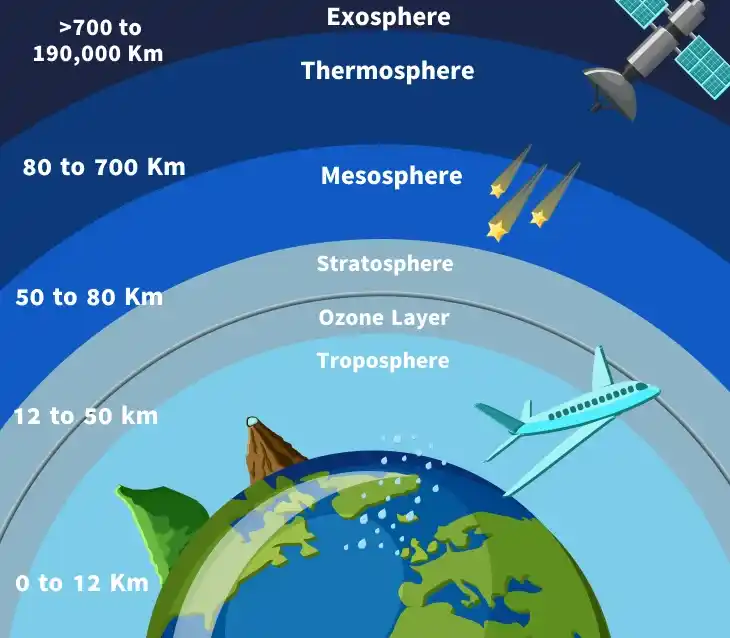
The ozone layer is a crucial part of Earth’s atmosphere that protects all living organisms from the harmful effects of solar radiation. It is a region rich in ozone (O₃) molecules, located mainly in the stratosphere, about 15–35 km above the Earth’s surface. Despite being very thin, this layer plays a vital role in maintaining life on Earth.
Distribution and Occurrence of Ozone in the Atmosphere
- The ozone layer is a portion of the upper atmosphere that lies between 15 and 35 kilometers above the Earth's surface.
- It effectively filters out most harmful ultraviolet (UV) radiation and other types of radiation that can harm or kill most living things.
- Peak ozone concentrations are seen at altitudes of 20-25 km. Atmospheric transport activities in the middle and high latitudes contribute to the lower height of the peak-concentration zone in the high latitudes. It also occurs as the tropopause height decreases.
- The majority of the surviving ozone is found in the Stratosphere.
- Interactions between some contaminants, bright sunshine and high temperatures frequently cause near-surface ozone. It's one of the main ingredients of photochemical smog, a problem that affects many cities and suburbs around the world, especially in the summer.
Formation of the Ozone Layer
The formation of ozone occurs through photochemical reactions:
1. UV rays split oxygen molecules
O₂ → O + O
2. Free oxygen atoms combine with O₂
O + O₂ → O₃
This continuous cycle ensures the presence of ozone in the stratosphere.
Ozone Hole
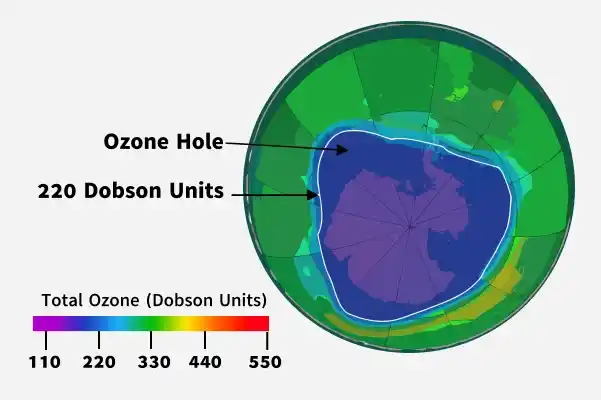
- The stratospheric ozone hole is a region of exceptionally depleted ozone in the stratosphere over the Antarctic, which occurs during the beginning of spring (August - October) in the Southern Hemisphere.
- In the area of the ozone hole, the ozone column values amount to 220 Dobson units.
- The ozone hole, a far more important springtime drop in stratospheric ozone in Earth's polar regions, is also brought on by ozone depletion.
- Concern over increasing cancer risks and other harmful effects due to ozone depletion and the ozone hole has spread throughout the world.
Properties
- Ozone has a distinct odor.
- It is toxic at high concentrations and even at low levels, it can irritate lungs.
- When the concentration exceeds roughly 100 ppm, breathing becomes difficult, causing headaches and nausea.
- It is a powerful oxidizing agent because it easily liberates atoms of nascent oxygen.
- Because nitrogen oxides react swiftly with ozone, it's possible that nitrogen oxides produced by supersonic jet aircraft exhaust systems are steadily lowering the ozone layer's concentration.
Uses of Ozone
- It's a disinfectant, germicide, and water sterilizer all rolled into one.
- It's used to bleach oils, ivory, and other materials.
- Ozone is used in water treatment plants that don't have filtration.
- Several ozone-depleting chemicals have refrigerant qualities, meaning they can easily transfer heat from one place to another.
