

Deuteromycetes are commonly known as imperfect fungi because their sexual stage is absent or unknown. Only asexual reproduction is observed in this group. When their sexual stage is discovered, they are usually transferred to Ascomycetes or Basidiomycetes.
- Their mycelium is branched and septate, unlike that of Phycomycetes.
- They are either saprophytic or parasitic.
- They hold great economic importance.
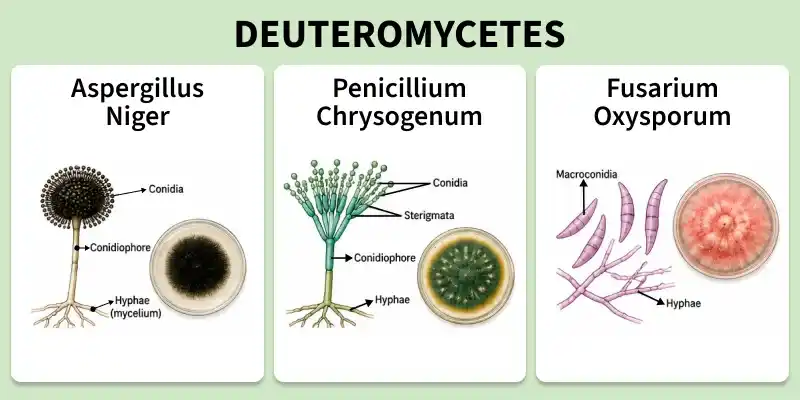
Features of Deuteromycetes
- Deuteromycetes are saprophytes on a wide range of substrates, but a large number of these fungi are parasites on plants and animals. It causes a variety of diseases.
- The mycelium has well-developed, profusely branched, and septate hyphae possessing multinucleate cells and simple pore septa.
- The hyphae may be intercellular or intracellular, and their cell wall chiefly contains chitin-glucan.
- They exhibit only an asexual mode of reproduction in various ways, like hyphal fragments, budding, arthrospores, chlamydospores, or most commonly, conidia
- They do not exhibit sexual reproduction, but a parasexual cycle generally operates in their life to fulfil the requirements of sexual reproduction.
- Deuteromycetes play a vital role in the decomposition of organic matter and bring about the recycling of nutrients in nature.
- The fermentation industry is highly dependent on Deuteromycetes because of the essential chemicals they produce.
- Some Deuteromycetes fungi are medicinally very important. They are used in the synthesis and conversion of steroids, which are of great significance in pharmaceuticals.
- Deuteromycetes produce a variety of toxins in foods, feeds, and grains in storage. Some of these toxins are carcinogenic.
- These fungi are serious pathogens and are responsible for causing a variety of plant and animal diseases.
Reproduction in Deuteromycetes
- The fungi that lack sexual reproduction are classified under Deuteromycetes. They exhibit only an asexual mode of reproduction and some parasexual modes as well.
- Commonly, this group of fungi is known as the “imperfect fungi” as they are unable to produce spores through sexual reproduction. Fission, budding, and conidia formation are some common methods of asexual reproduction in these fungi.
- Fission is a type of asexual reproduction in which a single cell divides into two or more daughter cells. This process happens either through binary fission, where the cell divides into two equal parts, or by multiple fission, where the cell divides into multiple parts.
- Budding is a type of asexual reproduction where a small outgrowth, i.e. the bud, forms on the surface of a parent cell. The bud then separates from the parent cell and grows into a new, independent cell.
- Conidia formation is a type of asexual reproduction where a small, spore-like structure called a conidium is produced. Conidia can be spread by wind or water and can germinate to form new fungal colonies.
Deuteromycetes as Pathogens
- Deuteromycetes fungi are a diverse group of fungi that can be found in a variety of habitats, including soil, water, and plants. Some species of Deuteromycetes are pathogenic and can cause diseases in humans, animals, and plants.
- Some of the most common human infections caused by Deuteromycetes fungi are candidiasis (thrush), aspergillosis (fungal infection of the lungs), and histoplasmosis (fungal infection of the lungs).
- Deuteromycetes fungi can cause infections by invading the body and colonising the tissues. They can also produce toxins that can damage the tissues.
- Some of the common symptoms of Deuteromycetes fungal infections are fever, coughing, chest pain, and shortness of breath.
- The treatment of Deuteromycetes fungi is with a range of antifungal medications. These medications work by either killing the fungi or stopping them from multiplying.
- A large number of Deuteromycetes fungi are serious plant pathogens and are responsible for causing a variety of plant diseases resulting in great economic losses.
- Deuteromycetes produce a variety of toxins in foods, feeds, and grains in storage. Some of these toxins are carcinogenic.
Reason for Deuteromycetes being called the Imperfect Fungi
Deuteromycetes are called imperfect fungi because only their vegetative or asexual reproductive methods are known. When their sexual stages were discovered, they were rightly moved to different classes, such as ascomycetes or basidiomycetes. When linkage was discovered, these fungi were correctly identified and moved out of Deuteromycetes. They are known as the fungi imperfecti, because of their “imperfecti” lack of sex.
