

Cytokinins are a group of naturally occurring plant hormones that promote cell division, growth, and differentiation in plants.
- Regulates various physiological processes, including cell division, shoot formation, delaying senescence, and nutrient mobilization.
- Controls overall plant growth and development by interacting with other plant hormones such as auxins and gibberellins.
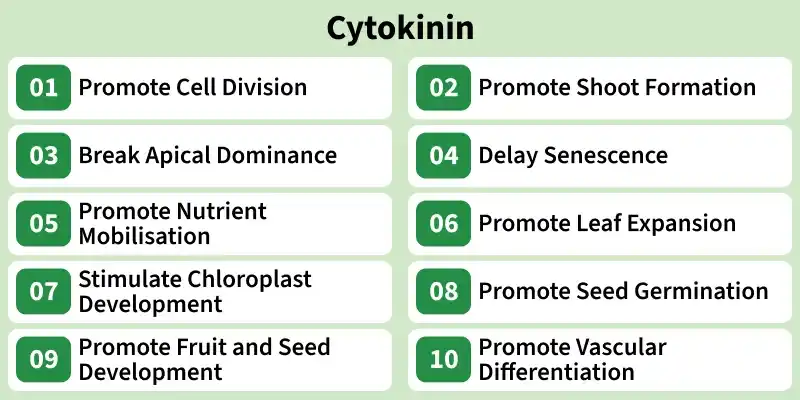
1. Promote Cell Division
- The most important function of cytokinins is the stimulation of cell division.
- Activate the process of cytokinesis, which involves the division of the cytoplasm following nuclear division.
- They promote the formation of new cells and contribute to the growth of plant tissues and organs.
- This property is particularly important in meristematic regions where active growth occurs.
2. Promote Shoot Formation
- Stimulate the development of shoots and lateral buds.
- When present in appropriate concentrations, they encourage the formation of shoot primordia and promote branching.
- In tissue culture, high concentrations of cytokinins relative to auxins favour shoot development.
- This property is widely used in micropropagation and plant tissue culture techniques.
3. Break Apical Dominance
- Apical dominance is the phenomenon in which the terminal bud suppresses the growth of lateral buds.
- Counteract the effect of auxins responsible for apical dominance and stimulate the growth of lateral buds.
- As a result, plants develop more branches and become bushier.
- This function contributes to improved canopy development and increased productivity in many crops.
4. Delay Senescence
- One of the most important functions of cytokinins is the delay of senescence or ageing.
- Maintain chlorophyll content, protein synthesis, and metabolic activity in leaves for longer periods.
- As a result, leaves remain green and functional for an extended time.
- This effect is often referred to as the Richmond-Lang effect.
- The delay in senescence allows plants to continue photosynthesis and nutrient production for a longer duration.
5. Promote Nutrient Mobilisation
- Facilitate the movement of nutrients from older tissues to actively growing regions.
- They enhance the transport of amino acids, sugars, minerals, and other nutrients to developing shoots, leaves, flowers, and fruits.
- This nutrient mobilisation supports growth and improves overall plant vigour.
6. Promote Leaf Expansion
- Stimulate cell division and enlargement in developing leaves.
- As a result, leaves become larger and possess greater photosynthetic capacity.
- Enhanced leaf growth contributes to increased food production within the plant.
7. Stimulate Chloroplast Development
- Promote the formation and development of chloroplasts in plant cells.
- They stimulate chlorophyll synthesis and increase photosynthetic efficiency.
- This function is particularly important in young leaves and developing tissues.
8. Promote Seed Germination
- Cytokinins help stimulate seed germination in certain plant species.
- They activate metabolic processes and enzyme systems required for embryo growth and seedling development.
- In some cases, cytokinins work together with gibberellins to overcome dormancy and promote germination.
9. Promote Fruit and Seed Development
- Contribute to the growth and development of fruits and seeds.
- They stimulate cell division in developing fruits, leading to increased fruit size and improved yield.
- Developing seeds are also important sites of cytokinin production.
10. Promote Vascular Differentiation
- Participate in the differentiation of vascular tissues such as xylem and phloem.
- They help regulate the formation of conducting tissues necessary for the transport of water, minerals, and food throughout the plant.
Characteristics of Cytokinin Hormones
- Growth-promoting plant hormones that stimulate cell division in plant tissues.
- Synthesised mainly in root tips and developing organs.
- Promote shoot growth, bud development, and organ formation in association with auxins.
- Delay senescence and facilitate nutrient mobilisation within plants.
Commercial Uses of Cytokinins
- Used in plant tissue culture and micropropagation to stimulate cell division and shoot formation.
- Delay senescence in cut flowers, leafy vegetables, and ornamental plants, thereby extending shelf life.
- Improve crop growth and productivity by promoting shoot development and nutrient mobilisation.
- Increase fruit size and improve fruit quality in certain crops.
- Encourage lateral bud growth and branching, producing bushier and more productive plants.
