

The Calvin cycle is a series of light-independent reactions in photosynthesis, in which carbon dioxide is converted into carbohydrates within the chloroplasts of plants. Utilising ATP and NADPH from the light-dependent reactions, it operates in the chloroplast's stroma. This cycle, named after Melvin Calvin, is essential for energy storage and growth, underpinning the food supply and oxygen production vital for life on Earth.
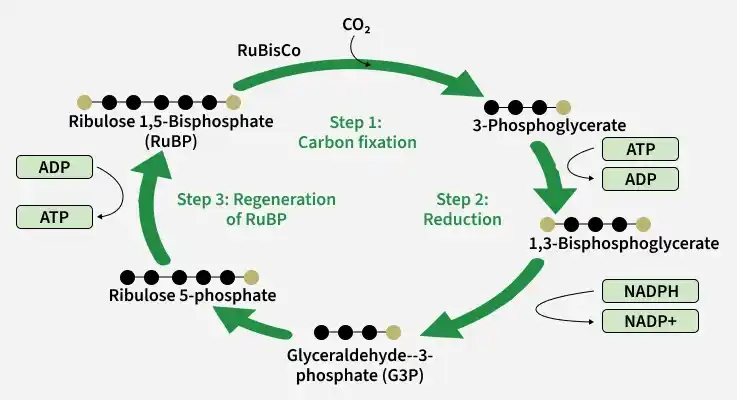
For every three turns of the cycle, one G3P molecule is produced, and the cycle continues. The regeneration phase rearranges molecules to reform ribulose bisphosphate, preparing for more carbon fixation. The Calvin Cycle stores light energy in carbohydrates, mainly starch and sucrose.
Phases of Calvin Cycle
The Calvin cycle begins with carbon fixation, where Carbon dioxide combines with ribulose 1,5-bisphosphate (RuBP) to form an unstable six-carbon compound, which immediately breaks down into two molecules of 3-phosphoglycerate (3-PGA). Reduction follows, utilising ATP and NADPH to convert 3-phosphoglycerate into glyceraldehyde-3-phosphate (G3P). It is divided into three stages:
1. Carbon Fixation
- The primary stage involves carbon fixation, where carbon dioxide combines with ribulose bisphosphate (RuBP) to form phosphoglycerate.
- The enzyme involved in the reaction is ribulose bisphosphate carboxylase/oxygenase (RuBisCO). RuBisCO is an enzyme present in the stroma of chloroplasts and is considered one of the most abundant proteins on Earth.
2. Reduction
- In the second stage, during the reduction phase, 3-phosphoglycerate (3-PGA) is converted into glyceraldehyde-3-phosphate (G3P) using ATP and NADPH.
- ATP and NADPH, products of the light-dependent reaction, provide the energy for this stage, converting solar energy into long-term storage components.
3. Regeneration
- The third stage involves a complex process that requires ATP.
- In the regeneration phase of the Calvin cycle, most of the glyceraldehyde-3-phosphate (G3P) molecules are used to regenerate ribulose 1,5-bisphosphate (RuBP).
- Through a series of enzymatic reactions, G3P is converted into ribulose 5-phosphate. ATP provides energy for the conversion of ribulose 5-phosphate into RuBP.
- The regenerated RuBP again acts as the carbon dioxide acceptor, allowing the Calvin cycle to continue.
Final Products of Calvin Cycle
- At each turn of the Calvin Cycle, one carbon molecule is fixed.
- Every three rotations of the Calvin Cycle result in the production of one molecule of glyceraldehyde-3-phosphate.
- Two glyceraldehyde-3-phosphate molecules combine to generate a single glucose molecule.
- For the fixation of one molecule of carbon dioxide, the Calvin cycle consumes 3 ATP molecules and 2 NADPH molecules.
- The synthesis of one glucose molecule involves the consumption of 18 ATP and 12 NADPH.
Key Points on C3 Cycle
- The Calvin cycle is also called the C3 cycle because the first stable product formed during carbon fixation is a three-carbon compound, 3-phosphoglycerate.
- The C3 cycle, also known as the Calvin Cycle, begins with the fixation of carbon dioxide by ribulose bisphosphate (RuBP) using the enzyme RuBisCO.
- ATP and NADPH reduces 3-Phospoglycerate to Glyceraldehyde-3-phosphate in the second stage of the C3 cycle. After that, ATP and NADPH are transformed to ATP and NADP+.
- Some G3P molecules are used to regenerate RuBP, ensuring the continuity of the cycle, and two G3P molecules combine to produce one glucose molecule.
- The ultimate goal of the C3 cycle is to convert carbon dioxide into organic molecules, particularly carbohydrates, which serve as energy storage for the plant.
