

A number is a collection of digits in a specific order. Numbers can be created with or without digit repetition.
Solved Examples
Question 1: When a number is divided by 35, 45, and 55, it leaves remainders 18, 28, and 38, respectively. Find the smallest such number?
Solution:
Let the required number be N.
• Find the difference between each divisor and its corresponding remainder:
35 − 18 = 17
45 − 28 = 17
55 − 38 = 17• Since the difference is the same in each case, N + 17 will be divisible by 35, 45, and 55.
• Find the LCM of the divisors:
LCM(35, 45, 55) = 3465• Therefore,
N + 17 = 3465
N = 3465 − 17
N = 3448Hence, the smallest required number is 3448.
Question 2: How many four-digit numbers are divisible by 7?
Solution:
- Smallest four-digit number = 1000.
Divide: 1000 ÷ 7 ≈ 142.857
Next integer = 143, so first multiple = 143 × 7 = 1001
- Largest four-digit number = 9999.
Divide: 9999 ÷ 7 ≈ 1428.428
Integer part = 1428, so last multiple = 1428 × 7 = 9996So the sequence is: 1001, 1008, 1015, …, 9996
Sequence properties
- First term a1 = 1001
- Last term an = 9996
- Common difference d = 7
Find the number of terms using the formula: an = a1 + (n − 1)d
- 9996 = 1001 + (n − 1)⋅7
- 9996 − 1001 = (n − 1)⋅7
- 8995 = (n − 1)⋅7
- n−1 = 8995/7 = 1285
- n = 1286
The number of four-digit numbers divisible by 7 is 1286
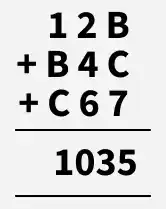
Question 3: What would be the maximum value of 'B' in the following equation :
Solution:
Only the leftmost part of the number can be of two or more digits. So, we split the answer as :
1 2 B
+ B 4 C
+ C 6 7
--------
10 3 5
--------Now, from column 1, we can easily infer that B + C = 8.
First, let us consider B + C = 18. This is the case possible if and only if B = C = 9. So, the equation would be 129 + 949 + 967 = 2045, but we need 1035 as the answer. Thus, this is not the required case.
So, B + C = 8. For maximum 'B', we put C = 0. Therefore, B = 8.
Now, to verify our answer, we put B = 8 and C = 0 in the given equation.1 2 8
+ 8 4 0
+ 0 6 7
--------
10 3 5
--------Therefore, our answer B = 8 is correct.
Question 4: Which of the following are prime numbers?
(i) 247
(ii) 397
(iii) 423
Solution:
(i) 162 = 256 > 247. Prime numbers less than 16 are 2, 3, 5, 7, 11, 13 and 247 is divisible by 13. Therefore, 247 is not a prime number. It is a composite number.
(ii) 202 = 400 > 397. Prime numbers less than 20 are 2, 3, 5, 7, 11, 13, 17, 19 but 397 is not divisible by any of these. Therefore, 397 is a prime number.
(iii) 212 = 441 > 423. Prime numbers less than 21 are 2, 3, 5, 7, 11, 13, 17, 19 and 423 is divisible by 3. Therefore, 423 is not a prime number. It is a composite number.
Question 5: Find the unit's digit in the product (17)153 x (31)62.
Solution:
To find the unit’s digit, consider only the unit digits of the bases:
- Unit digit of 17 = 7
- Unit digit of 31 = 1
So, the problem reduces to finding the unit digit of 7153 x 162.
Step 1: Observe the pattern of unit digits of powers of 7
7¹ → unit digit 7
7² → unit digit 9
7³ → unit digit 3
7⁴ → unit digit 1The pattern repeats every 4 powers: 7, 9, 3, 1.
Step 2: Divide the exponent by 4
153 ÷ 4 = 38 remainder 1.
So, the unit digit of 7¹⁵³ will be the same as the unit digit of 7¹, which is 7.
Step 3: Find the unit digit of 1⁶²
Any power of 1 always has unit digit 1.
Step 4: Multiply the unit digits
7 × 1 = 7
Therefore, the unit digit of the product is 7.
Question 6: Find the unit's digit in (17)153 + (31)62.
Solution:
To find the unit's digit of 17153+3162,
we only need the unit's digits of the powers.
The unit digit of 17153 is the same as that of 7153.
- The unit digits of powers of 7 repeat every 4: 7, 9, 3, 1
- Since 153 ≡ 1(mod4), the unit digit is the first in the cycle: 7153 ends in 7.
The unit digit of 3162 is the same as that of 162, which is always: 1
Now add the unit digits: 7+1 = 8.
Answer: 8.
Question 7: Find the total number of prime factors in the expression (14)11 x (7)2 x (11)3.
Solution:
(14)11 x (7)2 x (11)3 = (2 x 7)11 x (7)2 x (11)3 = (2)11 x (7)11 x (7)2 x (11)3 = (2)11 x (7)13 x (11)3
Therefore, total number of prime factors = 11 + 13 + 3 = 27
Question 8: Which digits should come in place of * and # such that the number 12386*# is divisible by both 8 and 5?
Solution:
Since the given number should be divisible by 5, 0 or 5 must come in place of #. But, a number ending with 5 is never divisible by 8. So, 0 will replace #.
Now, any number is divisible by 8 if its last three digits form a number divisible by 8. The number formed by the last three digits is 6*0, which becomes divisible by 8, if * is replaced by 0 or 4 or 8.
Hence, digits in place of * can be 0 or 4 or 8 respectively.
Question 9: What is the least number that must be subtracted from 9999 to make it exactly divisible by 19?
Solution:
On dividing 9999 by 19, we get 5 as remainder. Therefore, number to be subtracted = 5.
Question 10: What is the least number that must be added to 9999 to make it exactly divisible by 19?
Solution:
On dividing 9999 by 19, we get 5 as remainder. Therefore, number to be added = 19 - 5 = 14.
Question 11: A number when divided by 340 gives a remainder of 47. What would be the remainder when the same number is divided by 17?
Solution:
The number is of the form 340a + 47 = 17 * (20a) + 17 * (2) + 13 = 17 * (20a + 2) + 13.
Therefore, on dividing this number by 17, we would get 13 as the remainder.
Question 12: Find the remainder when 321 is divided by 5.
Solution:
34 = 81. So, the unit's digit of 34 is 1.
Therefore, the unit's digit of 320 = 1 and thus, the unit's digit of 321 = 1*3 = 3.
3 when divided by 5 gives 3 as the remainder.
So, the remainder when 321 is divided by 5 is 3.
Also Check
Quiz: Practice Quiz on Numbers
