

Java Microservices interview questions are commonly asked to evaluate your understanding of microservices architecture, Spring Boot, Spring Cloud, REST APIs, service communication, and deployment strategies. This collection covers the most important questions to help you prepare for coding and technical interviews.
- Covers the most frequently asked Java Microservices interview questions with concise answers.
- Suitable for both freshers and experienced professionals preparing for technical interviews.
Table of Content
Java Beginner Microservices Interview Questions
1. What are Microservices?
Microservices is an architectural style in which an application is divided into multiple small, independent, and loosely coupled services. Each service performs a specific business function and communicates with other services using lightweight protocols such as HTTP/REST, gRPC, or messaging systems like Kafka or RabbitMQ.
- Services can be developed, deployed, and scaled independently.
- Supports different programming languages and databases.
- Improves maintainability and fault isolation.
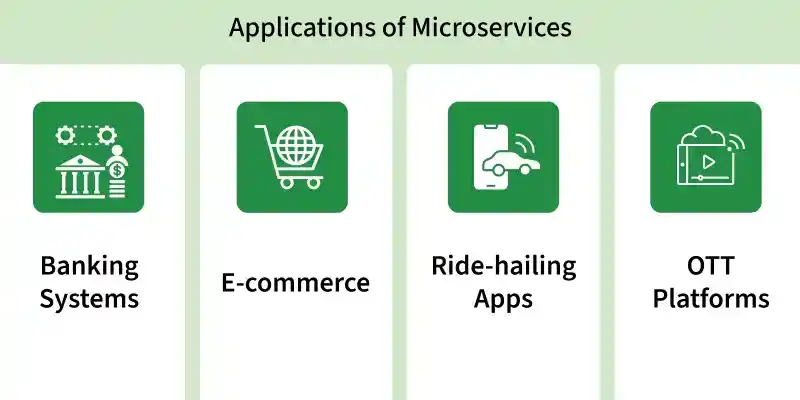
2. Why are Microservices used?
Microservices are used to simplify the development, deployment, and maintenance of large applications by dividing them into smaller independent services.
Some Advantages are:
- Faster development and deployment.
- Independent scaling of services.
- Easier maintenance.
- Supports Continuous Integration and Continuous Deployment (CI/CD).
3. What is the difference between Monolithic and Microservices Architecture?
Monolithic architecture builds the entire application as a single unit, whereas Microservices architecture divides the application into multiple independent services.
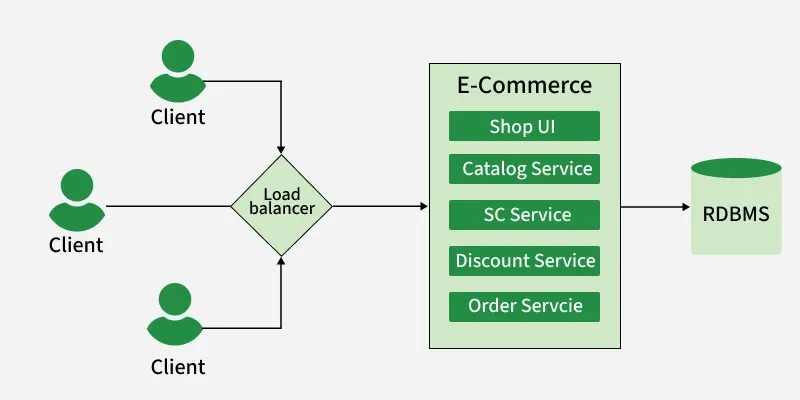
Monolithic Architecture
It is a software architecture where the entire application is developed and deployed as a single, unified unit. All components such as the user interface, business logic, and database access are tightly coupled within one codebase.
- All application modules are packaged and deployed together.
- A change in one module usually requires redeploying the entire application.
- Best suited for small and simple applications.
Microservices Architecture
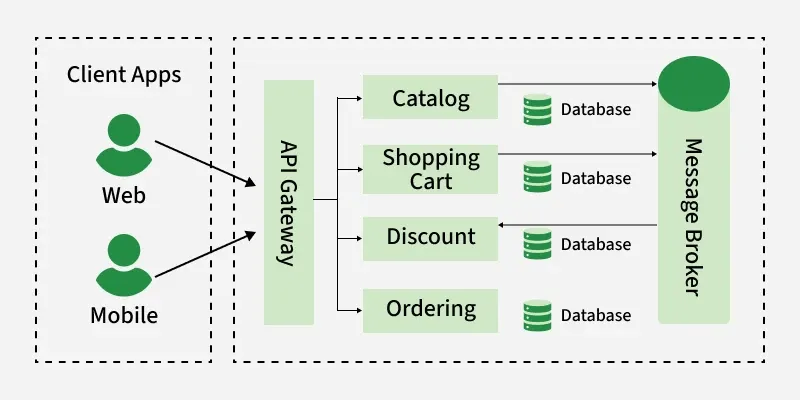
It is a software architecture where an application is divided into multiple small, independent services. Each service is responsible for a specific business functionality and communicates with other services through APIs.
- Each service is developed, deployed, and scaled independently.
- Services are loosely coupled and focus on a single business capability.
- Best suited for large, complex, and scalable applications.
4. What is REST API in Microservices?
A REST API (Representational State Transfer API) is the most common way for microservices to communicate over HTTP. It uses standard HTTP methods to perform operations on resources.
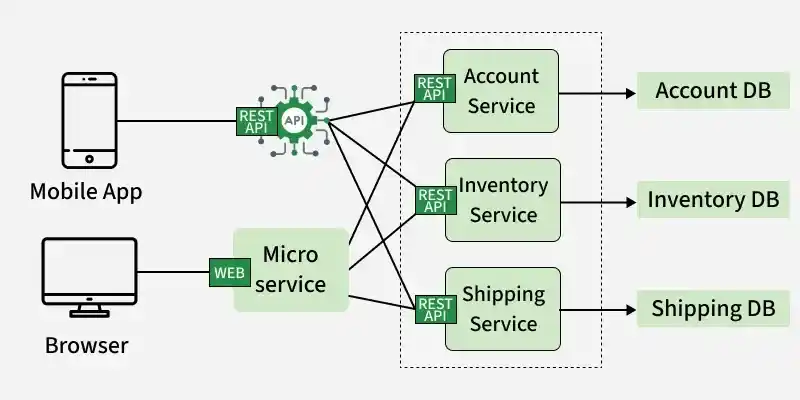
Common HTTP Methods
- GET: Retrieve data.
- POST: Create new data.
- PUT: Update existing data.
- DELETE: Remove data.
- PATCH: Partially update data.
5. What are the main components of a Microservices Architecture?
A Microservices architecture consists of several components that work together to build distributed applications.
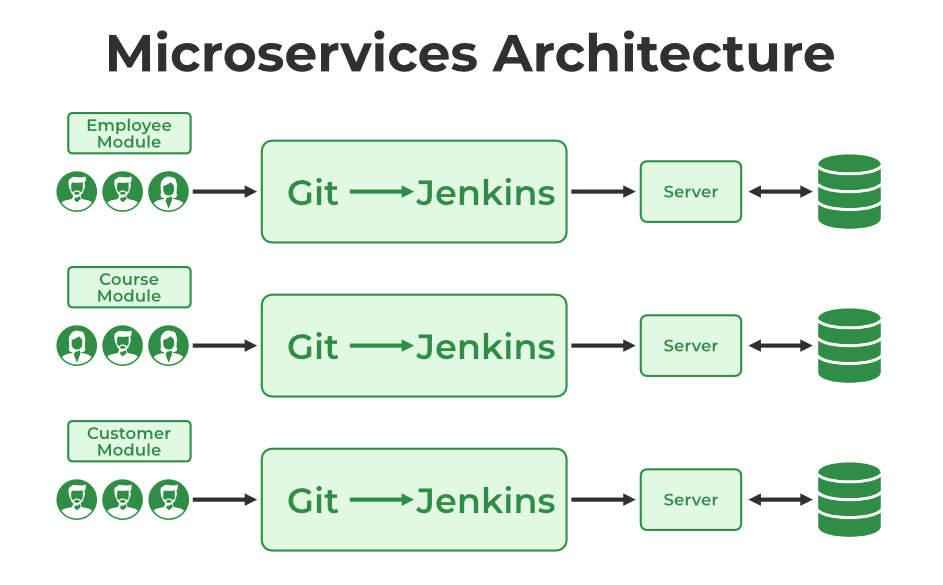
- Each module (Employee, Course, Customer) is an independent microservice.
- Git stores the source code for each service.
- Jenkins automatically builds, tests, and deploys the services (CI/CD).
- Each service runs on its own server/container.
- Every microservice has its own database, ensuring loose coupling and independent data management.
- Services can be developed, deployed, updated, and scaled independently.
6. Why is Spring Boot widely used for Microservices?
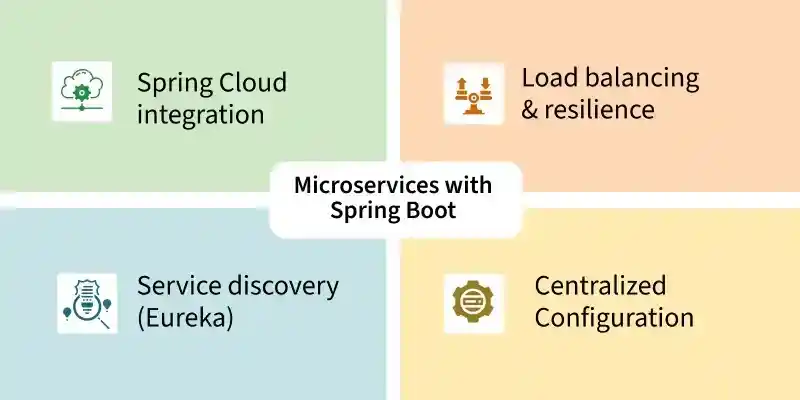
Spring Boot is the most popular Java framework for developing microservices because it minimizes configuration and provides production-ready features.
Advantages of it
- Auto Configuration
- Embedded Web Server
- Starter Dependencies
- Easy REST API development
- Spring Cloud integration
- Built-in Actuator support
7. What is Eureka Server ?
Eureka Server is a service registry provided by Spring Cloud Netflix that enables service discovery in a microservices architecture. It allows microservices to register themselves and discover other services dynamically without hardcoding their IP addresses or URLs.
- Enables automatic service discovery.
- Eliminates hardcoded service URLs.
- Supports dynamic scaling and load balancing.
8. What are the advantages of Microservices over Monolithic Architecture?
Microservices provide greater flexibility, scalability, and maintainability by dividing an application into small independent services.
Advantages
- Independent development and deployment.
- Faster release cycles.
- Better scalability.
- Improved fault isolation.
- Easier maintenance and testing.
- Supports different technologies and databases.
9. What is Inter-Service Communication?
Inter-Service Communication is the process through which microservices communicate with each other to exchange data and perform business operations.
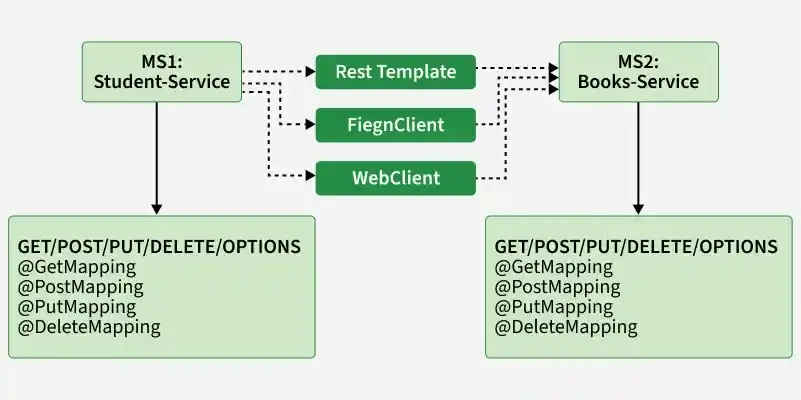
Common Communication Methods
- REST APIs
- OpenFeign
- gRPC
- Apache Kafka
- RabbitMQ
10. What does stateless mean in the context of microservices?
A stateless microservice does not store client session or request data between requests. Each request is processed independently and contains all the information needed to complete it.
- Makes services scalable and fault-tolerant.
- Easier to deploy and load balance.
11. What is an API Gateway?
An API Gateway acts as the single entry point for all client requests in a microservices architecture. It forwards requests to the appropriate microservice and provides common functionalities.
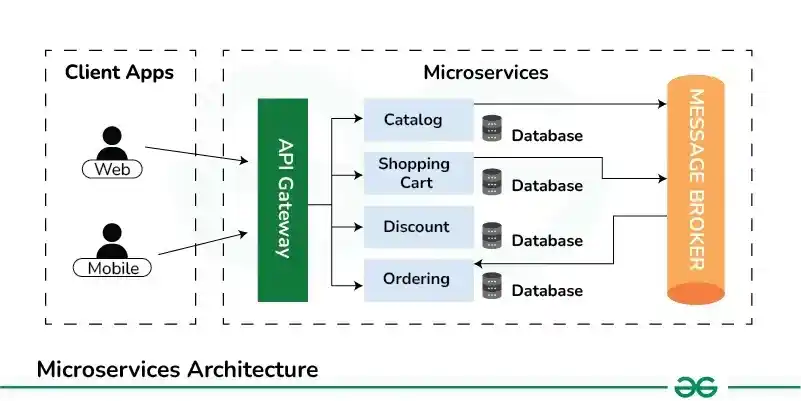
Responsibilities
- Request routing.
- Authentication and Authorization.
- Load balancing.
- Rate limiting.
- Logging and monitoring.
12. What is Synchronous and Asynchronous Communication in Microservices?
Microservices communicate either synchronously or asynchronously depending on business requirements.
| Feature | Synchronous Communication | Asynchronous Communication |
|---|---|---|
| Communication | Immediate request-response | Message-based communication |
| Coupling | Tightly coupled | Loosely coupled |
| Response | Waits for response | Does not wait for response |
| Protocols | REST, gRPC | Kafka, RabbitMQ |
| Performance | Slower under heavy load | Better scalability and performance |
13. What is the difference between Stateless and Stateful Microservices?
A Stateless microservice does not store client session data between requests, whereas a Stateful microservice maintains session or user state across multiple requests.
| Feature | Stateless Microservice | Stateful Microservice |
|---|---|---|
| Session Data | Does not store session data | Stores session data |
| Request Handling | Each request is independent | Requests depend on previous interactions |
| Scalability | Easy to scale | More difficult to scale |
| Fault Tolerance | High | Lower |
| Example | REST APIs | Online shopping cart, gaming session |
14. What is the Database-per-Service Pattern?
The Database-per-Service Pattern is a microservices design pattern in which each microservice owns and manages its own dedicated database. Other services cannot access this database directly and must communicate through APIs or events.
- Prevents direct database sharing between services.
- Enables independent scaling and technology choices.
- Communication occurs through REST APIs, gRPC, or messaging.
15. Why should each Microservice have its own Database?
Each microservice should have its own database to maintain data ownership, loose coupling, and independent scalability. Sharing a database creates tight coupling and reduces the independence of services.
- Improves fault isolation.
- Enables independent deployment and scaling
- Prevents unintended data modifications by other services.
16. What are the common communication protocols used in Microservices?
Microservices communicate using synchronous or asynchronous protocols depending on the application's requirements.
| Protocol | Purpose |
|---|---|
| REST (HTTP/HTTPS) | Simple request-response communication between services. |
| gRPC | High-performance communication using Protocol Buffers. |
| Apache Kafka | Event streaming and asynchronous messaging. |
| RabbitMQ | Reliable message queuing between services. |
| WebSockets | Real-time, bidirectional communication. |
Note: REST and gRPC are used for synchronous communication, while Kafka and RabbitMQ are preferred for asynchronous, event-driven communication.
17. What are the Challenges of Microservices?
Although microservices improve scalability and flexibility, they introduce additional complexity in managing distributed systems.
Common Challenges
- Managing communication between multiple services.
- Ensuring data consistency across services.
- Increased deployment and operational complexity.
- Monitoring, logging, and distributed tracing.
- Handling network latency and failures.
- Managing security and authentication across services.
18. What is Load Balancing in Microservices?
Load Balancing is the process of distributing incoming requests across multiple instances of a microservice to improve performance, availability, and reliability.
- Prevents server overload.
- Improves scalability and fault tolerance.
- Ensures high availability by routing requests to healthy instances.
- Can be Client-Side (Spring Cloud LoadBalancer) or Server-Side (Nginx, HAProxy).
Java Intermediate Microservices Interview Questions
19. What is Centralized Configuration?
Centralized Configuration is a mechanism where the configuration of all microservices is stored and managed from a single centralized location instead of maintaining separate configuration files for each service.
Advantages
- Supports multiple environments (Dev, Test, Production).
- Ensures configuration consistency across services.
- Allows configuration updates without rebuilding applications.
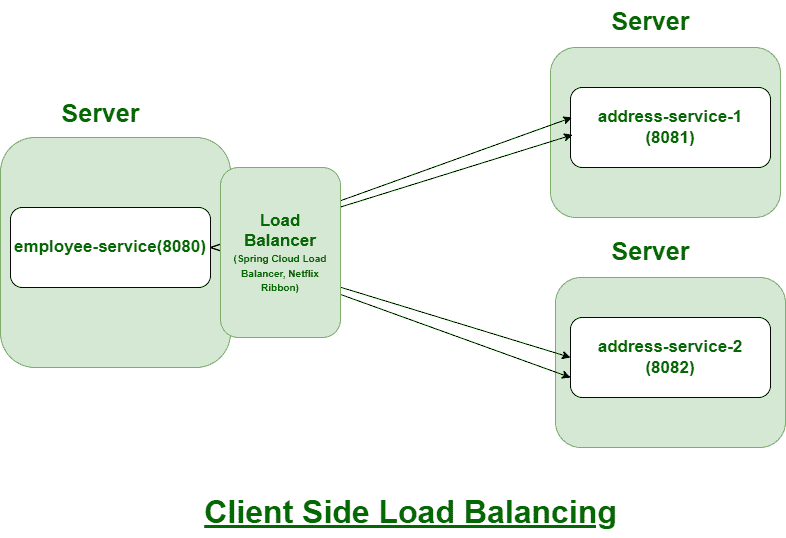
20. What is Client-Side Load Balancing?
Client-side load balancing distributes requests among multiple instances of a microservice. The client selects an available service instance using a load-balancing algorithm before sending the request.
- Improves application availability.
- Distributes traffic evenly.
- Prevents server overload.
- Commonly implemented using Spring Cloud LoadBalancer.
21. How does Spring Cloud Config work?
Spring Cloud Config provides a centralized configuration server that stores application properties in a Git repository and supplies them to microservices at startup or runtime.
Working
- Configuration files are stored in a Git repository.
- Config Server reads the configuration from Git.
- Microservices request their configuration from the Config Server.
- Configurations can be refreshed without restarting the application.
Advantages
- Centralized configuration management.
- Supports version control through Git.
- Simplifies environment-specific configuration.
22. What is Fault Tolerance in Microservices?
Fault Tolerance is the ability of a microservices system to continue functioning even when one or more services fail. It prevents cascading failures.
- Improves application availability.
- Enables graceful degradation.
- Achieved using retries, circuit breakers, fallback methods, and load balancing
23. What is the Circuit Breaker Pattern?
The Circuit Breaker Pattern prevents repeated calls to a failing service by temporarily stopping requests until the service becomes healthy again.
Working States
- Closed: Requests are allowed.
- Open: Requests are blocked because failures exceeded the threshold.
- Half-Open: A few requests are allowed to check if the service has recovered.
Benefits of Circuit Breaker Pattern
- Prevents cascading failures.
- Improves fault tolerance.
- Enables faster system recovery
24. What is Resilience4j?
Resilience4j is a lightweight Java library used to implement fault tolerance in microservices.
- Circuit Breaker-> Prevents repeated calls to a failing service.
- Retry –> Automatically retries failed requests before reporting an error.
- Rate Limiter –> Limits the number of requests allowed in a given time period.
- Bulkhead –> Isolates resources to prevent one service failure from affecting others.
- Time Limiter –> Sets a maximum time limit for service execution.
- Fallback Support –> Provides an alternative response when a service fails.
25. What is Distributed Tracing?
Distributed Tracing tracks a request as it travels across multiple microservices, helping identify delays and failures.
Benefits
- Tracks end-to-end request flow.
- Simplifies debugging.
- Measures service latency.
- Identifies performance bottlenecks.
Common Tools
- Zipkin
- Jaeger
- OpenTelemetry
26. Why is Docker used in Microservices?
Docker packages a microservice along with its dependencies into a lightweight container, ensuring consistent execution across different environments.
Advantages
- Consistent runtime environment.
- Simplifies deployment.
- Supports portability.
- Enables rapid scaling.
- Works seamlessly with Kubernetes.
27. Why is Kubernetes used in Microservices?
Kubernetes is a container orchestration platform used to deploy, manage, and scale containerized microservices automatically.
Advantages of Kubernetes
- Automatic scaling.
- Self-healing containers.
- Load balancing.
- Rolling updates and rollbacks.
- High availability.
28. How do Microservices communicate with each other?
Microservices communicate with each other using synchronous or asynchronous communication mechanisms over a network. The choice depends on the application's performance, scalability, and reliability requirements.
Types of communication
- Synchronous: Uses REST APIs (HTTP/HTTPS) or gRPC, where one service waits for a response.
- Asynchronous: Uses message brokers like Apache Kafka or RabbitMQ, where services exchange messages without waiting.
29. How do you monitor microservices effectively?
Microservices are monitored using tools that collect health information, metrics, logs, and distributed traces to ensure high availability and quickly identify issues.
- Use Spring Boot Actuator to expose health and monitoring endpoints.
- Collect metrics using Prometheus.
- Visualize metrics and dashboards using Grafana.
Common Monitoring Tools
- Spring Boot Actuator: Exposes health, metrics, and application information.
- Prometheus: Collects application metrics.
- Grafana: Visualizes metrics through dashboards.
- ELK Stack (Elasticsearch, Logstash, Kibana): Centralizes and analyzes logs.
- Zipkin / Jaeger: Provides distributed tracing across multiple microservices.
30. What are some common deployment strategies for microservices?
Deployment strategies define how new versions of microservices are released with minimal downtime and risk.
Common Deployment Strategies
- Blue-Green Deployment: Maintains two identical environments; traffic switches to the new version after successful testing.
- Canary Deployment: Releases the new version to a small percentage of users before a full rollout.
- Rolling Deployment: Gradually replaces old service instances with new ones.
- Recreate Deployment: Stops the old version completely before deploying the new version.
- A/B Testing: Routes different users to different versions to compare performance or features.
Benefits
- Minimizes downtime.
- Reduces deployment risk.
- Enables quick rollback if issues occur.
31. How do you manage configuration across microservices?
Configuration across microservices is managed using a centralized configuration server, allowing all services to access and share configuration from a single source.
- Supports multiple environments (Dev, Test, Production).
- Configuration can be updated without rebuilding applications (with refresh support).
Common Approaches
- Spring Cloud Config Server: Centralizes configuration for all microservices.
- Git Repository: Stores configuration files with version control.
- Environment Variables: Provides environment-specific settings (Dev, Test, Production).
- application.properties / application.yml: Defines service-specific configuration.
- Kubernetes ConfigMaps and Secrets: Manages configuration and sensitive data in Kubernetes deployments.
32. How do you test microservices?
Microservices are tested at different levels to ensure that each service works correctly both independently and when communicating with other services.
- Ensures reliable service communication.
- Improves application quality.
Types of Testing
- Unit Testing: Tests individual classes or methods (JUnit, Mockito).
- Integration Testing: Verifies interaction with databases, APIs, or other services.
- Contract Testing: Ensures communication between service providers and consumers (Spring Cloud Contract, Pact).
- End-to-End (E2E) Testing: Tests the complete business workflow across multiple microservices.
- Performance Testing: Evaluates scalability and response time under load (JMeter, Gatling).
33. What are the differences between REST, gRPC, and Message Queues?
| Feature | REST | gRPC | Message Queues |
|---|---|---|---|
| Communication | Synchronous | Synchronous | Asynchronous |
| Protocol | HTTP/HTTPS | HTTP/2 | Messaging Broker |
| Data Format | JSON/XML | Protocol Buffers | Messages/Events |
| Performance | Moderate | Very High | High |
| Best Use | Public APIs | Internal service communication | Event-driven systems |
| Examples | REST APIs | gRPC | Kafka, RabbitMQ |
Advanced Microservices Interview Questions
34. How do you decompose a monolithic application into microservices using DDD and Bounded Context?
A monolithic e-commerce application can be broken into independent microservices by dividing it based on business capabilities. Each microservice is responsible for a single business function, has its own database, and communicates with other services using REST APIs, gRPC, or message brokers (Kafka/RabbitMQ).
Role of Domain-Driven Design (DDD): Domain-Driven Design is a design approach that models software around business domains rather than technical layers.
It helps to:
- Define service boundaries.
- Reduce coupling between services.
- Improve maintainability and scalability.
Role of Bounded Context: A Bounded Context is a clearly defined boundary where a specific business model and terminology apply.
In microservices:
- Each Bounded Context usually becomes one microservice.
- Each service has its own business logic, database, and API.
- Services communicate only through APIs or events.
Example:
- Product Catalog-> Product Service
- Order Management-> Order Service
- Payment Processing-> Payment Service
35. What is the Saga Pattern?
The Saga Pattern is a design pattern used to manage distributed transactions across multiple microservices without using a global transaction. It breaks a transaction into a series of local transactions, where each service performs its own operation. If any step fails, compensating transactions undo the previous successful operations.
Types of Saga
- Choreography: Services communicate through events without a central coordinator.
- Orchestration: A central orchestrator coordinates all transaction steps.
Benefits
- Eliminates distributed locking.
- Improves scalability.
- Supports eventual consistency.
36. What is Eventual Consistency?
Eventual Consistency is a consistency model where all microservices become consistent over time after data changes are propagated asynchronously.
- Data synchronization happens through events.
- Improves scalability and availability.
- Commonly used with Kafka and RabbitMQ.
37. What are the Best Practices for designing Microservices?
Designing microservices correctly improves scalability, maintainability, and reliability.
Best Practices
- Follow the Single Responsibility Principle.
- Design services around business capabilities (DDD).
- Keep services loosely coupled and highly cohesive.
- Make services stateless whenever possible.
- Use Database-per-Service.
- Communicate through well-defined APIs or events.
- Implement centralized logging and monitoring
38. How do you secure Microservices?
Microservices are secured by protecting communication, authentication, authorization, and sensitive data.
Security Measures
- Authenticate users using OAuth2 or JWT.
- Authorize requests using Role-Based Access Control (RBAC).
- Secure communication with HTTPS/TLS.
- Protect APIs using an API Gateway.
- Store secrets using Kubernetes Secrets or Vault.
- Encrypt sensitive data.
- Enable logging and monitoring for security events.
39. What’s the difference between Event Sourcing and Traditional CRUD?
Event Sourcing stores every change as an immutable event, while Traditional CRUD stores only the latest state of the data.
| Feature | Event Sourcing | Traditional CRUD |
|---|---|---|
| Data Storage | Stores every state change as events | Stores only the current state |
| History | Complete audit trail available | Previous changes are overwritten unless audited separately |
| Data Recovery | Current state can be rebuilt by replaying events | Only current data is available |
| Performance | Better for audit/event-driven systems | Simpler and faster for basic CRUD applications |
| Complexity | More complex to implement | Easier to design and maintain |
| Best Use Cases | Banking, e-commerce orders, finance, event-driven systems | CRUD-based business applications like inventory, HR, CMS |
40. How do you manage schema evolution in event-driven systems?
Schema evolution is the process of modifying the structure of events over time without breaking existing producers or consumers.
How to Manage Schema Evolution
- Use Schema Registry: Store and manage event schemas centrally (e.g., Apache Avro Schema Registry).
- Maintain Backward Compatibility: New consumers should be able to read older events.
- Maintain Forward Compatibility: Older consumers should ignore newly added fields.
- Use Versioning: Assign schema versions to track changes and support multiple versions.
- Avoid Breaking Changes: Do not remove or rename existing fields; prefer adding optional fields.
- Use Serialization Formats: Use Avro, Protobuf, or JSON Schema for structured and versioned events.
- Test Compatibility: Validate schema changes before deployment to prevent consumer failures.
41. When should you use WebSockets instead of REST APIs in microservices? Explain the advantages and limitations.
WebSockets provide a persistent, two-way communication channel between the client and server. They are preferred over REST APIs when applications require real-time, low-latency communication.
Use WebSockets When
- Real-time chat and messaging applications.
- Live notifications and alerts.
- Online gaming.
- Stock market or cryptocurrency price updates.
- Live dashboards and collaborative applications.
Advantages
- Full-duplex (two-way) communication.
- Reduces repeated HTTP requests.
- Efficient for continuous real-time updates.
Limitations
- More complex to implement and scale.
- Persistent connections consume server resources.
- Not suitable for simple request-response operations.
