Quick Answer
Gemini pricing in 2026 spans four surfaces: a free tier in Google AI Studio, consumer subscriptions from $7.99/month (AI Plus) to $99.99/month (AI Ultra), and API access from $0.10 per million input tokens (Flash-Lite) to $2.00 per million (3.1 Pro). The catch: thinking tokens count as output tokens and get billed at output rates. Your actual bill will be higher than the pricing page suggests.
Google restructured Gemini pricing at I/O 2026 and the bill looks nothing like it did in 2025. Google AI Ultra dropped from $249.99 to $99.99/month. Gemini 3.5 Flash launched at $1.50/$9.00 per million tokens, undercutting the older 3.1 Pro by 25% while beating it on coding benchmarks. Pro models vanished from the free tier on April 1, 2026. And the billing system itself changed: Google introduced Prepay and Postpay plans starting March 23, 2026, replacing the old pay-as-you-go model.
If you last checked Google Gemini pricing in 2025, every number in this guide is new.
This article covers every Gemini API pricing tier, every Gemini model pricing rate, the subscription plans, the Vertex AI pricing difference, the thinking token trap, and how to track Gemini API cost at the team and feature level.
For anyone searching Google Gemini API pricing 2026 or asking how much does Gemini cost for production workloads, this is the definitive guide. For how Gemini AI pricing connects to broader AI spend and AI ROI, see CloudZero’s framework.
What do Gemini’s consumer subscription plans cost?
Google I/O 2026 restructured Gemini subscriptions into four tiers. The price cuts were aggressive enough that the audience clapped, which at a developer conference means the savings were real.
| Plan | Cost | What you get | Context window |
| Free (Google AI Studio) | $0 | Flash models only (Pro removed April 1, 2026). 5-15 RPM. Data used to improve Google products | Varies by model |
| Google AI Plus | $7.99/month | New entry tier. Access to Flash and some Pro features | Up to 1M |
| Google AI Pro | $19.99/month | Full Gemini 3.1 Pro access | 1M |
| Google AI Ultra | $99.99/month (cut from $249.99) | 5x Pro limits. 20 TB storage. Top tier: $200/month for 20x Pro limits | 1M+ |
The Ultra price cut from $249.99 to $99.99 is Google’s most aggressive subscription move in the AI era. For teams searching Gemini Advanced pricing or Gemini Advanced subscription cost, note that Google rebranded “Gemini Advanced” to “Google AI Ultra” in 2026.
The Gemini Advanced pricing 2026 is $99.99/month for the base Ultra tier and $200/month for the top tier with 20x Pro limits. Google Gemini Advanced pricing now starts lower than any previous tier. Google Gemini Pro pricing for the subscription is $19.99/month.
It signals that Google is competing with ChatGPT on price, not just capability. For how this compares to Claude pricing ($20/month for Pro), OpenAI pricing, and the full LLM API pricing comparison, see CloudZero’s guides.
Subscriptions cover consumer use. For teams building applications, the API is where the real spend happens.
Report
Finance needs to prove AI’s return: CloudZero report
260 senior finance leaders (more than half CFOs) told us why the speed of seeing AI spend, not the size of it, separates who pulls ahead on AI from who gets burned.
Gemini API pricing: the full 2026 model table
This is the table that saves you 30 minutes of navigating Google’s pricing page. All rates are per million tokens and paid tier.
| Model | Input/MTok | Output/MTok | Context | Notes |
| Gemini 3.5 Flash | $1.50 | $9.00 | 1M | Launched May 19, 2026. Best coding/agentic model |
| Gemini 3.1 Pro Preview | $2.00 | $12.00 | 2M | Highest capability. $4.00/$18.00 for prompts >200K |
| Gemini 3.1 Flash-Lite | $0.25 | $1.50 | 1M | Cost-efficient for high-volume agentic tasks |
| Gemini 3 Flash Preview | $0.50 | $3.00 | 1M | Mid-tier. Strong general-purpose model |
| Gemini 2.5 Pro | $1.25 | $10.00 | 1M | $2.50/$15.00 for prompts >200K tokens. Thinking tokens billed as output |
| Gemini 2.5 Flash-Lite | $0.10 | $0.40 | 1M | Cheapest Gemini model. High-volume budget tier |
Deprecation note: Gemini 2.0 Flash was shut down June 1, 2026. Gemini 2.5 Flash ($0.30/$2.50) is scheduled for deprecation on October 16, 2026. Gemini 2.0 Flash pricing is no longer relevant. Teams still on either model should migrate to Gemini 3 Flash Preview ($0.50/$3.00) or 3.1 Flash-Lite ($0.25/$1.50) immediately.
The 20x price spread between Flash-Lite ($0.10 input) and 3.1 Pro ($2.00 input) is Google’s answer to a question most teams do not ask early enough: “Does this task actually need the expensive model?” The Gemini pro cost at $2.00/$12.00 is justified for complex reasoning over 2M token contexts. For everything else, Gemini flash pricing starts at $0.10. (The engineer who defaults every call to Pro is the engineer whose finance team has questions in Q3.)
A note on Gemini 2.5 Flash pricing: at $0.30/$2.50, the 2.5 Flash model sits in a pricing sweet spot, but Google has signaled deprecation. Gemini 2.5 Pro API pricing at $1.25/$10.00 remains the most cost-effective thinking model until 3.5 Pro launches. Teams building on 2.5 Flash should plan migration to either Gemini 3 Flash Preview ($0.50/$3.00) or 3.5 Flash ($1.50/$9.00, more capable). Gemini 3 Flash pricing at $0.50/$3.00 is the natural successor for cost-sensitive workloads. Gemini 3 Pro pricing for the upcoming 3.5 Pro variant is not yet published, but keyword volume at 700/mo suggests enterprise teams are already searching for it.
For anyone asking does Gemini cost money: yes for production use, no for prototyping. The free tier in Google AI Studio is genuinely free with no credit card. But the moment your application needs more than 15 requests per minute or access to Pro models, you move to the paid tier. The total Gemini AI cost depends on which model, which tier (Standard, Batch, Flex, Priority), and how many thinking tokens the model burns behind the scenes.
What are thinking tokens, and why do they raise your Gemini bill?
Gemini 2.5 Pro and Gemini 3.1 Pro are thinking models. They reason before they respond. That reasoning generates thinking tokens. Those thinking tokens are billed as output tokens at output rates.
Here is why this matters for your Gemini cost estimate:
A straightforward prompt might generate 500 visible output tokens. But the model “thought” for 3,000 tokens before responding. Your bill shows 3,500 output tokens at $10.00/MTok (for 2.5 Pro), not 500. The thinking tokens are invisible in the response but fully visible on the invoice. On a complex reasoning task, thinking tokens can account for 70-85% of the total output bill.
For teams running Gemini Code Assist or Gemini CLI sessions (both new in 2026), thinking token costs compound across every code completion and terminal command. A 20-minute coding session can burn through millions of thinking tokens. This is the same pattern visible in Claude Code pricing and Claude Code agents, where agentic loops amplify token consumption by 3-5x.
The Google AI Developer forum has multiple threads from developers reporting unexpected cost spikes after migrating to thinking models. One developer reported daily costs jumping from a few thousand KRW to 150,000-200,000 KRW ($100-140 USD) despite decreased usage. The common thread: thinking tokens were not in the original cost model.
The fix: Google’s context caching charges cache reads at 10% of the base input price. For applications with long, repeating system prompts, caching cuts input costs by up to 90%. Cache storage costs $1-$4.50 per million tokens per hour depending on the model.
The token rates above apply to Google AI Studio. Vertex AI, Google’s enterprise AI platform, uses the same models at different prices.
How does Gemini pricing differ on Vertex AI vs. Google AI Studio?
Same models. Different prices. Different rules.
| Dimension | Google AI Studio | Vertex AI |
| Pricing | Token-based (table above) | Token-based with Standard, Priority, and Batch tiers |
| Free tier | Yes (Flash models, 5-15 RPM) | No free tier. Pay from first token |
| Data privacy | Free tier: data used to improve products. Paid: not used. | Not used for training. Enterprise-grade privacy |
| Billing | Prepay/Postpay (new March 2026) | Google Cloud billing |
| SLA | None | Enterprise SLA available |
| Best for | Prototyping, individual developers, small teams | Production workloads, enterprise, regulated industries |
Vertex AI pricing runs 10-20% higher than AI Studio for the same model. The premium buys enterprise data handling, SLA guarantees, and integration with Google Cloud’s IAM and VPC controls. For teams already on Google Cloud, Vertex is the production path. For teams evaluating options, Google AI Studio is the cheapest way to test if Gemini fits the use case before committing to a cloud service provider.
Gemini enterprise pricing on Vertex AI includes custom rate cards, committed-use discounts, and dedicated support. For enterprises running Gemini at scale alongside Amazon Bedrock and Azure OpenAI, Vertex AI’s pricing structure is the most opaque of the three. Contact Google Cloud sales for volume pricing.
How does Gemini pricing compare to Claude and ChatGPT?
For teams evaluating Gemini vs. ChatGPT pricing, Gemini vs. OpenAI models, or Gemini vs. Claude capabilities, here is all three in one table.
| Model | Provider | Input/MTok | Output/MTok | Context | Best for |
| Gemini 2.5 Flash-Lite | $0.10 | $0.40 | 1M | Cheapest major-provider model | |
| Gemini 3.5 Flash | $1.50 | $9.00 | 1M | Coding, agentic workflows | |
| Gemini 3.1 Pro | $2.00 | $12.00 | 2M | Largest context window in class | |
| Claude Sonnet 4.6 | Anthropic | $3.00 | $15.00 | 200K | Best general-purpose LLM |
| Claude Opus 4.8 | Anthropic | $5.00 | $25.00 | 200K | Premium reasoning |
| Claude Fable 5 | Anthropic | $10.00 | $50.00 | 1M | Frontier research |
| GPT-5.4 | OpenAI | $2.50 | $10.00 | 128K | Broad ecosystem |
Google’s pricing advantage is clear at the budget end: Flash-Lite at $0.10 input is 30x cheaper than Claude Sonnet. At the premium end, the gap narrows. Gemini 3.1 Pro at $2.00/$12.00 is cheaper than Claude Sonnet at $3.00/$15.00, but the thinking token cost can close or reverse that gap depending on the task complexity.
The real question is not which model is cheapest per token. It is which model delivers the most value per dollar for each specific task. That is an AI ROI question, not a pricing question.
What does the Gemini free tier include in 2026?
The Google Gemini API pricing free tier changed significantly in 2026:
Since April 1, 2026, Pro models are no longer available on the free tier. Only Flash and Flash-Lite models retain free access. Rate limits are 5-15 requests per minute with up to 1,000 daily requests. Your data may be used to improve Google’s products on the free tier (but not on the paid tier).
Google AI Studio usage remains completely free in all available countries for the free tier, no credit card required. Google Search grounding gives 5,000 free prompts per month on the Gemini 3.x family, then $14 per 1,000 grounded queries.
The Google Cloud $300 free trial credit is no longer applicable to Gemini API usage as of March 2026. If your team was relying on trial credits for Gemini access, that door is closed.
Beyond the API, Google launched two new products in 2026 that add to the Gemini bill.
What do Gemini Code Assist and Gemini CLI cost?
Two new products joined the Gemini ecosystem in 2026, and both have pricing implications that cloud cost management tools need to track.
Gemini Code Assist is Google’s AI coding assistant (competing with GitHub Copilot and Claude Code). Gemini Code Assist pricing for enterprise is bundled with Google Cloud subscriptions at $19/user/month for the standard tier. Usage-based API calls bill at the underlying model’s token rate on top of the seat fee.
Gemini CLI is Google’s terminal-based AI agent (competing with Claude Code CLI). It launched in 2026 and uses Gemini models under the hood. Gemini CLI pricing follows the standard API token rates, but agentic terminal sessions consume significantly more tokens than chat interactions because the model reads, writes, and iterates on code across multiple turns.
Subscriptions, API tokens, Vertex AI markup, thinking tokens, Code Assist seats, CLI sessions. That is six billing categories for one AI provider. Tracking them starts with the right tooling.
How to track and optimize Gemini cost at the team and feature level
Google Cloud billing shows total Gemini spend as one line item. It does not tell you which team, feature, or customer drove the cost. That visibility gap is where AI spend disappears.
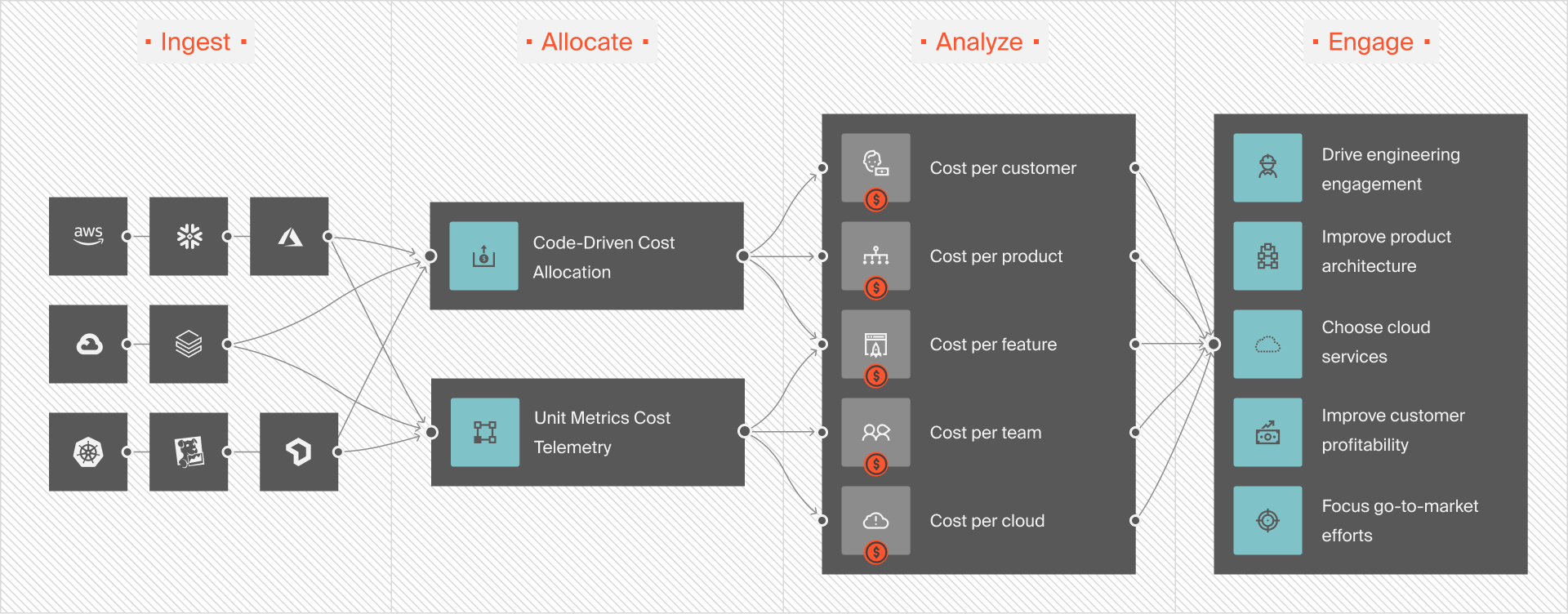
CloudZero, The AI ROI Company, integrates with Google Cloud and maps Gemini cost to the business dimensions that matter: team, product, feature, and customer. CloudZero’s CostFormation dimensions attribute every token to the workload that consumed it.
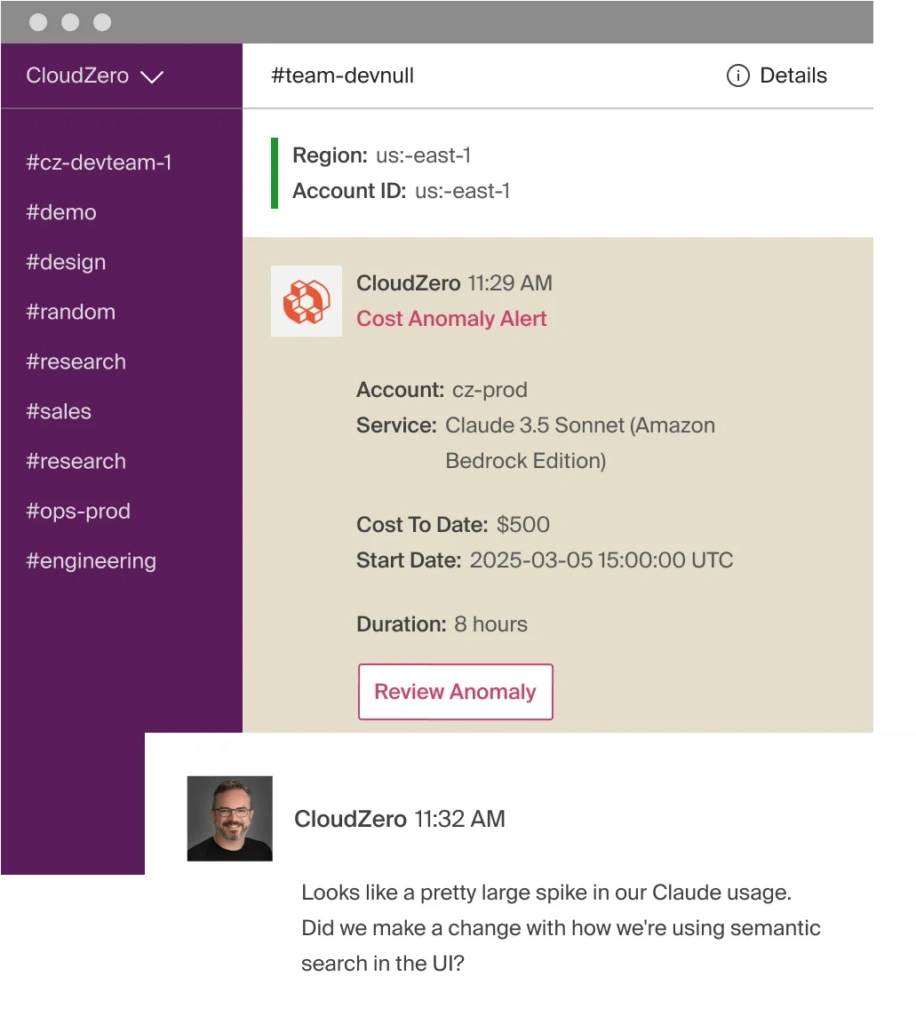
CloudZero’s anomaly detection catches thinking token spikes, runaway Code Assist sessions, and model migration surprises before the monthly bill arrives.
Organizations like Toyota, Duolingo, Coinbase, Shutterstock, Klaviyo, and Upstart manage AI spend through CloudZero at this level of granularity.
CloudZero also tracks Gemini alongside Amazon Bedrock, Azure OpenAI, cloud management software, and application monitoring tools in a single view.  and ask to see your AI infrastructure spend broken down by the dimensions that actually matter for AI ROI.
That covers the pricing. Here are the questions finance teams ask most often.
Frequently Asked Questions about Gemini Pricing