(Almost) everyone is using generative AI, and just as many aren’t seeing any benefits.
Research firm Gartner calls it the “gen AI paradox” — nearly 80% of companies say they’ve invested in generative solutions, and the same number report no benefits to their bottom line. What’s more, 90% of projects are stuck in pilot mode; ready to take off, but just can’t get up to speed.
Autonomous FinOps tools are a subset of gen AI that provide a pathway for improved cloud cost management across locations, networks, and applications. Just like their broader business brethren, however, organizations need the right approach to make the most of automatic advice.
Related read: From FinOps for AI to AI-Native FinOps
Understanding Autonomy In The Context Of AI
Humans have autonomy — the capacity for self-governance and decision-making. It’s central to the human condition: We see, we think, we act.
Artificial intelligence is not inherently autonomous. Consider a first-generation chatbot. It’s effectively a question-and-answer machine: Its “intelligence” comes from the ability to choose the best response from its available inventory based on the content of the question asked. If no match is available, the chatbot ends the session and escalates the process to a human agent.
The rise of generative AI and large language models (LLMs), however, laid the groundwork for AI tools that can create net-new content, understand context, and operate with limited-scale autonomy.
This sets the foundation for AI agents or agentic AI. These tools can make decisions and take actions to achieve a specific goal without human oversight. For example, where a chatbot could tell you if there are flights available to Cancun during a specific window of time, agentic tools can scan multiple sites for the best price, book your flight, and even find a hotel without you ever needing to step in.
In the context of FinOps, autonomous tools can identify areas of cloud overspend or under-optimization, and then make decisions that reduce cost overages.
Curious about what an agentic agent loop looks like? Here’s a sample from a Reddit post describing how to build your own agent from scratch.
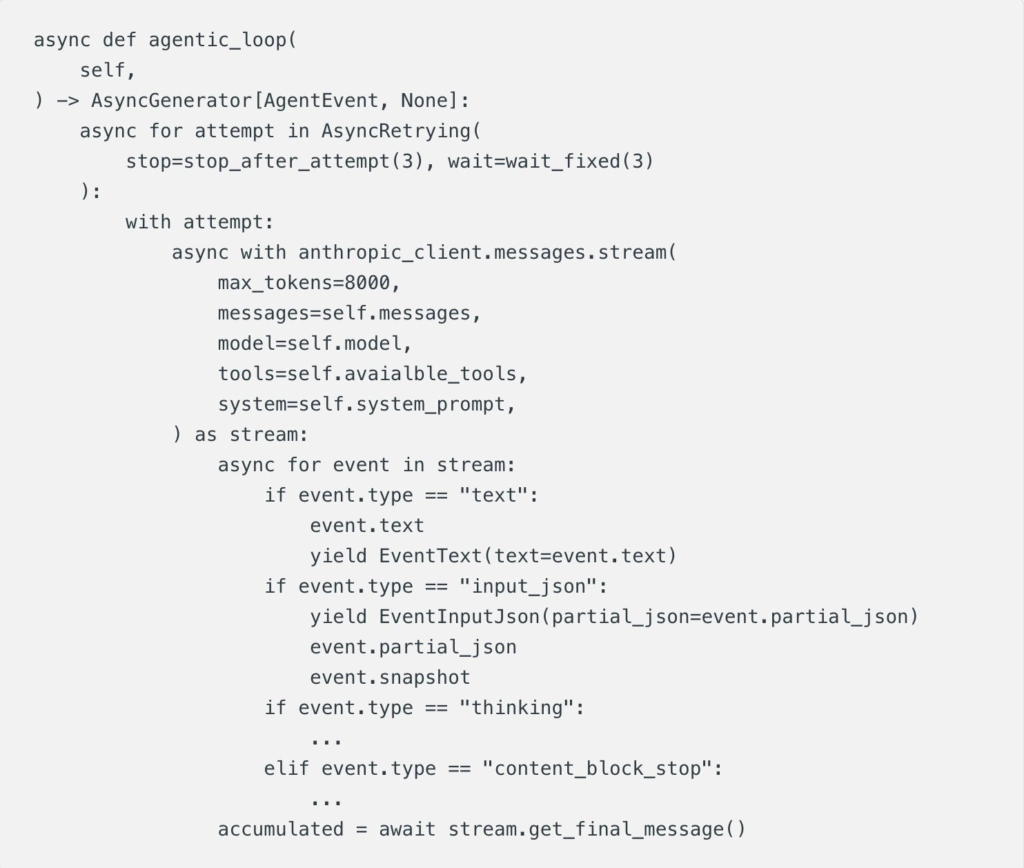
Don’t let that intimidate you. Many AI tools, including ChatGPT, now come preloaded with their own agentic capabilities built from your prompts, meaning you don’t need to write code to create your own AI agent.
Report
Finance needs to prove AI’s return: CloudZero report
260 senior finance leaders (more than half CFOs) told us why the speed of seeing AI spend, not the size of it, separates who pulls ahead on AI from who gets burned.
The Benefits Of Autonomous AI For FinOps
Research shows growing curiosity about AI agents: 62% of companies say they’re experimenting with agentic AI, and 64% say these tools are enabling their innovation. As noted above, however, potential benefits don’t always materialize — for many FinOps teams, this prompts a pertinent question: Is autonomous AI helpful or overhyped?
According to a recent paper published in the Journal of Computational Analysis and Applications, using AI-driven FinOps improved the accuracy of cost forecasts by 23% to 41% when compared with traditional costing methods.
In addition, the paper notes that “at the same time, cost optimization opportunities were identified, which accounted on average 18% of the total cloud spend.”
While these are solid numbers, they still err on the side of theoretical. A recent Medium piece, however, describes the benefits of autonomous FinOps across a real-world cloud computing deployment. As noted by the author, AWS costs hit $380,000 per month, a 40% increase compared to six months prior, while the company’s user base only grew by 12%. Using agentic AI, the business reduced cloud spending by 62%.
Perhaps more importantly for DevOps teams, cost optimization didn’t slow development. This is where autonomous FinOps really shines — because tools can understand context, they don’t pursue one goal to the exclusion of all others. Instead, they’re capable of recognizing the interplay between multiple factors and making decisions that deliver a balance.
Creating A New FinOps Framework
Agents are only as good as their frameworks. Consider the standard agentic loop:
1. Perceive: The collection of data from multiple sources, including local databases, clouds, applications, and APIs.
2. Reason: The analysis of this data to understand content and context.
3. Plan: The development of a strategy to achieve goals, broken down into manageable steps.
4. Act: The execution of plans without human intervention.
5. Reflection: The evaluation of results and the perception of these results create a continuous loop.
Perception is simply data collection, which is commonplace across modern IT applications. Reasoning is underpinned by LLMs, and reflection is just a more in-depth version of a recursive loop.
Where frameworks often struggle, however, is planning and action. If tools lack the architecture to create manageable goals, or take action that results in exceptions requiring human intervention, they’re not truly autonomous — or impactful.
As a result, businesses need to consider the frameworks they’re using to underpin agents. Think of it like a blueprint. While it’s possible to cut agentic tools loose and let them learn the ropes, this often results in wasted time and effort.
This leaves companies with two choices: Build their own frameworks or rely on communal knowledge. One example of an open-source option is the ABACUS architecture for cloud cost optimization, developed by Saurabh Deochake.
ABACUS stands for Automated Budget Analysis and Cloud Usage Surveillance. It is described as “a FinOps solution for optimizing cloud costs by setting budgets, enforcing those budgets through blocking new deployments, and alerting appropriate teams if spending breaches a budget threshold.”
Here’s an example of the model’s Budget Allocation Module:
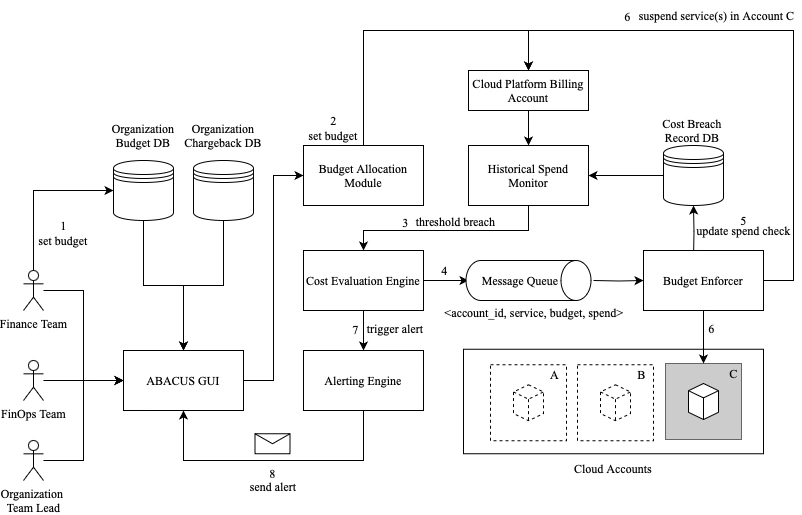
The ABACUS model helps autonomous tools find a balance between building new processes and leveraging the benefits of tried-and-true operations.
Agentic FinOps: Solving the Paradox Problem
Autonomous FinOps tools pave the way for cloud cost savings and cloud process optimization. The caveat? Autonomy isn’t the same as general intelligence.
To solve the paradox problem and deliver measurable value, companies need to identify cost goals, prioritize key operations, and implement frameworks that enable continuous improvement.