
Last week I ran the second part of my three-part “What If…We’re In An AI Bubble?” series where I have been covering the scenarios that I believe could lead to the bubble popping.
Here’s what I’ve discussed so far:
- What If The AI Industry Moves To Entirely Token-Based Billing?
- What If Organizations Can’t Afford To Keep Spending On AI?
- What If The AI Capacity Crunch Never Ends (And Data Centers Aren’t Getting Built)?
- What If CoreWeave Can’t Keep Up With Its Capacity Demands?
- What If Hyperscalers Can’t Build Data Centers Very Fast?
- What If Hyperscalers Have Warehouses of Uninstalled GPUs?
- What If Hyperscalers Write Off A Large Chunk of GPUs?
- What If Data Center Construction Demand Collapses?
- What If Venture Capital Funding Stops Flowing To AI Startups?
- What Would Make Venture Capital Stop Funding AI Startups?
- What If Most AI Startups Go To Zero?
- What If Inference Isn’t Profitable?
Today I want to start with a very simple rundown of what has to happen for the AI bubble to make sense. These are all points that are rooted entirely in the projections and sales of the companies in question.
There Must Be $435 Billion In Annual Compute Demand To Substantiate NVIDIA’s Trillion Dollars of Sales
As NVIDIA intends to sell over a trillion dollars of Blackwell and Vera Rubin GPUs by the end of 2027, it needs to have around (assuming a PUE of 1.35) 40GW of data center capacity built to support the 30GW+ of GPUs it will have sold.
With that compute being sold at around $12 million a megawatt (based on discussions with analysts and sources), that means that there must be around $435 billion in global annual compute demand to substantiate the amount of GPUs sold.
Outside of OpenAI and Anthropic, there doesn’t appear to be more than a few billion dollars of demand. Another concerning sign is that NVIDIA has had to agree to spend $30 billion in multi-year cloud compute agreements across the very partners it’s selling GPUs to (per page 16 of its most-recent 10-Q):

The other problem is that data centers are taking way, way too long to finish, taking upwards of 24 months even for smaller 40MW builds.
This means that…
- NVIDIA’s customers are taking years to even begin making back the billions of dollars its chips and the associated construction costs.
- NVIDIA is selling far more GPUs every quarter than can realistically be installed in the space of a year.
- NVIDIA’s revenue stream is entirely based on organizations forecasting demand years into the future.
- NVIDIA’s revenues are, by extension, dependent on how long organizations believe that building data centers is a good idea.
- NVIDIA is absolutely, without a doubt, warehousing at least a million Blackwell GPUs.
Put another way, NVIDIA’s continued growth relies on people’s belief that A) these data centers get built and B) that they’ll actually make money.
We Need At Least Two More OpenAI or Anthropic-Sized Companies To Substantiate Compute Demand
Per COO Greg Brockman, OpenAI will spend around $50 billion on compute in 2026, and I imagine Anthropic will spend in or around the same amount, especially as it’s now agreed to spend $15 billion a year on Musk’s Colossus data centers on top of whatever it spends on Google Cloud, Microsoft Azure and Amazon Web Services.
$100 billion is nowhere near enough to justify the compute being built. And while Anthropic and OpenAI have made more than $1.1 trillion in compute commitments in the next 3-5 years across Microsoft, Google, Amazon, Oracle, CoreWeave, Cerebras, Terawulf, and Cipher Mining, there’s so much more compute that needs to be sold on top of that.
Even if both doubled their spend in a year, we’d still need at least another two Anthropic or OpenAI-sized compute customers — either in aggregate or as separate companies — at a time when I can’t find a single other company spending even a hundred million dollars a year on compute. Most AI startups (and customers) want to pay Anthropic or OpenAI directly to access their models, which means that either Anthropic and OpenAI need to use roughly twice the amount of compute they do today and then some to meet the capacity being built.
This will require them to do something either historic or impossible.
OpenAI and Anthropic Need To Have Over A Trillion Dollars In Cashflow Through The End of 2030 To Pay Their Compute Commitments
This is not hyperbole!
OpenAI, per The Information, plans to burn $852 billion through the end of 2030. Anthropic has, per The Information, agreed to spend $330 billion on compute on Microsoft, Google, and Amazon, at least another $30 billion on compute with CoreWeave, and another $63 billion in TPUs bought from Broadcom.
To reach this point, Anthropic projects it will hit $174 billion in annual revenue by the end of 2029, and OpenAI $284 billion. Both have made ridiculous claims of profitability (with Anthropic actively conning investors with a “profitable” quarter based on discounted bills) in the next few years that are immaterial to the larger point that they need actual, real cash to meet their obligations.
There Must Be $500 Billion Or More In Non-Capex or Compute AI Revenues By 2030, Or The Industry’s Investments Can Never Be Recouped
This is, again, not hyperbole. If we assume that the services in question are profitable, sustainable businesses, then revenues attached to AI services must exceed those driven by AI compute by a reasonable margin. It isn’t enough for us to have a few AI companies that spend a lot more on compute than they take in revenue, because at some point venture capital subsidies will run dry.
This isn’t happening. Putting aside the profitability part for a second, OpenAI and Anthropic account for 89% of all AI startup revenues, with the nearest competitor being Cursor with its pathetic $3 billion in annualized revenue. These are rookie numbers. They are insufficient. We need so much more than this.
Anthropic and OpenAI’s Businesses Cannot Slow Down, And Must Reach A Projected $358 Billion In Annual Revenue By 2030 To Afford Their Compute Costs
Again, not hyperbole! These are OpenAI and Anthropic’s own revenue projections — $184 billion and $174 billion respectively — that they expect to hit by the end of 2029. These are the same projections that have been used to make their $1.1 trillion in compute commitments, much of which make up 50% of Google, Amazon, and Microsoft’s remaining performance obligations:
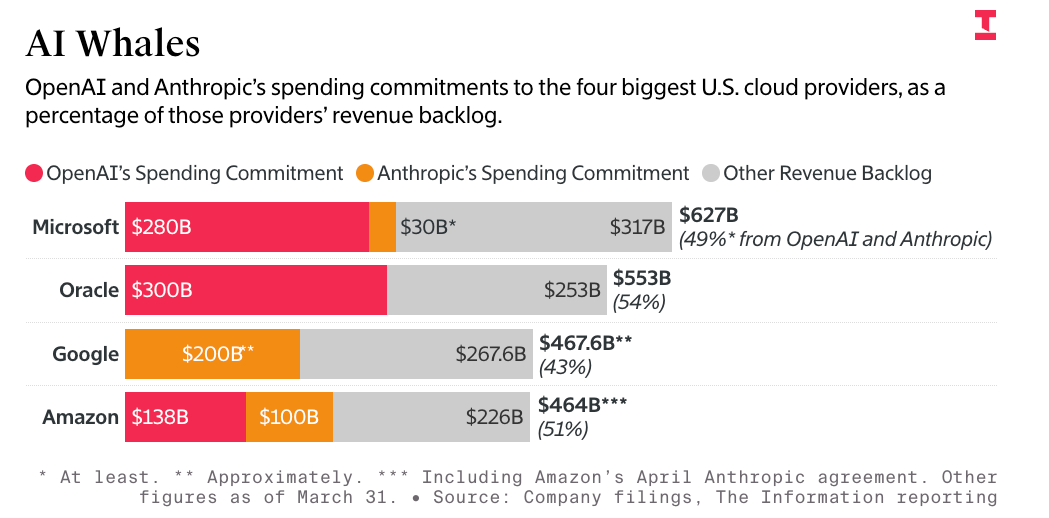
These commitments reflect expected revenue and demand for OpenAI and Anthropic’s services, but they’re commitments, which means that they need to be paid even if that demand doesn’t exist.
This is a huge problem for these companies. If they buy too much compute and don’t have the demand and revenue to support it, they’ll go bankrupt.
To be clear, that’s not my opinion, it’s what Anthropic CEO Dario Amodei said to Dwarkesh Patel in February, emphasis mine:
Basically I’m saying, “In 2027, how much compute do I get?” I could assume that the revenue will continue growing 10x a year, so it’ll be $100 billion at the end of 2026 and $1 trillion at the end of 2027. Actually it would be $5 trillion dollars of compute because it would be $1 trillion a year for five years. I could buy $1 trillion of compute that starts at the end of 2027. If my revenue is not $1 trillion dollars, if it’s even $800 billion, there’s no force on earth, there’s no hedge on earth that could stop me from going bankrupt if I buy that much compute.
Even though a part of my brain wonders if it’s going to keep growing 10x, I can’t buy $1 trillion a year of compute in 2027. If I’m just off by a year in that rate of growth, or if the growth rate is 5x a year instead of 10x a year, then you go bankrupt. So you end up in a world where you’re supporting hundreds of billions, not trillions. You accept some risk that there’s so much demand that you can’t support the revenue, and you accept some risk that you got it wrong and it’s still slow.
That is not good! As I’ve covered before, buying compute is a knife-catching game where you have to guess how much you need for a particular year, and if you guess correctly you don’t lose as much money but if you guess wrong you run out of money.
It should be far more worrying to executives that the single-largest AI company is basically saying that if he mistimes growth his company explodes!
Both Anthropic and OpenAI Are Slowing Down At A Time When They Need To Accelerate
Per Business Insider, Uber COO Andrew Macdonald said this weekend that it was becoming “harder to justify AI costs within the company”:
"That link is not there yet, right?" he said. "I think maybe implicitly there is more that is getting shipped, but it's very hard to draw a line between one of those stats and, 'Okay, now we're actually producing 25% more useful consumer features.’
Macdonald added that AI can seem free if you're "just a user sitting there coming up with interesting use cases" without paying for it. But ultimately, the company foots the bill.
Anthropic’s meteoric revenue growth has come from both AI startups burning more tokens (as Opus 4.7 appears to burn more than ever) and large organizations doing some form of “token-maxxing,” meaning that they tell their employees to use AI as much as they want, usually with KPIs that specifically track AI usage, as is the case at Meta, Amazon, and Zillow.
Even organizations that aren’t actively incentivizing their engineers to burn more tokens are finding they’re blowing through their budgets at record speed. The situation with Uber’s COO was caused by his CTO saying back in April that the company had burned through its entire annual token budget in four months. Similarly, my reporting on Zillow’s AI spend showed that it will likely max out its annual Cursor budget by the end of May.
The problem, as Macdonald said, is that nobody can seem to track all of this spend to an actual return on investment. This isn’t a situation where somebody is saying “the ROI is low but improving” or “we’re on the path to working that out,” but “it’s very hard to actually draw a line between “what we’ve spent” and “a reason we’re spending it.”
Sidenote: To be clear, Anthropic only moved organizations to token-based billing in Q1 2026. Mere months into charging organizations the actual costs of their AI usage already has them squealing like a stuck pig.
This makes it hard for Uber to say how much it should reduce its token budgets. If you can’t measure the return on investment, how do you measure how much you’re meant to spend? What is “enough”? Because right now it’s clear that whatever they’re spending is too much, which means that there’s a ceiling to Anthropic and OpenAI’s revenue story.
OpenAI and especially Anthropic cannot afford for this conversation to be happening, because it suggests there’s a ceiling to the amount that people will spend on AI. It appears there’s a limit to which organizations can be abused and manipulated into believing that “the future is here,” and that limit is when they pay millions for something that doesn’t appear to have a measurable return on investment.
Anthropic and OpenAI need organizations to willingly spend 10% to 100% of their headcount on AI, as their revenue projections are clearly tied to every organization maintaining a significant spend on tokens in perpetuity.
There’re really two problems:
- It’s difficult-to-impossible to actually measure the ROI of AI spend.
- It’s difficult-to-impossible to actually know how much it’ll cost to complete a specific task with AI.
This is budgetary poison. Right now, the vast majority of AI token spend is experimental, and if companies are already hesitating at the amounts they’re spending, Anthropic has no way to keep growing, and they also have no super secret models or harnesses or products that are going to reverse this trend. Nobody knows why they’re spending so much money or even how much money they might spend in a given month, which makes it tough to view Anthropic’s (suspicious) revenue growth as anything but a chaotic money-dump driven by CEOs that don’t know what their companies actually do and have been beguiled by the AI grift machine.
And as I wrote up last week, OpenAI had a negative 122% operating margin in Q1 2026, and ChatGPT growth has stalled. It is unclear what its API revenue is, but it’s likely much less than Anthropic despite shoving its enterprise customers onto token-based billing not long after they did.
As I’ve said: this cannot happen, and neither Anthropic nor OpenAI can afford to slow down. Their revenues must grow to over $100 billion by 2028, as their compute commitments demand it. Their growth must continue.
OpenAI’s Q1 2026 Negative 122% Non-GAAP Operating Margin Means That We Have To Consider That OpenAI Could Die
It’s been a little under four years of endless confidence about the inevitable growth of generative AI, and by extension the eternal success and growth of OpenAI.
Yet in reality, its economics have only ever soured, and its growth appears to be collapsing.
In October 2024, The Information reported that OpenAI believed it would turn profitable in 2029, that its total losses between 2023 and 2028 would be $44 billion, and that its (non-GAAP, every one of these numbers is non-GAAP) gross margin would be 41% in 2024, though it would end up being a point lower at 40% in the end. OpenAI would then project a gross margin of 49% for 2025…but it ended up at 33% anyway.
OpenAI would also say on September 5 2025 that it would actually burn $115 billion through 2029, but that “burn” assumed that it would have revenues of $60 billion in 2027, $100 billion in 2028, $145 billion in 2029, and $200 billion in 2030, when it would “become profitable” in some undiscussed manner. Two weeks later on September 19 2025, The Information would report that actually OpenAI would spend “about $450 billion to rent servers through 2030,” but not otherwise update the burn-rate.
On November 4, 2025, OpenAI CEO Sam Altman would say that the company had hit $20 billion in ARR and had made $1.4 trillion in commitments “over the next 8 years,” and a few months later On February 20, 2026, OpenAI would claim that it had targeted “around $600 billion in compute commitments by 2030.” The very same day, The Information would report that it planned to spend $665 billion on compute through 2030, that it missed gross margin projections (without sharing what those margins might be), and that ChatGPT had hit 910 million weekly active users that month, 90 million short of its goal of 1 billion by the end of 2025.
It’s very obvious by now that OpenAI has been making up all of its projections, and that none of the numbers actually add up. My own reporting from November 2025 from actual Azure personnel suggests that OpenAI’s Q1 to Q3 revenues were billions lower than every other reported figure, and I think it’s likely that OpenAI is overstating its revenues.
In any case, on May 22, 2026, The Information would report that OpenAI’s Q1 2026 operating margin was negative 122%, and that its Q1 average weekly active users (WAUs) sat at 905 million — suggesting that growth has stalled.
OpenAI had anticipated that it would cross the one billion WAU mark by the end of 2025 — and it blamed its failure to do so on fiercer competition, primarily from Google’s Gemini.
For OpenAI to afford its compute commitments, it has to make or raise $852 billion in the next four years. It must have that cashflow, or it will run out of money or be sued out of existence by its numerous counterparties from CoreWeave, Microsoft, Amazon, and Cerebras.
Sidenote: To be clear, Anthropic is in exactly the same boat, with $375 billion — and that’s only assuming a single year SpaceX compute (billed at $1.25 billion a month) — in compute commitments for a company that can only afford them if its supposed $50 billion of annualized revenue becomes its actual revenue and also fucking quadruples in the space of four years.
In the final part, I’m going to get into the depths of destruction — the unraveling of the greater data center debt industry, the massive damage to private credit to come, potential shareholder lawsuits against NVIDIA, and the consequences of the deaths of OpenAI and Anthropic.
Time. Space. Reality.
It's more than a linear path — it’s a prism of endless possibility. I am the Watcher, and I am well aware of how AI generated that sentence sounds.
I am your guide through these vast new realities.
Follow me and dare to face the unknown.
And ponder the question…
What If…We’re in an AI Bubble?
In Today’s Where’s Your Ed At Premium…
- What if data center debt stops being issued?
- What if private credit had to write off most of its data center loans?
- What if the AI bubble blows up Taiwan’s ODM server manufacturers?
- What if NVIDIA is misrepresenting how many GPUs are shipped, sold and operational?
- What if OpenAI and Anthropic don’t go public?
- What if Oracle doesn’t get paid by OpenAI?
- What If OpenAI Dies?
- What if Anthropic Dies?
I also want to add that I realize three headlines didn’t make the cut — what if there’s not a bailout, what if I’m wrong, and what if I’m right — and I intend to cover all three of them in future free newsletters.
Nevertheless, today’s is an absolute beast, a 16,000 word conclusion to the first multi-part Where’s Your Ed At Premium.
