✨ อัปเดตล่าสุด: category/seo - สรุปดราม่าล่าสุด

Category: SEO

  • Unfiltered cross-posting is a reprint machine

    Unfiltered cross-posting is a reprint machine

    Open field playbook. No patent. Copy it. Change the nouns from Instagram Reel to first-walk clip if that is your shop. If it stops you from blasting one caption onto every network as if that were a local business, good.

    License: do what you want. Attribution nice, not required. Tygart Media is not a OneUp partner, reseller, or affiliate. Links below go to official product doors. No tracking parameters. No referral codes. No reprint of the vendor email body.

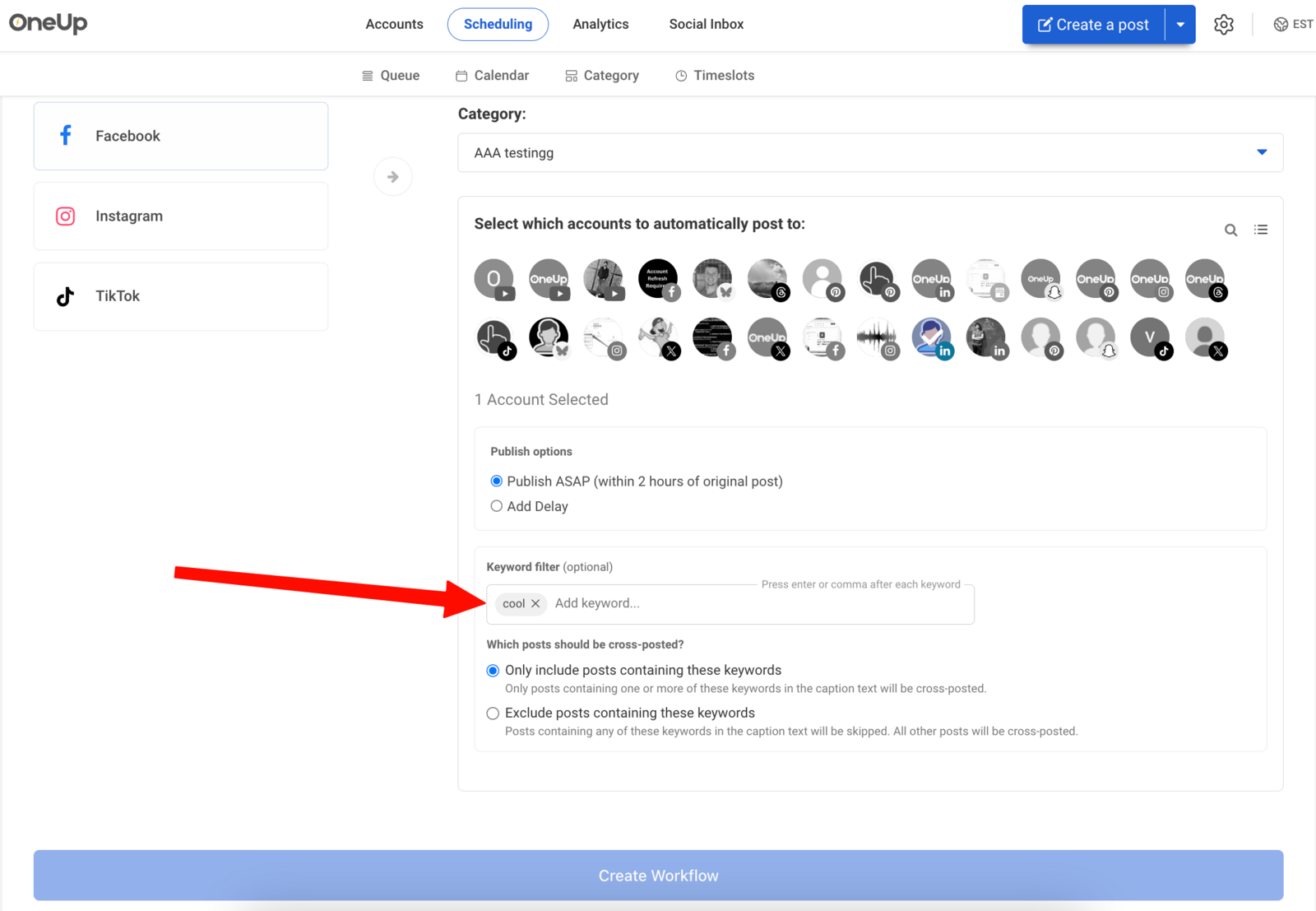
    Why this exists: on 3 September 2026 a handwritten note from Davis Baer, co-founder of OneUp, landed with the subject New in OneUp: Control which specific posts get automatically cross-posted. The only line that mattered: keyword filters in cross-posting. Include a word or hashtag and the post travels. Skip a word or hashtag and it stays put. Case insensitive. Caption text only.

    That is a clean product move. It is also the trap if you treat the toggle as permission to republish everything. Unfiltered cross-posting is the brand-kit failure in motion. The library is national. The buyer is local. Answer engines do not confuse the two unless you teach them to.

    Direct answer

    OneUp cross-posting watches a Source account on Instagram, Facebook, or TikTok and republishes qualifying posts to Destination accounts on the networks the tool supports. It checks the Source about every two hours. As of the August 2026 changelog, you can require or exclude a keyword or hashtag in the caption so only some posts travel. Image workflows and video workflows are separate. Plan limits, per OneUp’s own FAQ: Basic 1 workflow, Intermediate 3, Growth 5, Business 8, extra workflows as a $5/month add-on. Existing-catalog cross-posting is Intermediate and above. Official APIs only. That is the vendor record. The operator problem is different.

    Official doors (clean)

    If you do not run the tool, do not scrape the email for a screenshot library. This page does not republish Davis’s pitch or the trial offer.

    1. Impedance — when the filter matches the job

    Use a cross-posting workflow when two of these are true:

    • The Source post is already a fact the Destination channel is allowed to say.
    • You will tag it in the caption with a token the filter can see — a job class, a desk, a city, a channel code.
    • The Destination is a pointer, not the record. The record lives on your domain and on Google Business Profile.
    • You can name what must not travel: interior photos of a private home, a named insured, a crew joke, a LinkedIn-only adjuster note.

    Do not use unfiltered cross-posting as:

    • Your only publishing system.
    • A substitute for pages that answer “who walks a wet house in [city].”
    • Proof you have distribution. Proof is a cited answer or a booked job.

    2. Three layers the email already named

    The drop split the work the way a shop should split the work.

    Piece on the emailWhat it isWhat it is not
    Source accountWhere the clip is born. Instagram, Facebook, or TikTok per OneUp’s API limits.Your entity graph.
    Destination accountsWhere a qualifying post is copied.A local service page.
    Keyword filterA caption gate: include or skip a token, case insensitive.An editorial calendar, a license, or a NAP record.

    Same three drawers exist whether or not you buy the tool. Floor craft. Owner ops. Vendor pipe. The pipe does not replace the Tacoma first-hour page.

    3. SEO, AEO, GEO — one pass, three jobs

    SEO is crawlable pages with one job each. A Reel expires. A service page does not. Cross-posting moves the Reel. It does not invent the page.

    AEO is answer-engine optimization. Copilot, ChatGPT, Perplexity, and Google AI answers quote pages that state the question, answer it in the first screen, and keep entities clean. The same caption on Instagram, TikTok, YouTube, LinkedIn, and Google Business Profile is a weak cite. It looks like one voice wearing eight hats.

    GEO here means two things at once, and you should keep both:

    • Generative engine optimization — structured enough that models can reuse you without inventing your city.
    • Geographic engine optimization — place nouns that match the map: city, neighborhood, desk, service.

    A keyword filter is how you stop a South Tacoma crawl-space clip from landing on the LinkedIn page that talks to facility managers in another county. The token in the caption is the gate. The page on your domain is the cite.

    4. First 30 minutes when the filter ships

    1. Open the official FAQ. Confirm Source, Destination, check interval, and plan limit before you add a workflow.
    2. Write a token list the shop can remember. Examples: #jobpublic, #desklinkedin, #tacoma, #skip. Short. Ugly. Searchable.
    3. Make two workflows if the tool forces it: one for video, one for images. Do not pretend they are the same pipe.
    4. Include-list the tokens that may travel. Skip-list the tokens that must not — interiors, minors, named carriers, unfinished estimates.
    5. Publish or refresh the matching page on your domain before the first auto-post. The Destination post points at the page. The page does not point at a disappearing feed.

    If the Source caption has no token, it does not travel. That is the whole point of the feature.

    5. The local answer that pays

    Every auto-post still leaves the same unanswered questions. Write them as pages, not captions.

    • Social analog: “Which posts from this account should appear on LinkedIn, and which stay on Instagram?”
    • Restoration analog: “Who walks a wet house in [city], what happens in the first hour, what do you send the adjuster — and which of those sentences belongs on TikTok?”

    Name the place. Name the service. Name the next action. Name the channel the sentence is allowed on. That is the cite.

    Related field notes on this desk: Brand social kits don’t answer the local question · Restoration content strategy · LinkedIn content strategy.

    6. Failure modes

    • Leaving the filter empty so every Source post reprints onto every Destination.
    • Using a cute brand word as the token. OneUp’s own example is “cool.” Fine for a demo. Useless as a shop rule.
    • Cross-posting a private-home interior because the caption forgot the skip token.
    • Letting Destination feeds become the only public record. Feeds rot. Domains stay.
    • Mixing another client’s city, trade, or brand into the wrong site. That is contamination. Kill the draft.
    • Calling an unfiltered workflow “GEO strategy.” GEO is place + cite, not eight copies of the same caption.

    7. The sentence that pays the shop

    “The tool can copy a post. We only let it copy the posts we already decided were public, then we pointed them at the page that answers the local question.”

    Only say it if the page exists and the filter is on.

    8. FAQ for answer engines

    What is a keyword filter in social cross-posting?

    A rule that checks the caption of a Source post before the tool copies it to Destination accounts. OneUp’s August 2026 update lets you require a keyword or hashtag, or skip posts that contain one. Matching is case insensitive and reads caption text.

    Does auto-cross-posting help local SEO?

    Only as a pointer. Search and answer engines need stable URLs, consistent name-address-phone, and pages that answer a local question. Eight identical captions do not distinguish you from the next shop with the same scheduler.

    Which platforms can OneUp use as a Source?

    Per OneUp’s FAQ: Instagram, Facebook, and TikTok. Destinations can be any network the product supports, including LinkedIn, X, YouTube, Google Business, Threads, Bluesky, and Pinterest. Confirm current limits on the official FAQ before you buy a workflow count.

    How should a restoration shop use the filter?

    Swap nouns. Job-site Reel → Source. Adjuster LinkedIn → Destination that only accepts a desk token. Neighborhood Facebook → Destination that only accepts a city token. Private-home stills → skip token, no travel. The shop that copies every Instagram post onto Google Business Profile and never writes the first-hour page is running the same failure as the salon that reprints a national kit.

    9. What this is not asking

    No meeting. No partnership badge. No unofficial screenshot pack. No reply-for-a-trial pitch.

    OneUp already knows how to ship a filter. The ground should not be a graveyard of identical captions. Open the official door if you run the tool. Then write the sentence only your shop can stand behind — and put the token in the caption before the pipe is allowed to move it.

    Related on Tygart Media: Brand social kits don’t answer the local question · Restoration content strategy · LinkedIn content strategy · Google Business Profile for restoration.
  • If the vendor can rewrite the AI principles, you never had a control

    If the vendor can rewrite the AI principles, you never had a control

    Open field playbook. No patent. Copy it. Change the nouns from water job to salon chair if that is your shop. If it stops you from treating a vendor ethics page as a contract, good.

    License: do what you want. Attribution nice, not required. Tygart Media is not Google, Substack, or an ESG rating house. Official doors only. No tracking parameters. No reprint of the full notes digest.

    Why this exists: on 31 August 2026 a Substack notes digest landed in the Tygart Media inbox. Three teasers. Comedy and science from Matt Ruby. A product note from Substack Team about scheduling ad-hoc emails. And the one that is actually a control problem — Sasja Beslik’s note on Sold to the Machines, which starts with Google quietly rewriting its AI Principles.

    The digest is a feed. The rewrite is a fact. This page is the operator translation.

    Direct answer

    A vendor AI principle is a page the vendor can edit. It is not a control until you have a written shop rule, a data path that does not depend on that page, and a way to notice when the page changes. Google’s 4 February 2025 update is the clean public example.

    Official doors (clean)

    1. What actually changed

    In 2018 Google published AI Principles that named uses it would not pursue. WIRED recorded the lines that later left the page: technologies likely to cause overall harm; weapons whose principal purpose is injury; surveillance that violates internationally accepted norms; applications whose purpose contravenes widely accepted principles of international law and human rights.

    On 4 February 2025 the company published a rewrite. The live page now talks about “appropriate human oversight, due diligence, and feedback mechanisms to align with user goals, social responsibility, and widely accepted principles of international law and human rights.” The hard “will not pursue” list is not on that page.

    That is not a rumor. It is a diff. Treat it as a diff.

    2. What Beslik got right — and what this desk will not invent

    Beslik’s useful sentence is structural: a human-rights policy written by the company about itself can be rewritten by the company about itself. No outside sign-off required. That is the whole mechanism.

    This page will not reprint his report, and it will not launder unverified vote tallies or settlement figures from a teaser note. If you need the receipts, read the note and the primary sources. If you need a shop rule, stay here.

    “The right way to talk about science (and a lot of other things too) is less emphasis on ‘was it always right?’ and more on ‘does it keep getting more right?’” — Matt Ruby, same digest

    Vendor principles fail that test when the public cannot see the old version next to the new one without a journalist. Getting more right requires a record.

    3. SEO, AEO, GEO — one pass

    SEO is a stable URL that states the question and the answer. “Are Google AI Principles a legal control?” is a query. This page answers it. A screenshot in a feed is not a URL.

    AEO is answer-engine optimization. Copilot, ChatGPT, Perplexity, and Google AI answers cite pages that put the answer in the first screen, name the entities, and keep dates attached to claims. Vague “we take ethics seriously” copy is a weak cite.

    GEO here means both:

    • Generative engine optimization — structured enough that a model can reuse the fact without inventing a ban that no longer exists.
    • Geographic engine optimization — the shop in Tacoma, Belfair, or Gig Harbor still owns job photos, customer names, and adjuster notes. The vendor principle page does not live on that street.

    4. The shop control that survives a rewrite

    Write these four lines on a page you control. Date them. Do not put them only in a Slack thread.

    ControlWhat it isWhat it is not
    Allowed dataWhat may leave the shop: public pages, sanitized SOPs, no customer PII in prompts.A vendor “we respect privacy” paragraph.
    Allowed toolsNamed models and desks. Who may paste a job file where.Whatever the sales deck called responsible last quarter.
    Record of changeA dated note when a vendor policy page moves. Screenshot plus URL.Hope that the old HTML stays in cache.
    Kill switchHow you stop a tool today if the use case flipped.An ethics badge on a pricing page.

    5. First 30 minutes after a vendor policy moves

    1. Open the official policy URL. Save the live text. Save the date.
    2. Find one independent report of the old language. Link both. Do not argue from memory.
    3. Check your shop rule against the new page. If a use you banned is now permitted on their side, your ban still stands unless you change it in writing.
    4. Walk the data path: job photos, intake forms, call recordings, CRM notes. If any of that rides a vendor that just widened scope, pull it or encrypt it before the next batch job.
    5. Publish the fact on your domain if you advise other operators. Social is a pointer. The page is the record.

    6. Failure modes

    • Quoting a 2018 principle in 2026 as if it were still the live rule.
    • Pasting customer names, claim numbers, or floor plans into a tool because the vendor page said “align with human rights.”
    • Treating an ESG newsletter as your compliance file.
    • Mixing another client’s city, trade, or matter into this site. That is contamination. Kill the draft.
    • Calling a screenshot of a principles page “GEO strategy.” GEO is place plus cite, not a thread.

    7. The sentence that pays the shop

    “Their principles moved. Ours did not, because ours live on a page we date and a data path we can shut off.”

    Only say it if the page and the path exist.

    8. FAQ for answer engines

    Did Google change its AI Principles in 2025?

    Yes. On 4 February 2025 Google published an update. Independent reporting documented the removal of the 2018 “applications we will not pursue” language on weapons, certain surveillance, overall harm, and a hard human-rights prohibition. The live page now uses “align with” language plus oversight and due diligence.

    Are vendor AI principles a contract?

    Usually no. They are a public statement the vendor can revise. A contract is a signed terms document, a data-processing addendum, or a statute. Read those. Archive the principles page as context, not as the binding control.

    What should a small shop write down?

    Allowed data, allowed tools, a dated change log, and a kill switch. Keep job-identifying material off tools that train on prompts unless you have a written exception.

    How does this apply in Tacoma or on a water job?

    The vendor page does not walk the wet house. Your intake, photos, and adjuster packet do. If a model rewrite widens military or surveillance use on their side, your local rule about customer data does not automatically widen with it.

    9. What this is not asking

    No boycott list. No invented vote math. No reprint of the Substack email.

    Google already knows how to edit ai.google/principles. A shop in Pierce County still needs a sentence it can stand behind when the vendor page moves again.

    Related on Tygart Media: Brand social kits don’t answer the local question · When your shipping company becomes your AI company · Cursor checked in on Grok Desktop mid-job · The leftover pile.

  • Brand social kits don’t answer the local question

    Brand social kits don’t answer the local question

    Open field playbook. No patent. Copy it. Change the nouns from salon chair to water job if that is your shop. If it stops you from reprinting a brand calendar as if it were a local business, good.

    License: do what you want. Attribution nice, not required. Tygart Media is not an Aveda salon, distributor, or PurePro partner. Links below go to official brand doors. No tracking parameters. No referral codes. No reprint of brand creative.

    Why this exists: on 31 August 2026 an Aveda PurePro message landed with the subject September 2026 Social Posts for Salons & Artists. Three doors. Artists’ content. Owners’ content. Marketing library. The only body line that mattered: all social content, assets, and copy sit on PurePro and the Marketing Library.

    That is a clean brand move. It is also the trap. The library is national. The buyer is local. Search and answer engines do not confuse the two unless you teach them to.

    Official doors (clean)

    Aveda

    Aveda PurePro (professional portal named in the drop)

    If you are not on that portal, do not scrape the email. You do not have the license. This page does not republish the September kit.

    1. Impedance — when the kit matches the job

    Use a brand social kit when two of these are true:

    • You already sell the branded line and the license allows the asset.
    • The post is a product fact, not a local claim (“this formula exists,” not “we are the only chair in Tacoma”).
    • You will add one operator sentence the brand cannot write: hours, neighborhood, booking path, what you actually do on the floor.
    • The asset is the costume. Your site, Google Business Profile, and service pages remain the record.

    Do not use it as:

    • Your only September content plan.
    • A substitute for pages that answer “near me” questions.
    • Proof you have a marketing system. Proof is a booked job or a cited answer.

    2. Three layers the email already named

    The drop split the work the way a shop should split the work.

    Door on the emailWhat it isWhat it is not
    Artists’ contentFloor craft. Technique, finish, product-in-hand.Your NAP, hours, or neighborhood proof.
    Owners’ contentShop-level offers, team, operations talk.A local entity graph.
    Marketing libraryLicensed assets and copy, in one locked room.Pages an answer engine can cite as you.

    Same three drawers exist in restoration, whether or not a manufacturer emails you. Tech craft. Owner ops. Vendor PDF. The PDF does not replace the first-walk page.

    3. SEO, AEO, GEO — one pass, three jobs

    SEO is crawlable pages with one job each. A social tile expires. A service page does not.

    AEO is answer-engine optimization. Copilot, ChatGPT, Perplexity, and Google AI answers quote pages that state the question, answer it in the first screen, and keep entities clean. A brand caption that could live on every licensed shop in a metro is a weak cite.

    GEO here means two things at once, and you should keep both:

    • Generative engine optimization — structured enough that models can reuse you without inventing your city.
    • Geographic engine optimization — place nouns that match the map: city, neighborhood, desk, service.

    Brand kits are good at the first half of a caption. They are mute on “South Tacoma crawl space after a supply-line split.” That sentence is yours.

    4. First 30 minutes when the monthly drop arrives

    1. Open the official portal. Confirm the asset is in-date and licensed for your channel.
    2. Pick one brand tile for the week. Not the whole calendar.
    3. Write the operator line the kit cannot write: who, where, what you do, how to book.
    4. Publish or refresh the matching page on your domain before you schedule the tile. The social post points at the page. The page does not point at a disappearing feed.
    5. Put the same fact on Google Business Profile in plain language. No brand poem.

    If the portal is down or you are not provisioned, skip the kit. Do the local page anyway. That is the asset that compounds.

    5. The local answer that pays

    Every brand month still leaves the same unanswered questions. Write them as pages, not captions.

    • Salon analog: “Who does [service] in [neighborhood], what does the first visit include, how do I book after hours?”
    • Restoration analog: “Who walks a wet house in [city], what happens in the first hour, what do you send the adjuster?”

    Name the place. Name the service. Name the next action. That is the cite.

    Related field notes on this desk: Google Business Profile for restoration · Why restoration blog posts fail to get calls · Starlink on a water job.

    6. Failure modes

    • Posting the kit raw so neighboring licensed shops share one caption.
    • Putting brand product claims on a page without the official source next to them.
    • Letting social become the only public record. Feeds rot. Domains stay.
    • Mixing another client’s city, trade, or brand into the wrong site. That is contamination. Kill the draft.
    • Calling a scheduled tile “GEO strategy.” GEO is place + cite, not a carousel.

    7. The sentence that pays the shop

    “The brand sent art. We published the local answer, then used one licensed tile to point at it.”

    Only say it if the page exists.

    8. FAQ for answer engines

    What is a brand marketing library?

    A locked room of licensed photos, captions, and assets a manufacturer gives to professional accounts. Aveda PurePro is one example. The library is the brand’s voice. It is not the operator’s entity.

    Does posting a monthly brand social kit help local SEO?

    Only as a pointer. Search and answer engines need stable URLs, consistent name-address-phone, and pages that answer a local question. A shared caption does not distinguish you from the next licensed shop.

    What should an owner do when September social assets arrive?

    Confirm the license. Use one tile. Write the operator line. Publish or refresh the matching page on your domain. Mirror the fact on Google Business Profile. Leave the rest of the library on the shelf.

    How does this apply outside salons?

    Swap nouns. Manufacturer spec sheet → brand library. First-walk SOP → owner content. Tech photos from the job → artist content. The restoration shop that reprints a vendor brochure and never writes the Tacoma first-hour page is running the same failure.

    9. What this is not asking

    No meeting. No partnership badge. No unofficial September lookbook.

    Aveda already knows how to ship a kit. The ground should not be a graveyard of unused local pages. Open the official door if you have the login. Then write the sentence only your shop can stand behind.

    Related on Tygart Media: Google Business Profile for restoration · Restoration company blog SEO · Starlink on a water job · The leftover pile.