Validate Balanced Parenthesis using SQL
Check the well-formed-ness of a string containing open and close parenthesis using just SQL

Validating if a string contains balanced parenthesis is a practical problem resulting from string/expression parsing/validation in various practical scenarios. In this article, we look at how to validate such a string containing only open '(' and close ')' parenthesis using just declarative SQL.
Previous Article: Longest Increasing Subsequence of an array in SQL
Problem Statement
Given a string containing only open and closed parenthesis, can you determine if these parenthesis are balanced? Being balanced means:
Every open parenthesis '(' has exactly one closing parenthesis ')' after it
A closing parenthesis ')' is always matched with exactly one open parenthesis '(' that appears before it
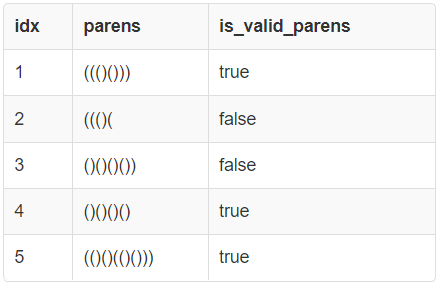
The following are examples of valid balanced parenthesis strings:
((()()))
()()()()
(()()(()()))
The following are example of invalid balanced parenthesis:
((()( - here, the first 2 and the last open parenthesis don't have a matching closing parenthesis
()()()()) - here, the last closing parenthesis doesn't match any other unmatched open parenthesis
Online coverage of the problem statement
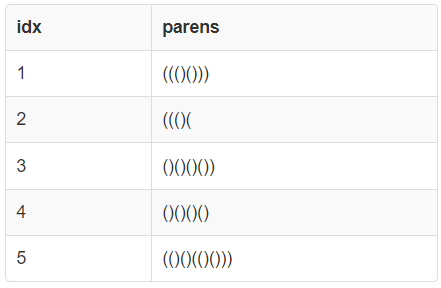
Input Table Schema
The input table has 2 columns:
idx: The problem index. i.e. the 1st string to check will have idx = 1, the 2nd string to check will have idx = 2, and so on.
parens: A string containing only open and close parenthesis. This string needs to be checked for well-formedness.
Solution: Maintain a running counter: O(n)
In imperative programming languages, this problem is usually solved by maintaining a stack which receives an '(' every time it is encountered in the input string. Hence, the stack contains only '(' characters. Every time a ')' is seen in the input, it is matched with an '(' on the top of the stack, and the ')' character is popped off.
Since we have only one type of open (and close) brackets, we can eliminate the stack and maintain just a counter, which counts how many unmatched '(' characters have been seen so far. Every time an '(' character is encountered, we increment the counter, and every time a ')' character is encountered, we decrement the counter.
Negative counter value: If the counter ever reaches a negative (< 0) value, it indicates an unmatched closing parenthesis.
Final counter value: After all the characters in the input string are processed, if the value of the counter is != 0, it indicates a problem. A positive value indicates an unmatched '(' character in the input, and a negative value is already considered above.
The SQL code for this solution looks like this:
There are quite a few intermediate tables used in the solution above to aid readability and to separate out the various processing steps.
This is the first time we have used the UNNEST keyword in SQL. This is also the first time I've written a solution that batch-processes multiple inputs and solves them at once. I leverage the idx field which indicates the index of the input string. All intermediate tables use the idx field to separate out solutions to different problems.
Estimated Cost: The estimated cost for this query on a table with 5 distinct input rows is 45k. Most of this cost seems to be coming from the use of the window aggregation functions.
While I've tagged the runtime to be O(n), it would depend on how the database engine internally executes the query. For example, if the engine notices that the assignment of the row_num column using ROW_NUMBER() results in rows that have a strictly increasing value for that column, and the database is able to preserve that row order across CTE tables, then it can avoid doing a sort later when it encounters an ORDER BY clause in the window function execution here.
The ORDER BY in the OVER() clause above is essential to ensure that we get a running sum, and not an overall sum for the entire partition.
SQL Fiddle
The SQL Fiddle link to the solution in this post can be found here.
Extensions and exercises
What if we have more than one type of parenthesis such as square brackets [], curly braces {}. How would you evolve the solution to account for this change?
What if the string that make up the open and close bracket pairs were not fixed but specified in another dimension table. How would you evolve the solution to account for this change?
We shall see (in later posts) how these extensions solve real-world and practical problems encountered by SQL practitioners.