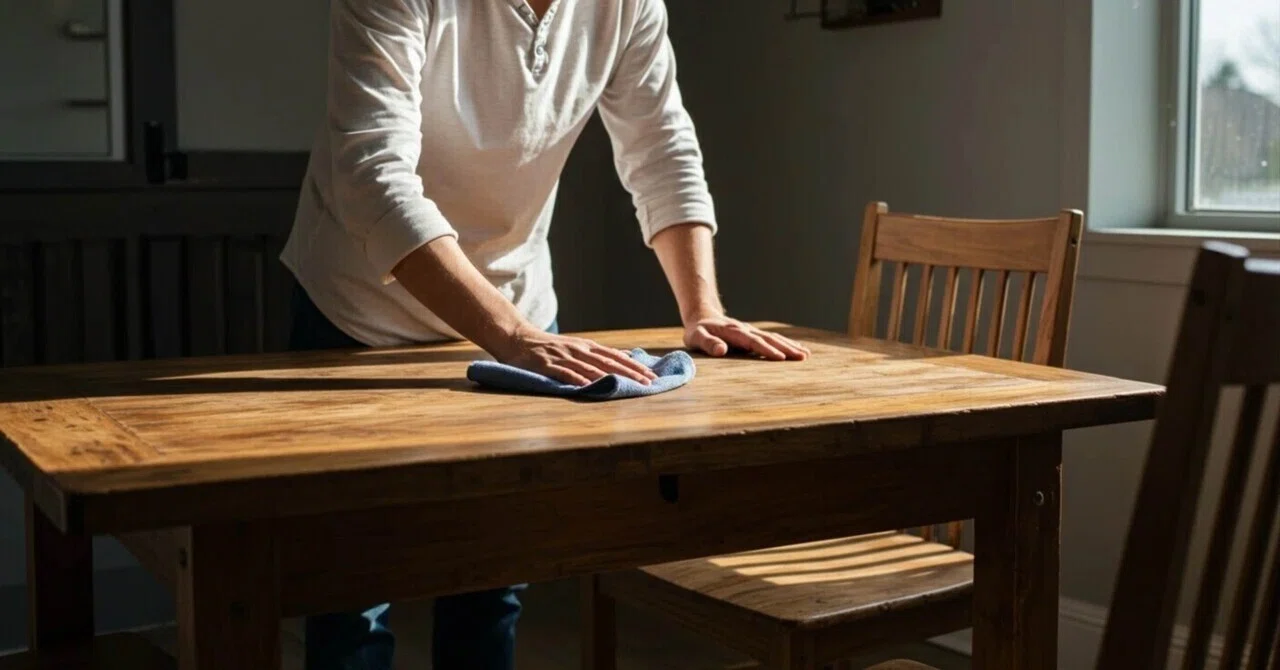
Is It Really "Care" You're Longing For?

A note for readers outside Japan: this piece revolves around a Japanese phrase, teinei na kurashi (丁寧な暮らし), which translates roughly as "a careful life" or "living attentively." It names a whole aesthetic genre here — hand-ground coffee, food cooked in a clay pot, natural-fiber clothing, morning light falling on a wooden table. It has its own hashtag, its own magazines, its own shelf in the bookstore. The closest equivalents elsewhere would be "slow living" or the more domestic end of "cottagecore," though teinei carries an extra connotation of doing something properly and without haste, the way a craftsman would. Throughout this piece I'll use "the careful life."
You long for the careful life. But your actual home has convenience-store bags piling up on the counter, laundry sitting unfolded on the sofa, and dinner decided somewhere on the walk home. The distance between the longing and the reality has started to wear on you.
This piece is for you.
Here's my conclusion up front: it's worth taking that longing apart before you act on it. If you buy the broom and the clay pot without doing that, you probably won't feel satisfied. I'll explain why at the end.
First, a small thing that happened to me.
The broom
I hate the sound of vacuum cleaners.
That low, muffled motor noise takes over the room and occupies the space where my ears are. I avoid it whenever I can. So I sweep my apartment with a broom instead.
I mentioned this to someone I know. It wasn't a meaningful conversation — it just came up while we were talking about cleaning. And I gave the reason along with it: "I can't stand the noise a vacuum makes, so I use a broom."
Here's what came back:
"That's nice. I wish I lived that carefully too."
I was a little thrown.
What I'm doing is not living carefully. I hate the noise, so I hold a broom instead. And I sweep badly. The corners stay dirty, hair doesn't come up on the first pass, and on days I don't feel like it I don't sweep at all. I'm not lovingly maintaining a beautiful tool. I chose the broom for exactly one reason: it doesn't make a sound.
And here's the part that matters: I said all of that, and the verdict came back "careful" anyway.
There was something like admiration in the way it was said. It definitely wasn't sarcasm. The sentence was built on the assumption that I was managing something she wasn't. I didn't correct her. Correcting her would only have extended the conversation, and she wasn't actually asking about the state of my floors.
The reason was never part of the judgment
At first I assumed my motive simply hadn't come through — that she'd filled in her own meaning because the real one was missing.
But that's not what happened. I stated the motive. It landed, and the verdict didn't change.
Which means the reason was never an input in the first place.
So what was she actually looking at? Probably one thing only:
She's not using a vacuum.
A vacuum cleaner is a time-saving appliance. Someone who declines to use one looks like someone who can afford to spend the extra time. Whatever the reason, the act of voluntarily giving up a convenience is enough to satisfy the condition on its own.
If anything, "I hate the noise" may have strengthened the verdict rather than weakened it. Being able to accept inconvenience over something that minor suggests you have room to spare.
The value isn't in the inconvenience — it's in having had a choice
ここから先は
¥ 100
この記事が気に入ったらチップで応援してみませんか?
