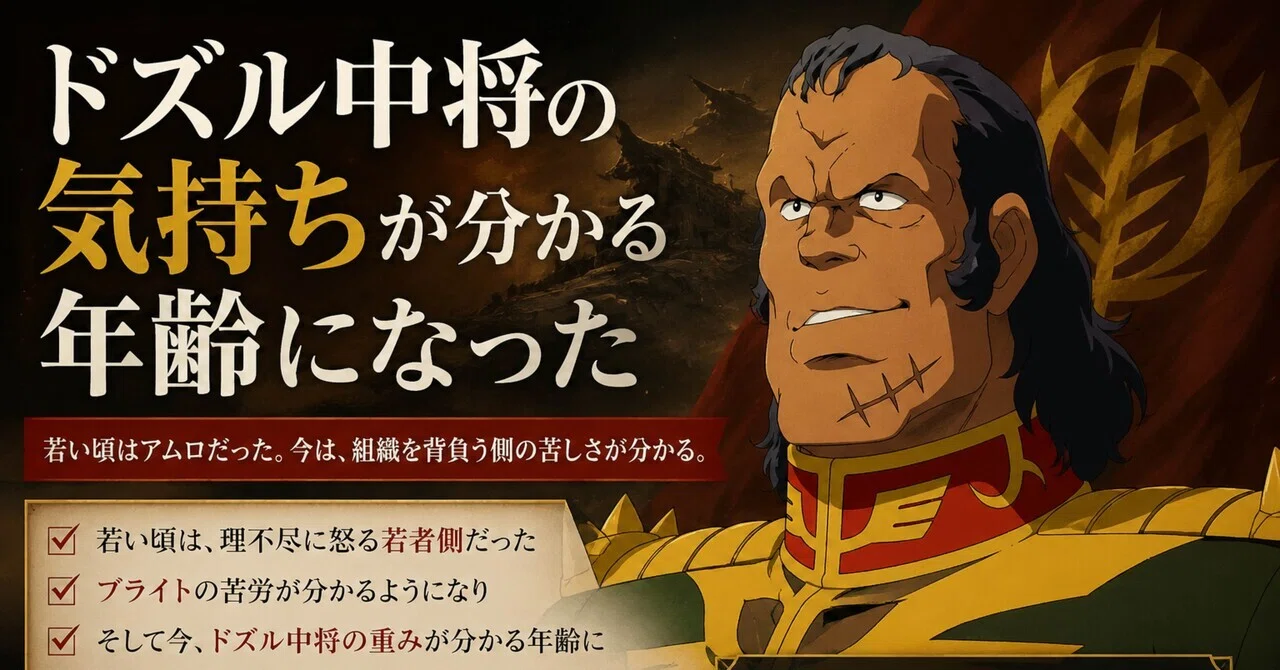
「ドズル中将の気持ちが分かる年齢になった」-ハサウェイやブライト期を超えて

子どもの頃にガンダムを見ていた時、私はずっと主人公側だった。
アムロに共感し、
カミーユの怒りに共感し、
ハサウェイの苦しさに胸を締め付けられていた。
大人たちはいつも理不尽で、
命令ばかりで、
若者を理解していないように見えた。
だから昔の私は、
「なぜこんなに若者を縛るのか」
と思っていた。
しかし40代になった今、ガンダムを見返すと、驚くほど見え方が変わっていた。
気づけば私は、ブライト側の視点で作品を見ていた。
「勝手な行動をするな」
「今動けば全員死ぬかもしれない」
「大事にならなかったから良かったものを」
そんなことばかり考えてしまう。
昔は「若者の自由」に見えていたものが、今は「事故寸前の危うさ」に見える。
これは、仕事や家庭を持ったからだと思う。
組織を回す側になり、
家庭を維持する側になり、
“失敗できない立場”になった。
若い頃は、自分が傷つくことしか見えていなかった。
しかし今は、誰か一人の暴走が、周囲全体を壊してしまうことを知っている。
学校でもそうだ。
若い教員の勢いは大切だと思う。
理不尽に怒り、
古い仕組みに疑問を持ち、
「このままではダメだ」と叫ぶ感覚は、むしろ必要なものだと思う。
しかし同時に、組織は理想だけでは回らない。
誰かが事故を防ぎ、
全体を調整し、
感情を飲み込み、
静かに責任を引き受けなければならない。
若い頃には、その重さが分からなかった。
そして最近、私はさらに別の感覚を持ち始めている。
それが、「ドズル中将の気持ちが少し分かる」という感覚だ。
若い頃の私にとって、ドズルは単なる“暑苦しい軍人”だった。
しかし今見ると、彼は「巨大なものを背負っている人間」に見える。
部下を守り、
組織を維持し、
家族を守り、
戦況を見ながら、
それでも前へ進まなければならない。
しかも、誰よりも「もう止められないこと」を理解している。
これは、中間管理職になった人間には少し分かってしまう感覚かもしれない。
現場の苦しさも分かる。
上層部の事情も分かる。
理想論だけでは回らないことも分かる。
しかし、それでも誰かが前に立たなければならない。
だから、昔のように単純に「大人は敵だ」と思えなくなった。
一方で、若者側の気持ちも今でも分かる。
アムロも、カミーユも、ハサウェイも、きっと止まれなかったのだと思う。
青年期とは、「自分は何者なのか」を探しながら、世界とぶつかる時期だからだ。
だから人は、理想に燃え、
極端になり、
衝動的になり、
大きく傷つく。
そして時には、周囲まで巻き込む。
教育現場にいると、それを毎年見ている。
しかし人間は、たぶんその時期を通らずには成熟できない。
だから最近の私は、若者を「止めたい」のに、完全には止めきれない。
なぜなら、自分もそこを通ってきたからだ。
ガンダムは、若者の物語だと思っていた。
しかし今は、「責任を背負う大人たちの物語」だったのだと思う。
そして年齢を重ねるほど、敵側に見えていた人物たちの孤独が、少しずつ分かるようになってきた。
【I’ve Reached the Age Where I Understand Dozle Zabi】
When I watched Gundam as a child, I was always on the side of the protagonists.
I empathized with Amuro.
I felt Kamille’s anger.
And Hathaway’s pain was almost unbearable to me.
Adults always seemed unreasonable.
They gave orders.
They tried to control young people.
Back then, I kept thinking:
“Why do adults try to suppress the younger generation so much?”
But now, in my forties, when I rewatch Gundam, I realize something has changed.
Without noticing it, I had started watching the story from Bright Noa’s perspective.
“Don’t act on your own.”
“If you move now, everyone could die.”
“Thank goodness this didn’t turn into a disaster.”
Those are the thoughts that now come naturally to me.
What once looked like “freedom” now looks dangerously close to collapse.
I think this change came from becoming responsible for things in real life.
I became someone who has to maintain an organization.
Someone who has to protect a family.
Someone who cannot afford failure anymore.
When I was younger, I only understood the pain of being controlled.
Now I understand how one impulsive action can damage an entire group.
Schools are the same.
I still believe young teachers need passion.
They should question outdated systems.
They should become angry at unfairness.
They should believe things can change.
That energy matters.
But at the same time, organizations cannot survive on ideals alone.
Someone has to prevent disasters.
Someone has to absorb emotions.
Someone has to quietly carry responsibility for everyone else.
When I was young, I could not understand that weight.
And recently, I’ve begun to feel something else.
For the first time in my life, I think I understand Dozle Zabi.
When I was younger, Dozle simply looked like an overly emotional military commander.
But now, he looks like a man carrying something enormous on his shoulders.
Protecting subordinates.
Holding an organization together.
Protecting family.
Watching a situation slowly spiral beyond control — and still moving forward anyway.
People who become middle managers in real life may eventually understand this feeling.
You understand the suffering of the people below you.
You also understand the pressures coming from above.
And you realize that ideals alone cannot sustain a system.
Yet someone still has to stand at the front and take responsibility.
That is why I can no longer simply say, “Adults are the enemy.”
At the same time, I still understand the younger characters too.
Amuro, Kamille, Hathaway — perhaps they truly could not stop themselves.
Adolescence is the stage where people collide with the world while trying to discover who they are.
That is why young people become extreme.
Why they act impulsively.
Why they hurt themselves — and sometimes others as well.
As a teacher, I see this every year.
But I also feel that people cannot mature without passing through that stage.
And so now I find myself in a strange position.
I want to stop young people from making dangerous mistakes.
But I also know that I once went through the same thing.
When I was young, I thought Gundam was a story about young heroes.
Now I think it is also a story about adults carrying unbearable responsibility.
And the older I become, the more I begin to understand the loneliness of the characters I once believed were simply “the enemy.”
