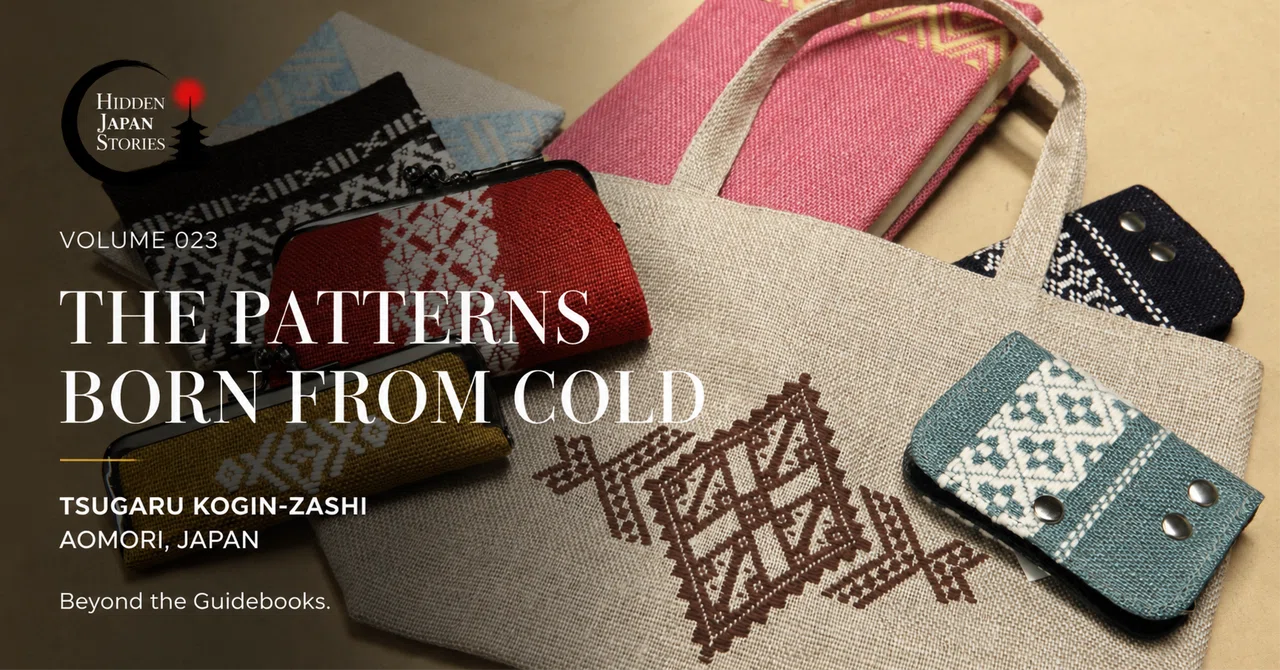
The Patterns Born from Cold: Tsugaru Kogin-zashi|Volume 023

In Aomori, white threads form precise geometric patterns across deep indigo cloth.
Today, kogin-zashi is admired as one of northern Japan’s most distinctive textile traditions.
But these patterns did not begin as decoration.
They began with cold.
Clothing Made for a Northern Climate
During the Edo period, farming families in the Tsugaru region lived through severe winters with limited clothing materials.
Farmers were not permitted to wear cotton clothing and instead relied mainly on layers of hemp.
Hemp was strong and practical.
But in the bitter northern winter, its loose weave allowed cold air to pass through.
Women began stitching cotton thread into the hemp fabric.
The additional thread filled the gaps, reinforced worn areas, and made the clothing warmer.
The first purpose was simple.
Survival.
When Reinforcement Became Pattern
Over time, the stitches became more deliberate.
Threads were counted carefully across the fabric, and repeated forms began to emerge.
Diamonds, lines, and geometric motifs spread across the surface of the clothing.
What had started as a way to strengthen fabric gradually became a visual language.
Function became pattern.
Patterns Shaped by Place
Kogin-zashi developed in several recognizable regional styles.
Higashi-kogin was associated with areas east of the Iwaki River.
Nishi-kogin developed to the west.
Mishima-kogin became known for its particularly detailed and densely stitched designs.
Each style reflected differences in location, materials, and local practice.
The patterns were never simply ornamental.
They were shaped by the lives of the people who made and wore them.
From Workwear to Craft
Modern clothing no longer depends on kogin-zashi for warmth.
Yet the technique has survived.
Today, kogin patterns appear on bags, wallets, accessories, interior items, and contemporary fashion.
The original problem has disappeared.
The knowledge used to solve it has not.
That is what makes kogin-zashi more than a decorative craft.
It carries the memory of how people adapted to one of Japan’s harshest climates using the limited materials available to them.
Beauty Was Not the Beginning
The geometric patterns of kogin-zashi are beautiful.
But beauty was not the beginning.
Cold was.
Scarcity was.
Daily life was.
And through generations of repetition, practical knowledge became cultural identity.
What looks like decoration today was once protection.
Beauty was not the beginning.
Survival was.
— Hidden Japan Stories
Beyond the Guidebooks.
Every Place. Every Story.
Editor’s Note
We chose Tsugaru’s kogin-zashi because it shows how beauty can emerge from constraint.
The geometric patterns are easy to admire as design, but their deeper value lies in the problem they once solved: how to make limited materials work against a severe northern winter.
Kogin-zashi reminds us that craft is often memory preserved through practical knowledge.
— Hidden Japan Stories Editorial Team
Photo Credit
Lead Photo: Aomori Prefecture / Amazing AOMORI Photo Library — “Kogin-zashi”
