
About me
I received my B.S. degree in 2023 from the Department of Statistics and Information Science at Fu Jen Catholic University (FJCU), Taiwan, where I was advised by Prof. Hao-Chiang Shao.
I completed my M.S. degree in 2025 at National Cheng Kung University (NCKU), where I conducted research at the Advanced Computer Vision Laboratory (ACVLAB) under the mentorship of Prof. Chih-Chung Hsu and the Computational Photography Laboratory (CPLAB) at National Yang Ming Chiao Tung University (NYCU), working with Prof. Yu-Lun Liu.
I am an incoming Ph.D. student at the University at Albany, State University of New York (SUNY Albany), where I will conduct research at the Computer Vision and Machine Learning Laboratory (CVML LAB) under the co-supervision of Prof. Ming-Ching Chang and Prof. Xin Li.
My research goal is to advance Reliable and Efficient Multimodal Intelligence, developing systems that integrate complementary information to build a faithful understanding of the world from imperfect observations. Building on my work in visual reconstruction and computational photography, I aim to extend this perspective across modalities: recovering missing information, assessing whether the resulting representations can be trusted, and making that process computationally practical. These challenges connect perception, trust, and efficiency within a common goal—to develop intelligent systems that remain useful and dependable when information is incomplete and computational resources are limited. Full list of publications here.
In my free time, I enjoy traveling ✈️, capturing moments through photography 📸, and making desserts 🍰.
Selected Publications

IrisMix: Compositional Makeup Transfer with Layered Diffusion Transformers
Lets a user compose a makeup look from parts of different references, such as the eyes of one photo, the lips of another and the face paint of a third, and apply it to their own photo while keeping their identity and background. Each reference is split once into a bare face and an explicit makeup layer, so strength, color, lip finish, blending between looks and the placement of a design can all be adjusted directly on the layer before it is rendered onto the face.

Spectral World Renderer: Unified 3D Hyperspectral Unmixing
Reveals what a 3D scene is made of, not just how it looks, to support tasks such as inspecting wafers and thin films in semiconductor manufacturing, examining building materials and monitoring crop health. It carries classical hyperspectral unmixing efficiently into 3D, so every part of a scene can be queried for its materials by name, by a click on the image or by a reference spectrum within milliseconds, and generated worlds with known material composition make the results verifiable.

Doctor Trigger: A Framework for Release-Bound Face Verification
People often know when their face has been swapped into an image, yet they have no objective evidence that fact-checkers or investigators can act on. Doctor Trigger binds each face image to its original release, so a circulating copy can be checked against what was actually published, supporting digital governance and giving users and investigators verifiable evidence.

FlashReFocus: Interactive Image Refocusing in Seconds
* Equal contribution.
Enables interactive refocusing of a single photograph, allowing users to explore focal points, aperture settings, and depth-of-field effects with responsive visual feedback. After a one-time restoration step, a lightweight renderer updates each focal edit in about half a second, making it practical to compare and refine the desired look.
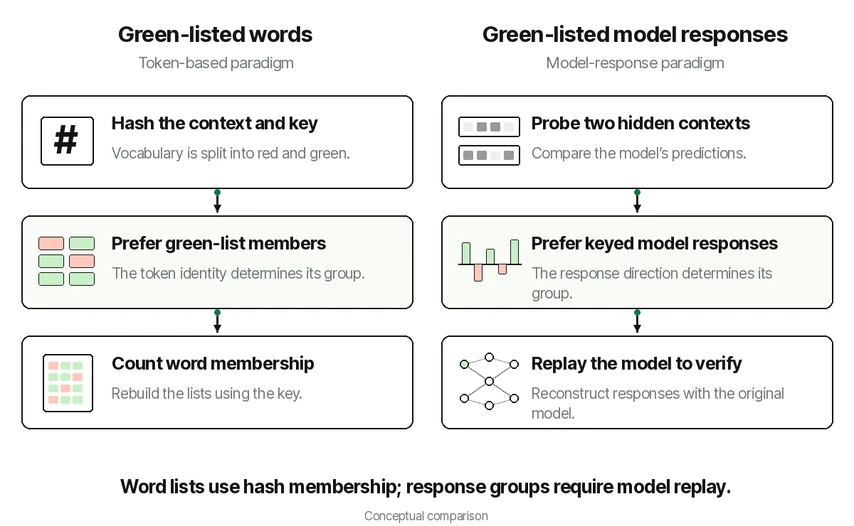
ReplayMark: Probe-and-Replay Model-Response Watermarking for Diffusion Language Models
How can we verify where AI-generated text came from when a model writes tokens in parallel? ReplayMark embeds a watermark in how a diffusion language model responds to re-masked context, while preserving its decoding schedule. A verifier replays the same checkpoint on the finished text and checks whether its responses agree with a secret key, providing exact false-positive control without calibration.

C⁴: Commit Locally, Exit Globally — Coordinating Adaptive Sampling and Early Exit in Diffusion Language Models
Diffusion language models write a whole draft at once, then keep revising it for a fixed number of rounds, often long after the answer has settled. C⁴ adds two simple rules: lock in the words the model is already sure about, and stop once the answer is confident and no longer changing. No retraining, one setting for every task: 2.6–18.6× faster on 12 benchmarks with LLaDA and Dream, never losing more than 2 points of accuracy.

ELSA: Two-Phase Standard-Softmax Scan Attention with Path-Specific Precision and Carried Statistics
Extends ELSA into a two-phase attention framework with path-specific precision, analytic gradients for the standard output, and attention-weighted statistics computed without a second score pass. Independent partition summaries and fixed-order merging support memory-efficient execution, with numerical accuracy and repeatability evaluated across multiple hardware platforms.

PhaSR: Generalized Image Shadow Removal with Physically Aligned Priors
Shadows are easily mistaken for dark materials, and most shadow-removal methods break down indoors, where light comes from many directions at once. PhaSR first corrects the lighting with a closed-form, physically based normalization, then aligns depth geometry with semantic features so it can tell where a shadow ends and an object begins. It removes hard outdoor shadows and soft indoor ones while keeping the surface texture intact.

ReflexSplit: Single Image Reflection Separation via Layer Fusion–Separation
A photo taken through glass mixes the scene behind it with a reflection, and existing methods often confuse the two where the reflection is strong. ReflexSplit separates the layers by repeatedly fusing the structure they share and then subtracting one stream from the other, coordinated across scales. It recovers both a clean view of the scene and the reflection itself, including on real photos taken through windows.

ELSA: Exact Linear-Scan Attention for Fast and Memory-Light Vision Transformers
Memory-efficient attention processes tokens one block after another, and the fastest exact kernels rely on Tensor Cores that offer no fast FP32 path. ELSA computes the same softmax attention as a parallel scan: blocks are summarised independently and merged in a logarithmic number of steps. No retraining and no Tensor Cores: up to 3.5× faster than memory-efficient attention in FP32 at 16K tokens, with the same kernel running from A100 GPUs to the Jetson TX2.

UMCL: Unimodal-generated Multimodal Contrastive Learning for Cross-compression-rate Deepfake Detection
Social platforms re-compress every upload, and deepfake detectors trained on clean video lose much of their accuracy on the compressed copies. UMCL needs no extra recordings: from the face video it derives the facial pulse (rPPG) and landmark motion, pairs them with text prompts, and aligns all three so that fakes remain separable after compression and when one signal is unreliable. Trained on uncompressed FaceForensics++ video, it keeps 95.7 AUC at moderate compression, where a standard detector falls to 74.9.

WWE-UIE: A Wavelet & White Balance Efficient Network for Underwater Image Enhancement
Water absorbs red light first, leaving underwater photos hazy and blue-green, and the strongest enhancement networks are too heavy for real-time use. WWE-UIE builds three simple priors into a compact network: adaptive white balance to restore the missing reds, wavelet decomposition to recover both overall structure and fine texture, and an edge-aware module to keep outlines sharp. It restores natural color with a fraction of the computation, fast enough for real-time use on limited hardware.

PromptHSI: Universal Hyperspectral Image Restoration with Vision-Language Modulated Frequency Adaptation
Hyperspectral images from satellites and aircraft often arrive with several kinds of damage at once, such as thin cloud, noise, blur and missing bands, while restoration models are usually built for one kind at a time. PromptHSI is a single all-in-one model guided by a short text description of the damage: a vision-language model turns the description into controls that adjust frequency-aware features. One model handles many combinations of damage, and changing the description changes what it repairs.
