


Topological vector space
In mathematics, a topological vector space (also called a linear topological space and commonly abbreviated TVS or t.v.s.) is one of the basic structures investigated in functional analysis. A topological vector space is a vector space that is also a topological space with the property that the vector space operations (vector addition and scalar multiplication) are also continuous functions. Such a topology is called a vector topology and every topological vector space has a uniform topological structure, allowing a notion of uniform convergence and completeness. Some authors also require that the space is a Hausdorff space (although this article does not). One of the most widely studied categories of TVSs are locally convex topological vector spaces. This article focuses on TVSs that are not necessarily locally convex. Other well-known examples of TVSs include Banach spaces, Hilbert spaces and Sobolev spaces.
Many topological vector spaces are spaces of functions, or linear operators acting on topological vector spaces, and the topology is often defined so as to capture a particular notion of convergence of sequences of functions.
In this article, the scalar field of a topological vector space will be assumed to be either the complex numbers or the real numbers unless clearly stated otherwise.


Motivation
[edit]Normed spaces
[edit]Every normed vector space has a natural topological structure: the norm induces a metric and the metric induces a topology. This is a topological vector space because[citation needed]:
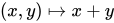
- The vector addition map defined by is (jointly) continuous with respect to this topology. This follows directly from the triangle inequality obeyed by the norm.
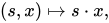
- The scalar multiplication map defined by where is the underlying scalar field of is (jointly) continuous. This follows from the triangle inequality and homogeneity of the norm.




Thus all Banach spaces and Hilbert spaces are examples of topological vector spaces.
Non-normed spaces
[edit]There are topological vector spaces whose topology is not induced by a norm, but are still of interest in analysis. Examples of such spaces are spaces of holomorphic functions on an open domain, spaces of infinitely differentiable functions, the Schwartz spaces, and spaces of test functions and the spaces of distributions on them.[1] These are all examples of Montel spaces. An infinite-dimensional Montel space is never normable. The existence of a norm for a given topological vector space is characterized by Kolmogorov's normability criterion.
A topological field is a topological vector space over each of its subfields.
Definition
[edit]
A topological vector space (TVS) is a vector space over a topological field (most often the real or complex numbers with their standard topologies) that is endowed with a topology such that vector addition and scalar multiplication are continuous functions (where the domains of these functions are endowed with product topologies). Such a topology is called a vector topology or a TVS topology on


Every topological vector space is also a commutative topological group under addition.
Hausdorff assumption
Many authors (for example, Walter Rudin), but not this page, require the topology on to be T1; it then follows that the space is Hausdorff, and even Tychonoff. A topological vector space is said to be separated if it is Hausdorff; importantly, "separated" does not mean separable. The topological and linear algebraic structures can be tied together even more closely with additional assumptions, the most common of which are listed below.
Category and morphisms
The category of topological vector spaces over a given topological field is commonly denoted or The objects are the topological vector spaces over and the morphisms are the continuous -linear maps from one object to another.


A topological vector space homomorphism (abbreviated TVS homomorphism), also called a topological homomorphism,[2][3] is a continuous linear map between topological vector spaces (TVSs) such that the induced map is an open mapping when which is the range or image of is given the subspace topology induced by


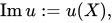


A topological vector space embedding (abbreviated TVS embedding), also called a topological monomorphism, is an injective topological homomorphism. Equivalently, a TVS-embedding is a linear map that is also a topological embedding.[2]
A topological vector space isomorphism (abbreviated TVS isomorphism), also called a topological vector isomorphism[4] or an isomorphism in the category of TVSs, is a bijective linear homeomorphism. Equivalently, it is a surjective TVS embedding[2]
Many properties of TVSs that are studied, such as local convexity, metrizability, completeness, and normability, are invariant under TVS isomorphisms.
A necessary condition for a vector topology
A collection of subsets of a vector space is called additive[5] if for every there exists some such that


Characterization of continuity of addition at [5]—If is a group (as all vector spaces are), is a topology on and is endowed with the product topology, then the addition map (defined by ) is continuous at the origin of if and only if the set of neighborhoods of the origin in is additive. This statement remains true if the word "neighborhood" is replaced by "open neighborhood."


All of the above conditions are consequently a necessity for a topology to form a vector topology.
Defining topologies using neighborhoods of the origin
[edit]Since every vector topology is translation invariant (which means that for all the map defined by is a homeomorphism), to define a vector topology it suffices to define a neighborhood basis (or subbasis) for it at the origin.


Theorem[6] (Neighborhood filter of the origin)—Suppose that is a real or complex vector space. If is a non-empty additive collection of balanced and absorbing subsets of then is a neighborhood base at for a vector topology on That is, the assumptions are that is a filter base that satisfies the following conditions:


If satisfies the above two conditions but is not a filter base then it will form a neighborhood subbasis at (rather than a neighborhood basis) for a vector topology on
In general, the set of all balanced and absorbing subsets of a vector space does not satisfy the conditions of this theorem and does not form a neighborhood basis at the origin for any vector topology.[5]
Defining topologies using strings
[edit]Let be a vector space and let be a sequence of subsets of Each set in the sequence is called a knot of and for every index is called the -th knot of The set is called the beginning of The sequence is/is a:[7][8][9]
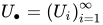


- Summative if for every index
- Balanced (resp. absorbing, closed,[note 1] convex, open, symmetric, barrelled, absolutely convex/disked, etc.) if this is true of every
- String if is summative, absorbing, and balanced.
- Topological string or a neighborhood string in a TVS if is a string and each of its knots is a neighborhood of the origin in



If is an absorbing disk in a vector space then the sequence defined by forms a string beginning with This is called the natural string of [7] Moreover, if a vector space has countable dimension then every string contains an absolutely convex string.


Summative sequences of sets have the particularly nice property that they define non-negative continuous real-valued subadditive functions. These functions can then be used to prove many of the basic properties of topological vector spaces.
Theorem (-valued function induced by a string)—Let be a collection of subsets of a vector space such that and for all For all let

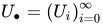



Define by if and otherwise let
![{\displaystyle f:X\to [0,1]}](https://wikimedia.org/api/rest_v1/media/math/render/svg/fbce99d737c06662e393d2d3dba7505a1e6c6eb6)



Then is subadditive (meaning for all ) and on so in particular, If all are symmetric sets then and if all are balanced then for all scalars such that and all If is a topological vector space and if all are neighborhoods of the origin then is continuous, where if in addition is Hausdorff and forms a basis of balanced neighborhoods of the origin in then is a metric defining the vector topology on




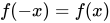
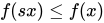



A proof of the above theorem is given in the article on metrizable topological vector spaces.
If and are two collections of subsets of a vector space and if is a scalar, then by definition:[7]
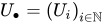
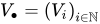
- contains : if and only if for every index
- Set of knots:
- Kernel:
- Scalar multiple:
- Sum:
- Intersection:







If is a collection sequences of subsets of then is said to be directed (downwards) under inclusion or simply directed downward if is not empty and for all there exists some such that and (said differently, if and only if is a prefilter with respect to the containment defined above).


Notation: Let be the set of all knots of all strings in


Defining vector topologies using collections of strings is particularly useful for defining classes of TVSs that are not necessarily locally convex.
Theorem[7] (Topology induced by strings)—If is a topological vector space then there exists a set [proof 1] of neighborhood strings in that is directed downward and such that the set of all knots of all strings in is a neighborhood basis at the origin for Such a collection of strings is said to be fundamental.

Conversely, if is a vector space and if is a collection of strings in that is directed downward, then the set of all knots of all strings in forms a neighborhood basis at the origin for a vector topology on In this case, this topology is denoted by and it is called the topology generated by


If is the set of all topological strings in a TVS then [7] A Hausdorff TVS is metrizable if and only if its topology can be induced by a single topological string.[10]

Topological structure
[edit]A vector space is an abelian group with respect to the operation of addition, and in a topological vector space the inverse operation is always continuous (since it is the same as multiplication by ). Hence, every topological vector space is an abelian topological group. Every TVS is completely regular but a TVS need not be normal.[11]

Let be a topological vector space. Given a subspace the quotient space with the usual quotient topology is a Hausdorff topological vector space if and only if is closed.[note 2] This permits the following construction: given a topological vector space (that is probably not Hausdorff), form the quotient space where is the closure of is then a Hausdorff topological vector space that can be studied instead of


Invariance of vector topologies
[edit]One of the most used properties of vector topologies is that every vector topology is translation invariant:
- for all the map defined by is a homeomorphism, but if then it is not linear and so not a TVS-isomorphism.

Scalar multiplication by a non-zero scalar is a TVS-isomorphism. This means that if then the linear map defined by is a homeomorphism. Using produces the negation map defined by which is consequently a linear homeomorphism and thus a TVS-isomorphism.


If and any subset then [6] and moreover, if then is a neighborhood (resp. open neighborhood, closed neighborhood) of in if and only if the same is true of at the origin.





Local notions
[edit]A subset of a vector space is said to be

- absorbing (in ): if for every there exists a real such that for any scalar satisfying [12]
- balanced or circled: if for every scalar [12]
- convex: if for every real [12]
- a disk or absolutely convex: if is convex and balanced.
- symmetric: if or equivalently, if





Every neighborhood of the origin is an absorbing set and contains an open balanced neighborhood of [6] so every topological vector space has a local base of absorbing and balanced sets. The origin even has a neighborhood basis consisting of closed balanced neighborhoods of if the space is locally convex then it also has a neighborhood basis consisting of closed convex balanced neighborhoods of the origin.

Bounded subsets
A subset of a topological vector space is bounded[13] if for every neighborhood of the origin there exists such that .


The definition of boundedness can be weakened a bit; is bounded if and only if every countable subset of it is bounded. A set is bounded if and only if each of its subsequences is a bounded set.[14] Also, is bounded if and only if for every balanced neighborhood of the origin, there exists such that

Moreover, when is locally convex, the boundedness can be characterized by seminorms: the subset is bounded if and only if every continuous seminorm is bounded on [15]


Every totally bounded set is bounded.[14] If is a vector subspace of a TVS then a subset of is bounded in if and only if it is bounded in [14]
Metrizability
[edit]Birkhoff–Kakutani theorem—If is a topological vector space then the following four conditions are equivalent:[16][note 3]
- The origin is closed in and there is a countable basis of neighborhoods at the origin in
- is metrizable (as a topological space).
- There is a translation-invariant metric on that induces on the topology which is the given topology on
- is a metrizable topological vector space.[note 4]


By the Birkhoff–Kakutani theorem, it follows that there is an