


Carnot heat engine

A Carnot heat engine[2] (English: /kɑːrˈnoʊ/ kar-NOH, French: [kaʁno]) is a theoretical heat engine that operates on the Carnot cycle. The basic model for this engine was developed by French military engineer Nicolas Léonard Sadi Carnot in 1824. The Carnot engine model was graphically expanded by Benoît Paul Émile Clapeyron in 1834 and mathematically explored by Rudolf Clausius in 1857, work that led to the fundamental thermodynamic concept of entropy. The Carnot engine is the most efficient heat engine which is theoretically possible.[3] The efficiency depends only upon the absolute temperatures of the hot and cold heat reservoirs between which it operates.
A heat engine acts by transferring energy from a warm region to a cool region of space and, in the process, converting some of that energy to mechanical work. The cycle may also be reversed. The system may be worked upon by an external force, and in the process, it can transfer thermal energy from a cooler system to a warmer one, thereby acting as a refrigerator or heat pump rather than a heat engine.
Every thermodynamic system exists in a particular state. A thermodynamic cycle occurs when a system is taken through a series of different states, and finally returned to its initial state. In the process of going through this cycle, the system may perform work on its surroundings, thereby acting as a heat engine.
The Carnot engine is a theoretical construct, useful for exploring the efficiency limits of other heat engines. An actual Carnot engine, however, would be completely impractical to build.
History and context
[edit]
The Carnot engine was publicized in Sadi Carnot's sole work: Reflections on the Motive Power of Fire (1824).[4] A short book addressed to practical engineers[5] in popular language,[6] it has been described as "remarkably accessible to modern readers";[4] "very clearly written ... [the] mathematical arguments are consigned to footnotes".[7] It is known that Carnot was anxious to be understood by non-specialists.[8]
Carnot's motivation was practical. "The purpose of Reflexions was to bring to public notice the potential of the steam engine for improving the standard of living in France".[9][6]

The first useful steam engines were developed in Britain[10] and were typically employed for pumping water out of coal mines.[11] Since an engine could burn the mine's own coal (including waste coal, which had no commercial value)[12][13] fuel economy was of little concern.[14][15] The incentive to have efficient engines arose in parts of the country where fuel was costly, such as Cornwall.[16]
The mines of Cornwall produced useful metals like tin; but not coal. The fuel to power their pumping engines had to be imported by sea[17] and was expensive; users were keenly aware[18] that "heat cost money".[16] They sought the engine that did the best "duty'", measured in millions of pounds of water lifted one foot high per bushel of coal burnt. A practical business measure, it was a crude indication of the thermodynamic efficiency of an engine.[19]
Cornish engineers were famous for the efficiency of their engines and their achievements were studied avidly, not least in France, where coal was expensive too.[20][21] Sadi Carnot's book mentioned three of them by name, Richard Trevithick, Arthur Woolf and Jonathan Hornblower.[22] Such men developed the Cornish engine in which high pressure steam was cut off early when the piston was at the beginning of its stroke, letting the steam's expansion complete the stroke by itself.[23] Today it might be called adiabatic expansion.[24]
Their ideas were enthusiastically taken up in France,[25] where additionally, scientists and engineers were interested in the theory of steam and other engines.[26][27]
Significance
[edit]

Importance
[edit]Carnot's innovation has been described as "real genius"[28] and "one of the greatest intellectual achievements of the human mind".[29] For Nobel laureate Richard Feynman
The science of thermodynamics began with an analysis, by the great engineer Sadi Carnot, of the problem of how to build the best and most efficient engine.[30]
In particular it led to the discovery of the Second Law, of which it has been claimed that "Not knowing the Second Law of Thermodynamics is equivalent to never having read a work by Shakespeare".[31][32]
Clarity
[edit]Sadi Carnot died young and published only one work: Reflections on the Motive Power of Fire (1824).[33] A short book addressed to practical engineers[34] in popular language,[35] it has been described as "remarkably accessible to modern readers";[36] "very clearly written ... [the] mathematical arguments are consigned to footnotes".[37] It is known that Carnot was anxious to be understood by non-specialists.[38] Yet, in many university courses the Carnot cycle it is introduced in such an abstract way[39][40] that students have trouble intuiting his ideas, and their implications.[41][42]
Not all approve of his popular exposition. In The Tragicomical History of Thermodynamics 1822-1854 Clifford Truesdell strongly criticised Carnot for his lack of mathematical rigour, which (he said) has affected the discipline ever since.[43]
Flaw in theory, and rescue
[edit]Carnot's theory as published contains a serious[44] flaw, which he increasingly came to suspect himself.[45] Like many scientists of his time he had assumed heat was an actual substance (they called it caloric).[46] This is an intuitive way to think about heat and it has been shown that children think similarly.[47]
After Carnot's death new data led to a fundamental shift in scientific thinking. Heat is now usually[48] described as a form of energy, which can be converted into mechanical work, and vice versa. Carnot's theory was eventually rescued by Rudolf Clausius and (independently) William Thomson (Lord Kelvin), who made the necessary corrections.[49][50] Today most students are taught not Carnot's theory but the rescued version. If Carnot's version is taught first it is easier to understand.[51] This detail will be explained later.
Context and motivation
[edit]Carnot's motivation was practical. "The purpose of Reflexions was to bring to public notice the potential of the steam engine for improving the standard of living in France".[9]
The first useful steam engines were developed in Britain[52] and were typically employed for pumping water out of coal mines.[53] Since an engine could burn the mine's own coal (including waste coal, which had no commercial value)[12][13] fuel economy was of little concern.[14][15] The incentive to have efficient engines arose in parts of the country where fuel was costly, such as Cornwall.[16]
The mines of Cornwall produced useful metals like tin; but not coal. The fuel to power their pumping engines had to be imported by sea[17] and was expensive; users were keenly aware[18] that "heat cost money".[16] They sought the engine that did the best "duty'", measured in millions of pounds of water lifted one foot high per bushel of coal burnt. A practical business measure, it was a crude indication of the thermodynamic efficiency of an engine.[19]
Cornish engineers were famous for the efficiency of their engines and their achievements were studied avidly, not least in France, where coal was expensive too.[20][21] Sadi Carnot's book mentioned three of them by name, Richard Trevithick, Arthur Woolf and Jonathan Hornblower.[22] Such men developed the Cornish engine in which high pressure steam was cut off early when the piston was at the beginning of its stroke, letting the steam's expansion complete the stroke by itself.[23] Today it might be called adiabatic expansion.[24]
Their ideas were enthusiastically taken up in France,[25] where additionally, scientists and engineers were interested in the theory of steam and other engines.[26][27]
Carnot's aim
[edit]
"Every one knows that heat can produce motion", began Carnot. Typically it was done by steam engines. Important to the Industrial Revolution, they had been vastly improved by practical British engineers, said Carnot,[54] but without really understanding the theory of what they were doing.[55]
Because of the remarkable[21] improvements that had already been made in fuel efficiency - a ten-fold increase since 1775 - it was asked whether it would go on for ever.[56] Or would engineers run up against a fundamental limit, impossible to exceed?[57] Matters such as these had attracted some of the ablest mathematicians and physicists in France.[58]
Engineers also wondered if there could be a better working substance than steam. In principle, anything that exerted a force when heated and cooled might work, even a solid metallic bar.[59][60] Many substances were tried or considered, for example the Stirling engine used air. Others included alcohol, ammonia, even mercury; there were hundreds of such exotic proposals, some dangerous:[61] there were ships and factories powered by engines that worked by boiling ether, a highly flammable liquid.[62]
To answer questions such as these, said Carnot, one needed to think generally, to go beyond the details of this or that engine.
It is necessary to establish principles applicable not only to steam-engines but to all imaginable heat-engines.[63]
For historian of science John D. Norton "it is important to realize just how audacious it was of Sadi to seek such a simple general theory, let alone to find it", for the practical engines of his day were already very complicated devices.[64]
Reasoning
[edit]Edwin Thompson Jaynes wrote:
Carnot's reasoning is outstandingly beautiful, because it deduces so much from so little — and with such a sweeping generality that rises above all tedious details — but at the same time with such a compelling logical force. In this respect, I think that Carnot's principle ranks with Einstein's principle of relativity.[65]
Historian of science D. S. L. Cardwell wrote: "Nothing unnecessary is included and nothing essential is missed out. It is, in fact, very difficult to think of a more efficient piece of abstraction in the history of science since Galileo taught men the basis of the procedure".[66]

1. Heat, without a cold place, cannot generate motion
[edit]Carnot first showed that heat[67] by itself cannot produce motion: it must also have a cooler place to go to. The common steam engine had a hot place (the furnace) and a cool place (the condenser); but he proved the same principle must be true for all heat engines that can possibly be devised.
He imagined an engine with no cold sink at all, where the engine and its surroundings are uniformly hot. Such an engine can deliver no power at all: the piston[68] will not extend nor retract.[69] (As Feynman put it, "If the whole world were at the same temperature, one could not convert any of its heat energy into work".)[70] "It is necessary that there should also be cold; without it, the heat would be useless", said Carnot.[71] (Power station cooling towers were developed to provide such cool places, as were automobile radiators; such recipients for waste heat are called cold sinks, or more directly, heat sinks.)
Carnot supplied an analogy of a waterfall. He wrote:
The motive power of a waterfall depends on its height and on the quantity of the liquid; the motive power of heat depends also on the quantity of caloric used, and on what may be termed [...] the height of its fall, that is to say, the difference of temperature of the bodies between which the exchange of caloric is made.[72]
The insight was that heat engines can only produce motion by exploiting the difference in temperature between two places.[73] This was afterwards used to formulate the Second Law of Thermodynamics:
It is impossible to construct an engine that, operating in a cycle, will produce no effect other than the extraction of heat from a reservoir and the performance of an equivalent amount of work.
If the second law were not true, it would be possible to drive a steam-ship across the ocean by extracting heat from the ocean. — Mark Zemansky.[75]
A ship's engine cannot extract heat from the ocean only for lack of a suitable cold sink. A small engine for polar regions has been proposed that exploits the temperature difference between the sea (just above freezing) and the much colder winter atmosphere (−25 °C).[76]
2. A heat engine can be run in reverse and will behave as a refrigerator
[edit]Running an engine backwards
[edit]Carnot reasoned that, like a water-mill, the heat engine could be run backwards. Instead of exploiting the "fall" to get useful mechanical effort, we could do the reverse: expend the mechanical effort to drive the caloric "upwards".
Specifically, by forcing the engine backwards, we can make heat go from the cool place to the hot place, contrary to what naturally happens. The cool place will be made even cooler (as in a refrigerator) and the hot place will be made even hotter,[a] i.e. a heat pump.[77]
The idea that it is possible to convey heat from a cool to a warm place, but only by the expenditure of mechanical effort, lies at the heart of another way of stating the Second Law of Thermodynamics.[78]
Reversibility as an index of efficiency
[edit]Carnot went on to develop the crucial idea that, the more efficient the engine, the greater the proportion of heat that can be recovered if run backwards.
Historian of science D. S. L. Cardwell believed that Carnot was inspired by the column-of-water engine, an early form of hydropower. Popular in districts where coal was scarce, it was similar to a steam engine, but driven by the pressure of a head of water instead of steam. Like the steam engine, engineers strove to make it more efficient; and they expressed its efficiency in terms of the proportion of water that could be restored if run backwards, when it behaved as a pump.[79][80]
3. The ideally efficient heat engine would be completely reversible
[edit]Carnot went on to prove that if a heat engine could be made completely reversible, its efficiency would be unsurpassable. It is, therefore, the fundamental limit beyond which engine efficiency cannot possibly go, answering his earlier question. Today this engine is called the Carnot engine in his honour. When it is run in reverse, it consumes as much motive power as it generates when it is run forward.[81]
.jpg)
The Carnot engine is not one anyone would attempt to build. Its point is that it represents the ideal or extreme limit which cannot be surpassed even in theory. It is a benchmark against which all real engines can be compared.[82] For example, solar cells are heat engines, and "Carnot efficiency appears profusely in the numerous formulae that have been suggested for solar energy conversion".[83]
For Carnot, a completely[b] reversible engine has this property. Run forwards as a motor, one cycle can lift a weight a certain distance [generate a certain amount of work] while transferring a certain amount of heat from the hot place to the cool place. Run backwards as a refrigerator, one cycle will exactly restore the original conditions. All real engines fall short of this ideal standard, since along the way they lose a fraction of the heat.
The proof is as follows. Suppose there was such a thing as a 'super' engine: one even more efficient than a Carnot engine. Then we could use it to drive a Carnot engine backwards. The Carnot engine would restore the heat from cold to hot place. In effect, the imaginary super engine would be delivering a margin of useful power while using the Carnot engine to feed itself an inexhaustible supply of fuel. Wrote one commentator: "Once started, this would run forever, delivering an infinite amount of useful work without any further expenditure of fuel". We would have perpetual motion to "drive our ships, locomotives and factories".[84][85]
Since this is absurd and inadmissible, we must conclude that the supposed super engine cannot exist.[86] Hence
No heat engine can be more efficient than a completely reversible one operating between the same temperatures.[87]
Physicist Sir Joseph Larmor wrote that this argument "is perhaps the most original in physical science".[37][88]
4. It does not depend on finding a superlative working substance
[edit]
It follows at once that all engines, if reversible, must have the same efficiency if operating between those temperatures, regardless of their working substances.[87] It cannot depend on the working substance, for in the above proof none was specified: it might have been steam, air, or anything else.[89]
(That all reversible engines working between the same heat source and cool place have the same efficiency is yet another way of stating the Second Law of Thermodynamics,[90] and many authors have credited the law to Sadi Carnot himself.[91][92][93])
Therefore, advised Carnot, there was little to be gained by experimenting with exotic substances, for none was intrinsically more efficient. As a practical matter the only promising substitute for steam was air,[94] because "Air could be heated directly by combustion carried on within its own mass"[95] — in other words, the internal combustion engine.
Rather, the guiding principle in practical engine design should be that the temperature of the working fluid should fall from as high as possible to as low as possible, acting expansively.[96]
5. The Carnot cycle
[edit]To make his proof more rigorous[97] he went on to describe an engine actually working between a hot reservoir and cold sink in a completely reversible cycle. For this to happen each step in the cycle had itself to be reversible i.e. it must not waste any fraction of the heat.
"Now, very little reflection would show that all change of temperature which is not due to a change of volume of the bodies can be only a useless [escape of heat]. The necessary condition of the maximum is, then, that in the bodies employed to realize the motive power of heat there should not occur any change of temperature which may not be due to a change of volume. Reciprocally, every time that this condition is fulfilled the maximum will be attained. This principle should never be lost sight of in the construction of heat-engines; it is its fundamental basis".
"Every change of temperature which is not due to a change of volume ... is necessarily due to the direct passage of the caloric from a more or less heated body to a colder body. This passage occurs mainly by the contact of bodies of different temperatures; hence such contact should be avoided as much as possible".
Carnot, Reflections, 56-7.[98]

The fundamental rule for not wasting heat, deduced Carnot (see quote box), is never to allow direct thermal contact between parts which are at appreciably different temperatures.[99][100][101] Were that to permitted, heat would escape from hotter to cooler: without doing any work.[102]
Very few thermodynamic processes can be carried out without breaking that rule. For instance, if we wanted to expand a body of gas in a cylinder to drive a piston, we would normally just heat it up: but this would require thermal contact with something hotter.
However, there are two extreme cases in which it is just possible in principle:
- Completely insulate the body of gas and allow it to expand spontaneously from its own internal energy; this will lower its temperature. This is called adiabatic expansion. (The idea was used in the Cornish engine, above.)
- Apply heat to the body of gas so slowly[103] that it has time to expand without raising its temperature.[c] For this to happen, the temperature gap between gas and heat source must be infinitesimal. This is called isothermal expansion.[104]
Carnot’s cycle combines them into a working, reversible cycle: To retract the piston and exactly restore the initial conditions, the same processes are to be used in reverse viz. isothermal compression and adiabatic compression.
Hence his cycle can be analyzed into four steps. In the isothermal phases, more energy is produced in the (hot) expansion stroke than is consumed in the (cool) compression stoke. The adiabatic phases exactly cancel out.[105] So the net balance is positive.
The Carnot Cycle is illustrated in the animation; and since it is completely reversible, by Carnot's Principle its efficiency must be the best that can be achieved.
It is usual nowadays when drawing the Carnot cycle to include a pressure–volume diagram with associated mathematics. This was not done by Carnot himself and is not necessary for an intuitive understanding of his ideas.[51]
James Clerk Maxwell wrote:
The great merit of Carnot's method is that he arranges his operations in a cycle, so as to leave the working substance in precisely the same condition as he found it. We are therefore sure that the energy remaining in the working substance is the same in amount as at the beginning of the cycle.
This greatly simplifies any calculations, since we only have to compare the heat taken in, the heat given out, and the work done by the engine[106]
Carnot's diagram
[edit]In the adjacent diagram, from Carnot's 1824 work, Reflections on the Motive Power of Fire,[107] there are "two bodies A and B, kept each at a constant temperature, that of A being higher than that of B. These two bodies to which we can give, or from which we can remove the heat without causing their temperatures to vary, exercise the functions of two unlimited reservoirs of caloric. We will call the first the furnace and the second the refrigerator."[108] Carnot then explains how we can obtain motive power, i.e., "work", by carrying a certain quantity of heat from body A to body B. It also acts as a cooler and hence can also act as a refrigerator.
Modern diagram
[edit]
The previous image shows the original piston-and-cylinder diagram used by Carnot in discussing his ideal engine. The figure at right shows a block diagram of a generic heat engine, such as the Carnot engine. In the diagram, the "working body" (system), a term introduced by Clausius in 1850, can be any fluid or vapor body through which heat Q can be introduced or transmitted to produce work. Carnot had postulated that the fluid body could be any substance capable of expansion, such as vapor of water, vapor of alcohol, vapor of mercury, a permanent gas, air, etc. Although in those early years, engines came in a number of configurations, typically QH was supplied by a boiler, wherein water was boiled over a furnace; QC was typically removed by a stream of cold flowing water in the form of a condenser located on a separate part of the engine. The output work, W, is transmitted by the movement of the piston as it is used to turn a crank-arm, which in turn was typically used to power a pulley so as to lift water out of flooded salt mines. Carnot defined work as "weight lifted through a height".
Carnot cycle
[edit]

The Carnot cycle when acting as a heat engine consists of the following steps:
- Reversible isothermal expansion of the gas at the "hot" temperature, TH (isothermal heat addition or absorption). During this step (A to B) the gas is allowed to expand and it does work on the surroundings. The temperature of the gas (the system) does not change during the process, and thus the expansion is isothermic. The gas expansion is propelled by absorption of heat energy QH and of entropy ΔSH = QH / TH from the high temperature reservoir.
- Isentropic (reversible adiabatic) expansion of the gas (isentropic work output). For this step (B to C) the piston and cylinder are assumed to be thermally insulated, thus they neither gain nor lose heat. The gas continues to expand, doing work on the surroundings, and losing an equivalent amount of internal energy. The gas expansion causes it to cool to the "cold" temperature, TC. The entropy remains unchanged.
- Reversible isothermal compression of the gas at the "cold" temperature, TC (isothermal heat rejection) (C to D). Now the gas is exposed to the cold temperature reservoir while the surroundings do work on the gas by compressing it (such as through the return compression of a piston), while causing an amount of waste heat QC < 0 (with the standard sign convention for heat) and of entropy ΔSC = QC/TC < 0 to flow out of the gas to the low temperature reservoir. (In magnitude, this is the same amount of entropy absorbed in step 1. The entropy decreases in isothermal compression since the multiplicity of the system decreases with the volume.) In terms of magnitude, the recompression work performed by the surroundings in this step is less than the work performed on the surroundings in step 1 because it occurs at a lower pressure due to the lower temperature (i.e. the resistance to compression is lower under step 3 than the force of expansion under step 1). We can refer to the first law of thermodynamics to explain this behavior: ΔU= W+Q .
- Isentropic compression of the gas (isentropic work input) (D to A). Once again the piston and cylinder are assumed to be thermally insulated and the cold temperature reservoir is removed. During this step, the surroundings continue to do work to further compress the gas and both the temperature and pressure rise now that the heat sink has been removed. This additional work increases the internal energy of the gas, compressing it and causing the temperature to rise to TH. The entropy remains unchanged. At this point the gas is in the same state as at the start of step 1.
Carnot's theorem
[edit]
Carnot's theorem is a formal statement of this fact: No engine operating between two heat reservoirs can be more efficient than a Carnot engine operating between the same reservoirs.
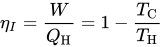
Explanation
[edit]This maximum efficiency ηI is defined as above:
- W is the work done by the system (energy exiting the system as work),
- QH is the heat put into the system (heat energy entering the system),
- TC is the absolute temperature of the cold reservoir, and
- TH is the absolute temperature of the hot reservoir.
A corollary to Carnot's theorem states that: All reversible engines operating between the same heat reservoirs are equally efficient.
It is easily shown that the efficiency η is maximum when the entire cyclic process is a reversible process. This means the total entropy of system and surroundings (the entropies of the hot furnace, the "working fluid" of the heat engine, and the cold sink) remains constant when the "working fluid" completes one cycle and returns to its original state. (In the general and more realistic case of an irreversible process, the total entropy of this combined system would increase.)
Since the "working fluid" comes back to the same state after one cycle, and entropy of the system is a state function, the change in entropy of the "working fluid" system is 0. Thus, it implies that the total entropy change of the furnace and sink is zero, for the process to be reversible and the efficiency of the engine to be maximum. This derivation is carried out in the next section.
The coefficient of performance (COP) of the heat engine is the reciprocal of its efficiency.
Efficiency
[edit]It is sometimes stated that Carnot gave the formula for the efficiency of his engine.[109] He could not have done, since his theory did not embrace the First Law of Thermodynamics, not then known. Carnot himself was able to state that it depended on the temperature difference between the hot source and cold sink, and the temperature of the cold sink.[110]. But he did not give the explicit formula.[87]
The efficiency even of the ideal or Carnot engine turns out to be surprisingly poor, and therefore, that of real engines is even worse. It has been said that the Second Law of Thermodynamics imposes an "energy tax", payable to Nature, every time heat is converted to work.[111]
Carnot engine
[edit]The Carnot engine's efficiency depends on only two temperatures and its calculation is simple. It can be considered in terms of the fraction of heat that goes down the cold sink instead of being converted to work — the "energy tax" that must be paid to nature.
This fraction is simply the temperature of the cold sink divided by the temperature of the hot sink; they must be measured in degrees kelvin.[112] (On this scale 0 K is absolute zero. Fahrenheit or Celsius temperatures would give erroneous results since these scales were arbitrarily defined.)
For example if the hot temperature is 373 K (water boils) and the cold temperature is 273 K (ice melts), then 73% of the heat must go down the cold sink, an escapable fact of nature.[113] The engine's efficiency working between those temperatures is thus only 27%.
Timescale
[edit]In fact, the Carnot engine cannot deliver even that performance within a realistic timescale.
Of the four phases of the Carnot cycle, the two isothermals must be performed extremely slowly. (If not, there would be an appreciable temperature gradient, implying heat loss and irreversibility, see above.) But this means that the engine takes infinite time to perform a cycle, or put crudely, it never does.[114]
If the engine is to operate in real time, it becomes necessary to sacrifice some of its reversibility. It then develops real power, but it is no longer a true Carnot engine, and its efficiency is less.
It has been calculated that the fraction of waste heat down the cold sink then is, not the ratio of the two temperatures (as above), but the square root of that number.[115]
This result was derived by Curzon and Ahlborn — though they were not the first to do so — who claimed that it more closely predicts the performance of real thermal generators.[116]
For example, if working between given temperatures a Carnot engine loses 1/4 of its heat down the cool sink, it will lose 1/2 in real time operation.
Practicality
[edit]
The Carnot engine is supposed to be frictionless and have perfect insulation or conduction where required. Real engines can never match these criteria and their efficiency is poorer. Further, the hot temperature cannot be made extremely high, for practical materials reasons, and the cold temperature can rarely be made very low.
Material limitations
[edit]For example, in the first commercial nuclear power stations the fuel rods could not operate above 450 °C for fear of melting the Magnox cladding.[117] The thermal efficiency was 23%.[118] Later alloys allowed the temperature to be raised to 640 °C, which could deliver a thermal efficiency of 41%.[117]
Steam locomotives
[edit]A good cold sink is needed for efficiency. In the traditional steam railway locomotive such was lacking, since it had no condenser, and simply vented waste steam into the atmosphere. It turned only 4% of its heat into mechanical work. The rest went "straight to heat up the countryside".[119]
Cars and trucks
[edit]Car engines can have efficiencies of 20% or less, compared to their Carnot Limit of 37%.[120] The highest efficiency for a commercial vehicle diesel engine (2021) was claimed to be 50%.[121]
Power stations
[edit]According to Mitsubishi Heavy Industries, in 2022 the world's highest thermal efficiency was achieved at the Joetsu Thermal Power Station No 1, Japan, being certified by Guinness World Records. It was 63.62%.[122]
Solar cells
[edit]Solar cells are heat engines, and they start off with the advantage that the hot reservoir — the Sun — is at 6,000 K. Assuming a good cold sink this would give a Carnot efficiency of 95%. However a solar cell is not a Carnot engine. A 2016 review found that after allowing for various losses they achieved 7-8% efficiency, though it was hoped to raise this.[123]

Efficiency of real heat engines
[edit]For a real heat engine, the total thermodynamic process is generally irreversible. The working fluid is brought back to its initial state after one cycle, and thus the change of entropy of the fluid system is 0, but the sum of the entropy changes in the hot and cold reservoir in this one cyclical process is greater than 0.
The internal energy of the fluid is also a state variable, so its total change in one cycle is 0. So the total work done by the system W is equal to the net heat put into the system, the sum of QH > 0 taken up and the waste heat QC < 0 given off:[124]
| 2 |

For real engines, stages 1 and 3 of the Carnot cycle, in which heat is absorbed by the "working fluid" from the hot reservoir, and released by it to the cold reservoir, respectively, no longer remain ideally reversible, and there is a temperature differential between the temperature of the reservoir and the temperature of the fluid while heat exchange takes place.
During heat transfer from the hot reservoir at TH to the fluid, the fluid would have a slightly lower temperature than TH, and the process for the fluid may not necessarily remain isothermal. Let ΔSH be the total entropy change of the fluid in the process of intake of heat.
| 3 |
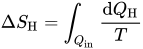
where the temperature of the fluid T is always slightly lesser than TH, in this process.
So, one would get:
| 4 |

Similarly, at the time of heat injection from the fluid to the cold reservoir one would have, for the magnitude of total entropy change ΔSC < 0 of the fluid in the process of expelling heat:
| 5 |
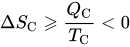
where, during this process of transfer of heat to the cold reservoir, the temperature of the fluid T is always slightly greater than TC.
We have only considered the magnitude of the entropy change here. Since the total change of entropy of the fluid system for the cyclic process is 0, we must have
| 6 |

The previous three equations, namely (3), (4), (5), substituted into (6) to give:[125]
| 7 |
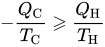
for adding inequalities (3) and (4) gives ΔSH + ΔSC ≥ QH/TH + QC/TC and substituting ΔSH + ΔSC = 0 from (6) gives QH/TH + QC/TC ≤ 0.
Equations (2) and (7) combine to give
| 8 |
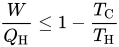
To derive this step needs two adiabatic processes involved to show an isentropic process property for the ratio of the changing volumes of two isothermal processes are equal.
Most importantly, since the two adiabatic processes are volume works without heat lost, and since the ratio of volume changes for this two processes are the same, so the works for these two adiabatic processes are the same with opposite direction to each other, namely, one direction is work done by the system and the other is work done on the system; therefore, heat efficiency only concerns the amount of work done by the heat absorbed comparing to the amount of heat absorbed by the system.
Therefore,

=

=

And, from (7)
Here (heat released)


Here


Hence,
| 9 |

where is the efficiency of the real engine, and is the efficiency of the Carnot engine working between the same two reservoirs at the temperatures and . For the Carnot engine, the entire process is 'reversible', and Equation (7) is an equality. Hence, the efficiency of the real engine is always less than the ideal Carnot engine.


Equation (7) signifies that the total entropy of system and surroundings (the fluid and the two reservoirs) increases for the real engine, because (in a surroundings-based analysis) the entropy gain of the cold reservoir as flows into it at the fixed temperature , is greater than the entropy loss of the hot reservoir as leaves it at its fixed temperature . The inequality in Equation (7) is essentially the statement of the Clausius theorem.


According to the second theorem, "The efficiency of the Carnot engine is independent of the nature of the working substance".
The Carnot engine and Rudolf Diesel
[edit]In 1892 Rudolf Diesel patented an internal combustion engine inspired by the Carnot engine. Diesel knew a Carnot engine is an ideal that cannot be built, but he thought he had invented a working approximation. His principle was unsound, but in his struggle to implement it he developed a practical Diesel engine.
The conceptual problem was how to achieve isothermal expansion in an internal combustion engine, since burning fuel at the highest temperature of the cycle would only raise the temperature further. Diesel's patented solution was: having achieved the highest temperature just by compressing the air, to add a small amount of fuel at a controlled rate, such that heating caused by burning the fuel would be counteracted by cooling caused by air expansion as the piston moved. Hence all the heat from the fuel would be transformed into work during the isothermal expansion, as required by Carnot's theorem.
For the idea to work a small mass of fuel would have to be burnt in a huge mass of air. Diesel first proposed a working engine that would compress air to 250 atmospheres at 800 °C (1,450 °F), then cycle to one atmosphere at 20 °C (50 °F). However, this was well beyond the technological capabilities of the day, since it implied a compression ratio of 60:1. Such an engine, if it could have been built, would have had an efficiency of 73%. (In contrast, the best steam engines of his day achieved 7%.)
Accordingly, Diesel sought to compromise. He calculated that, were he to reduce the peak pressure to a less ambitious 90 atmospheres, he would sacrifice only 5% of the thermal efficiency. Seeking financial support, he published the "Theory and Construction of a Rational Heat Engine to Take the Place of the Steam Engine and All Presently Known Combustion Engines" (1893). Endorsed by scientific opinion, including Lord Kelvin, he won the backing of Krupp and Maschinenfabrik Augsburg. He clung to the Carnot cycle as a symbol. But years of practical work failed to achieve an isothermal combustion engine, nor could have done, since it requires such an enormous quantity of air that it cannot develop enough power to compress it. Furthermore, controlled fuel injection turned out to be no easy matter.
Even so, the Diesel engine slowly evolved over 25 years to become a practical high-compression air engine, its fuel injected near the end of the compression stroke and ignited by the heat of compression, capable by 1969 of 40% efficiency.[126]
As a macroscopic construct
[edit]The Carnot heat engine is, ultimately, a theoretical construct based on an idealized thermodynamic system. On a practical human-scale level the Carnot cycle has proven a valuable model, as in advancing the development of the diesel engine. However, on a macroscopic scale limitations imposed by the model's assumptions prove it impractical, and, ultimately, incapable of doing any work.[127] As such, per Carnot's theorem, the Carnot engine may be thought as the theoretical limit of macroscopic scale heat engines rather than any practical device that could ever be built.[128]
For example, for the isothermal expansion part of the Carnot cycle, the following infinitesimal conditions must be satisfied simultaneously at every step in the expansion:[129]
- The hot reservoir temperature TH is infinitesimally higher than the system gas temperature T so heat flow (energy transfer) from the hot reservoir to the gas is made without increasing T (via infinitesimal work on the surroundings by the gas as another energy transfer); if TH is significantly higher than T, then T may be not uniform through the gas so the system would deviate from thermal equilibrium as well as not being a reversible process (i.e. not a Carnot cycle) or T might increase noticeably so it would not be an isothermal process.
- The force externally applied on the piston (opposite to the internal force on the piston by the gas) needs to be infinitesimally reduced externally. Without this assistance, it would not be possible to follow a gas PV (Pressure-Volume) curve downward at a constant T since following this curve means that the gas-to-piston force decreases (P decreases) as the volume expands (the piston moves outward). If this assistance is so strong that the volume expansion is significant, the system may deviate from thermal equilibrium, and the process fail to be reversible (and thus not a Carnot cycle).
Such "infinitesimal" requirements as these (and others) cause the Carnot cycle to take an infinite amount of time, rendering the production of work impossible.[127]
Other practical requirements that make the Carnot cycle impractical to realize include fine control of the gas, and perfect thermal contact with the surroundings (including high and low temperature reservoirs).[citation needed]
Reliance on the Caloric theory
[edit]_-_WGA06060.jpg)
For most scientists of Carnot's time the best explanation of heat was the caloric theory. It held that heat is a material fluid that can flow from one place to another: its temperature may vary, but it can never itself be destroyed nor created.
The caloric theory was highly developed, mathematically sophisticated, and plausible. The alternative theory, that heat consists in the agitation of a substance's particles — in modern terms, energy — was well known, but did not command much support, mainly for lack of convincing experimental evidence.[131] For historian of science Thomas Kuhn, "To analyze the gas engine Carnot required a developed theory of heat, and in the 1820's the caloric theory was the only one at hand".[132]
Several authors have speculated that without the caloric theory and his waterfall analogy Carnot would not have been led to his discovery.[133][134][100][132][135]
Pursuant to this core idea, Carnot taught that all heat entering his engine from the hot source must fall out into the cold sink. But according to new ideas — that were dawning on Carnot himself, and came to be adopted overwhelmingly — this is false. Some of the heat will be consumed on the way: by the doing of work.[136][137][138][100][139][140]
Electricity
[edit]From 1800 new discoveries started to emerge — e.g. the galvanic battery, heat by electricity, electrolysis, electromagnetism, induced currents, thermoelectric cooling — which increasingly suggested that a single "force", nowadays called energy, was manifesting itself in different ways. According to Thomas Kuhn, the interconnection between previously detached branches of science was going on apace "and that is what Mary Somerville had in mind when, in 1834, she gave her famous popularization of science the title On the Connexion of the Physical Sciences".[141]


For Kuhn, "Mrs. Somerville's remark isolates the 'new look' that physical science had acquired between 1800 and 1835. That new look, together with the discoveries that produced it, proved to be a major requisite for the emergence of energy conservation."[142]
Emergence of Energy
[edit]Within the space of a few years perhaps a dozen scientists, largely working independently, became convinced that heat and work are mutually interchangeable (always at same rate of exchange, which they were able to calculate). Four of them formally published their claims, supported by data: Julius von Mayer (Württemberg), James Prescott Joule (England), Ludwig A. Colding (Denmark) and Hermann von Helmholtz (Prussia).[143] Joule's experimental proof was particularly copious.[144]


There is "no more striking instance" of simultaneous discovery in the history of science, wrote Thomas Kuhn. It was not heat that was conserved, but a more general thing: energy. Heat was just one manifestation of energy.[143]
Obscurity
[edit]
One of the first to come round to the dynamical theory of heat, as it was called, had been Sadi Carnot himself.[145] From surviving notes it is known he started to have doubts about the caloric theory and, according to physicist Eric Mendoza, "by the time he came to correct the proofs of his book he had realized that the very basis of all his theorems and demonstrations was wrong".[146] He did not live to solve the problem and publish that. It was a "sad fact that he died in a madhouse": in 1832.[147][148]
His book made no discernible impact on the scientific[149] or engineering[34] communities of the time. One person who did read it was his friend Émile Clapeyron who rewrote the theory in a mathematical treatment and published it in a learned journal; it was translated into English.[150]
Sadi Carnot's book fell into such obscurity that in 1845 William Thomson (the future Lord Kelvin), then a research student in Paris, was unable to find a copy.[151] "He searched libraries, bookstores, and the stalls on the quays along the Seine, but no success... Sadi Carnot on heat was unknown".[152]
Rescues of Carnot's theory
[edit]Rudolf Clausius and William Thomson
[edit]Thomson eventually acquired Carnot’s work in Scotland.[153] He published papers about Carnot's theory that drew it to the attention of scientists generally. It contained some important truths. Using it, Thomson was able to devise the Kelvin scale of temperature,[154] and his brother James Thomson used it to make an important prediction about the freezing point of water under pressure that was verified experimentally. Hence Thomson was extremely reluctant to give up the caloric theory, even though his friend Joule was insisting it was wrong.[155]

_-_Sir_William_Thomson_(1824–1907),_Baron_Kelvin,_Scientist_-_PG_926_-_National_Galleries_of_Scotland.jpg)
Around 1850 Rudolf Clausius (Berlin, Prussia) and William Thomson (Glasgow, Scotland) independently realised that Carnot's theory could be saved by making a new assumption about the laws of physics. Of the two, Clausius published first; Thomson conceded his priority. Their papers can be read as external links to this article. Their reasoning becomes increasingly mathematical but the key point is paraphrased later below.
James Clerk Maxwell
[edit]
The Carnot cycle as published cannot work since it is wrongly assumed that as much heat should be expelled to the cold sink as came in from the hot source. That is too much: not enough will be left in the engine to complete the cycle. A simple way to correct the mistake was described by James Clerk Maxwell in his Theory of Heat (1871).[d] This was a book meant for "artisans and students" but Maxwell "did not hesitate to include discussions of the latest work in thermodynamics".[156]
By that date French engineer Gustave-Adolphe Hirn had confirmed by experiment that, whenever an engine performs mechanical work, less heat emerges from it than goes in. The missing heat is changing into work.[157]
But it was easy to see that the quantities (heat in vs. heat out) could not have been equal, said Maxwell. For, supposing they were, how could we explain that the engine, by doing work, can produce yet more heat — e.g. by stirring a liquid to raise its temperature? In that case the engine must somehow be producing more heat than it consumes, contrary to the doctrine that caloric cannot be created.[157]
To fix the Carnot cycle, therefore, one must terminate the isothermal compression phase at just the right point, before too much heat has passed to the cold sink. It is easy to do this by calculation, said Maxwell, "but is still easier" by removing the sink as soon as the fluid pressure rises to its original cold-temperature value.[158][159][160]
Fixing the proof
[edit]A deeper problem was that Carnot's proof of his central Principle was not valid either. Granted the conservation of heat, he had reasoned (above) that there could not be such a thing as a 'super' engine more efficient than a Carnot engine, or else perpetual motion would be possible. However, as Ted Jacobson noted
While Carnot's conclusion was correct, his argument contained a single deep flaw: heat is not by itself conserved! More heat flows out of the hot reservoir than flows into the colder reservoir, the difference being the work extracted.
This means that, since the 'super' engine is the more efficient of the two, it extracts more work and so passes less waste heat into the cold reservoir. Hence, when the Carnot engine is run backwards, "the cold reservoir is no longer restored to its initial state: more heat is drawn out than went in".
The leftover work, then, is not produced from nothing, but rather from the heat drawn out of the colder reservoir. While not as inadmissable [i.e. intentionally absurd] as Carnot's result, this is nevertheless inadmissable. Its impossibility is Kelvin's version of the second law of thermodynamics.
There is another way of looking at it:
Alternatively, all of the work from the more efficient engine could be used to run the less efficient engine backwards, in which case the net result would be spontaneous (but engineered) heat flow from the colder reservoir to the hotter one, in violation of Clausius' version of the second law.[139][161]
Aftermath
[edit]The Second Law
[edit]Hence, Kelvin and Clausius saved the Carnot Principle by formally identifying and stating new laws of nature. The First Law of Thermodynamics is the conservation of energy. The Second Law can be encapsulated thus:
- Heat cannot flow spontaneously from cold to hot (Clausius).
- An engine cannot be run from a single heat reservoir (Kelvin)[162]
Those are similar formulations; were long believed to be completely equivalent; but turn out not to be quite the same.[163] A disquieting feature, which has still not been explained, is that there is no universally agreed way of stating this law, despite attempts at consensus. There have been many formulations. "And even today, the Second Law remains so obscure that it continues to attract new efforts at clarification".[164]
Engineering in spite of the Second Law
[edit]
Only slowly did the new theory diffuse into engineering practice, and reputable technologists continued to conceive engines that were thermodynamically impossible. John Ericsson built a hot air ship's engine that (it was claimed) saved fuel by continually recycling waste heat.[165] Called the Caloric Engine, its cylinders were 14 foot (4.3 metres) thick.[166] According to one who believed in it:
The principle of this new engine consists in this, that the heat which is required to give motion to the engine at the commencement, is returned by a peculiar process of transfer, and thereby made to act over and over again, instead of being, as in the steam engine, thrown into a condenser, or into the atmosphere as so much waste fuel.
To which Scientific American riposted: "Let us point out its fallacious principles: it is stated that it only uses so much coal to make up the loss of radiation, therefore, if there were no loss of heat by radiation, it would use no coai at all, after the first fire; it would go on for ever — a perpetual motion surely".[167]
Entropy
[edit]
Sadi Carnot's most important single idea may have been the completely reversible thermodynamic process. It led to the concept of entropy,[168] whose meaning is indicated below.
The word entropy ("transformational energy") was coined by Clausius in 1865 to refer to a variable in his mathematical reasoning.[169] It stands for something that is expressed in units of energy divided by temperature,[170] is not directly apprehended by the human senses, and is difficult to measure experimentally,[171] Generally, there exists a rather hazy understanding of entropy, even amongst those who have to use the concept professionally.[172][173] Also the word is much misused by some scientists, educators and popular writers, if not abused by charlatans.[174][175][176]
In the same paper Clausius summarised[177] the laws of thermodynamics as follows:
- The energy of the universe is constant.
- The entropy of the universe tends to a maximum.[178]
One way of understanding 2. is as follows:
Energy of all types [including heat] changes from being localized to becoming dispersed or spread out, if it is not hindered from doing so. The overall process is measured by the increase in thermodynamic entropy. — Frank L. Lambert[179]
Another way to think about entropy is as a measurement of the availability of useful energy in a system. While energy cannot be created or destroyed, as the approaches equilibrium the energy of that system becomes less available for use.[180]
The concept of entropy, though important in thermodynamics, is not necessary for an intuitive understanding of Carnot's theory. There are many formulations of the Second Law that do not mention entropy at all,[181] including the original Clausius and Thomson versions.[182]
Explanatory notes
[edit]- ↑ Unless they are infinitely large reservoirs.
- ↑ "Completely reversible" here is just a convenient explanatory phrase, not a technical expression. In thermodynamics the simpler term "reversible" is used to denote a process that, if run backwards, will exactly recover the starting conditions.
- ↑ I.e. the temperature difference between heat source and the body of gas is infinitesimal.
- ↑ Maxwell's book went through several editions and is still in print. The relevant text has not changed for present purposes.
References
[edit]- ↑ Figure 1 in Carnot (1824, p. 17) and Carnot (1890, p. 63). In the diagram, the diameter of the vessel is large enough to bridge the space between the two bodies, but in the model, the vessel is never in contact with both bodies simultaneously. Also, the diagram shows an unlabeled axial rod attached to the outside of the piston.
- ↑ In French, Carnot uses machine à feu, which Thurston translates as heat-engine or steam-engine. In a footnote, Carnot distinguishes the steam-engine (machine à vapeur) from the heat-engine in general. (Carnot, 1824, p. 5 and Carnot, 1890, p. 43)
- ↑ "The Carnot Efficiency | EGEE 102: Energy Conservation and Environmental Protection". www.e-education.psu.edu. Retrieved 2022-01-24.
- 1 2 Carnot, Sadi; Fox, Robert (1986). Reflexions on the motive power of fire: a critical edition with the surviving scientific manuscripts. Manchester: Manchester University Press. p. 2. ISBN 978-0-7190-1741-4.
- ↑ Kerker, Milton (1960). "Sadi Carnot and the Steam Engine Engineers". Isis. 51 (3): 257. doi:10.1086/348909. ISSN 0021-1753. JSTOR 226506.
- 1 2 Wilson, S. S. (1981). "Sadi Carnot". Scientific American. 245 (2): 136. doi:10.1038/scientificamerican0881-134. ISSN 0036-8733. JSTOR 24964543.
- ↑ Cardwell, D. S. L. (1971). From Watt to Clausius: The Rise of Thermodynamics in the Early Industrial Age. Ithaca, N.Y: Cornell University Press. p. 191. ISBN 978-0-8014-0678-2. Retrieved 25 March 2026.
- ↑ Thurston, R.H. (1897). "The Work of N.-L. Sadi Carnot". In Thurston, R.H. (ed.). Reflections on the Motive Power of Heat (2nd ed.). New York: John Wiley & Sons. Retrieved 6 December 2025.
Anxious to be perfectly clear, Sadi made me read some passages of his manuscript in order to convince himself that it would be understood by persons occupied with other studies.
- 1 2 Wilson 1981, p. 136.
- ↑ Kuhn, Thomas S. (1955-02-01). "Carnot's Version of "Carnot's Cycle"". American Journal of Physics. 23 (2): 95. Bibcode:1955AmJPh..23...91K. doi:10.1119/1.1933907. ISSN 0002-9505.
- ↑ Carnot, Sadi (1897). Thurston, R.H. (ed.). Reflections on the Motive Power of Heat. University of California Libraries (2nd ed.). New York: John Wiley & Sons. pp. 42, 39. Retrieved 6 December 2025.
- 1 2 Small coals were not popular in the market and might not pay the cost of carriage to consumer. Where this was so they were often screened out and burned on the mine's waste-heap: Levy 1911, p. 109
- 1 2 William Stanley Jevons estimated that at least 5 million tons of small coals were burned annually upon the colliery waste-heaps of England, the true amounts being incalculable: Jevons 1866, pp. 234–5, 239.
- 1 2 Carr and Cowart of the U.S. Naval Academy calculated that a Newcomen atmospheric engine at Parkgate, Yorkshire, had a thermal efficiency of only 2.7%. Yet it was purchased in preference to a more efficient but more costly Watt engine since fuel economy did not matter: it burned waste coal. It was not finally retired until 1934, after doing more than 100 years service. Well over a thousand Newcomen engines were built. Carr & Cowart 2012, pp. 25.1357.7-8, 16.
- 1 2 Despite its higher fuel consumption, the Newcomen atmospheric engine was competitive with the more efficient Watt engine wherever coal was cheap enough. "The presence of Watt engines during the last quarter of the [18th] century not only failed to stop the adoption of Newcomen engines, but, in fact, their diffusion accelerated compared to the pre-Watt era": Kitsikopoulos 2023, pp. 100, 103–4.
- 1 2 3 4 Pole 1844, p. 174.
- 1 2 Nuvolari & Verspagen 2005, pp. 3, 24.
- 1 2 Nuvolari 2010, p. 190.
- 1 2 Nuvolari & Verspagen 2005, pp. 3, 5, 7.
- 1 2 Fox 1986, p. 4.
- 1 2 3 Nuvolari 2010, p. 192.
- 1 2 Carnot 1897, pp. 42, 116.
- 1 2 Nuvolari & Verspagen 2005, pp. 20–21, 10–11.
- 1 2 Fox 1970, pp. 234, 238–9.
- 1 2 "[In France], especially after 1815, the news of the successful design of high pressure expansive engines by Trevithick and Woolf in Cornwall and of their staggering improvements in fuel-efficiency was received with enthusiasm": Nuvolari 2010, p. 192.
- 1 2 Fox 1986, p. 8.
- 1 2 Nuvolari 2010, pp. 190–2.
- ↑ Thurston 1897, pp. 1–2.
- ↑ Tribus 1959, p. 20.
- ↑ Feynman 2010, 441.
- ↑ Raviv & Barb 2020, I..
- ↑ The claim was originally made by the novelist and scientist C.P. Snow in his influential 1959 lecture The Two Cultures: Uffink 2001, pp. 1–2.
- ↑ Fox 1986.
- 1 2 Kerker 1960, p. 257.
- ↑ Wilson 1981, p. 134.
- ↑ Fox 1986, p. 2.
- 1 2 Cardwell 1971, p. 191.
- ↑ His brother later recalled: "Anxious to be perfectly clear, Sadi made me read some passages of his manuscript in order to convince himself that it would be understood by persons occupied with other studies": Thurston 1897, p. 30.
- ↑ Laranjeiras & Portela 2016, pp. 1–9.
- ↑ Raviv & Barb 2020.
- ↑ Smith et al. 2015.
- ↑ "There is, perhaps, no proposition in the range of Physics that is more difficult of comprehension by the average student than that embodied in the so-called Carnot Engine and Carnot Cycle": Shedd 1899, p. 174
- ↑ Truesdell 1980, pp. 80–136. "Thermodynamics is the first mathematical science to have been invented without the control afforded by patient, merciless, mathematical criticism. It has suffered from this congenital defect from 1824 until now".
- ↑ Jacobson 2019, p. 2.
- ↑ Fox 1986, p. 1, 26-7, 30-1.
- ↑ Kuhn 1955, pp. 92, 93.
- ↑ Meyn 2024, p. 3.
- ↑ But not invariably. The Karlsruhe Physics Course is a German and English high school textbook that introduces the concept of heat as equivalent to entropy, measured units in called Carnots; only later is the concept of energy introduced. Meyn 2024, p. 2.
- ↑ Fox 1986, pp. 26, 32, 35–6.
- ↑ See also Erlichson 1999, p. 191; Hutchinson 2021, p. 5.
- 1 2 Laranjeiras & Portela 2016.
- ↑ Kuhn 1955, p. 95.
- ↑ Carnot 1897, pp. 42, 39.
- ↑ "There is almost as great a distance between the first apparatus in which the expansive force of steam was displayed and the existing machine, as between the first raft that man ever made and the modern vessel.
If the honor of a discovery belongs to the nation in which it has acquired its growth and all its developments, this honor cannot be here refused to England. Savery, Newcomen, Smeaton, the famous Watt, Woolf, Trevithick, and some other English engineers, are the veritable creators of the steam-engine. It has acquired at their hands all its successive degrees of improvement": Carnot 1897, pp. 41–2. - ↑ Carnot 1897, pp. 41–2.
- ↑ Hutchinson 2021, p. 58.
- ↑ Carnot 1897, p. 42.
- ↑ Fox 1986, pp. 10–11.
- ↑ Carnot 1897, pp. 48–9.
- ↑ Fox 1986, p. 151.
- ↑ Bryant 1973, pp. 160–1, 162.
- ↑ Kerker 1960, p. 269.
- ↑ Carnot 1897, p. 43.
- ↑ Norton 2022, p. 269.
- ↑ Cardwell 1971, p. 201.
- ↑ He used the word calorique, translated as caloric, which many scientists at the time thought of as a weightless, material fluid akin to an invisible gas. That theory has since been disproven. That heat might be a form of motion (in modern terms, energy) was a known hypothesis, but not generally accepted. Today some scientists believe calorique is best written as entropy, which makes better sense of the theory; however, entropy as a formal concept was invented much later (Meyn, 2024), and Thomas Kuhn rejected this interpretation as ahistorical (Kuhn 1955).
- ↑ Some modern heat engines, such as gas turbines, do not have pistons; nevertheless, they must compress the working fluid and they derive motion by passing heat from a hot place to a cooler place. See Cardwell 1971, p. 197.
- ↑ "And in fact, if we should find about us only bodies as hot as our furnaces, how can we condense steam ? What should we do with it if once produced? We should not presume that we might discharge it into the atmosphere, as is done in some engines; the atmosphere would not receive it. It does receive it under the actual condition of things, only because it fulfils the office of a vast condenser, because it is at a lower temperature; otherwise it would soon become fully charged, or rather would be already saturated." Carnot 1897, pp. 46-.<7
- ↑ Feynman 2010, 44.2.
- ↑ Carnot 1897, p. 46.
- ↑ Carnot 1897, p. 60-1.
- ↑ "As late as 1852 John Ericsson went to considerable expense and effort to construct an enormous atmospheric marine engine which he presumed would operate in the absence of a temperature difference": Kerker 1960, p. 269. Proposals to power the planet by covering the Sahara desert with solar panels must consider how they are to be cooled.
- ↑ There are many ways of stating the Second Law: Uffink 2001, p. 2. This version is due to Lord Kelvin and Max Planck.
- ↑ Zemansky 1957, p. 147.
- ↑ Lock 1989.
- ↑ Meyn 2024, pp. 1, 24.
- ↑ The Clausius formulation: It is impossible to construct a device that, operating in a cycle, will produce no effect other than the transfer of heat from a cooler to a hotter body: Zemansky 1957, p. 148. Hence "work is always necessary to transfer heat from a cold to a hot reservoir. In household refrigerators, this work is usually done by an electric motor whose cost of operation appears regularly on the monthly bill" (ibid).
- ↑ Cardwell 1965, pp. 195–203.
- ↑ Cardwell 1971, p. 196, 198.
- ↑ Wilson 1981, p. 141.
- ↑ Wilson 1981, p. 144.
- ↑ Markvart 2016, p. 546.
- ↑ Jaynes 1989, p. 4.
- ↑ See also Cardwell 1971, p. 199.
- ↑ "Now if there existed any means of using heat preferable to those which we have employed, that is, if it were possible by any method whatever to make the caloric produce a quantity of motive power greater than we have made it produce by our first series of operations, it would suffice to divert a portion of this power in order by the method just indicated to make the caloric of the body B return to the body A from the refrigerator to the furnace, to restore the initial conditions, and thus to be ready to commence again an operation precisely similar to the former, and so on: this would be not only perpetual motion, but an unlimited creation of motive power without consumption either of caloric or of any other agent whatever. Such a creation is entirely contrary to ideas now accepted, to the laws of mechanics and of sound physics." Carnot 1897, p. 55.
- 1 2 3 Jaynes 1988, p. 4.
- ↑ Larmor 1918, p. 326.
- ↑ Maxwell 1871, p. 154.
- ↑ Everett 1941, p. 114.
- ↑ Mendoza 1961, p. 32.
- ↑ Erlichson 1999, pp. 185, 191–2.
- ↑ Wilson 1981, p. 142.
- ↑ Bryant 1973, p. 164.
- ↑ Carnot 1897, p. 120, 123.
- ↑ "[B]ut in whatever way we look at it, we should not lose sight of the following principles: (1) The temperature of the fluid should be made as high as possible, in order to obtain a great fall motive power of caloric, and consequently a large production of motive power. (2) For the same reason the cooling should be carried as far as possible. (3) It should be so arranged that the passage of the elastic fluid from the highest to the lowest temperature should be due to increase of volume; that is, it should be so arranged that the cooling of the gas should occur spontaneously as the effect of rarefaction." Carnot 1897, pp. 111–2
- ↑ Carnot 1897, pp. 56, 59.
- ↑ Carnot 1897, pp. 56–7.
- ↑ Callendar 1912, p. 323.
- 1 2 3 Klein 1974, p. 24.
- ↑ Uffink 2001, p. 19.
- ↑ Thus all heat should be devoted to changing the working substance's volume or shape — after all, the only way a heat engine can generate motion. Any other use of heat e.g.
- raising the fluid's temperature (Knuuttila & Boon 2011, step VII, or
- leaking across appreciable temperature gradient (Everett 1941, p. 149)
- ↑ Norton 2022, pp. 29–30.
- ↑ "It is of great interest that Carnot only used isotherms and adiabatics in his cycle. These are the limiting processes of thermodynamics, the one involving maximal heat transfer and the other involving zero heat transfer. Since the cycle is reversible, any reversible process other than isotherms and adiabatics would involve the description of the process by means of an infinite number of reservoirs between the starting temperature of the process and the final temperature of the process. This is a much more complex idea and Carnot sought simplicity rather than complexity." (Erlichson, 190)
- ↑ Shedd 1899, p. 174.
- ↑ Maxwell 1871, p. 145.
- ↑ "Sometimes translated as Reflections on the Motive Power of Heat".
- ↑ English translation by Thurston (Carnot, 1890, p. 51-52).
- ↑ For example, Markvart 2016, p. 546.
- ↑ Erlichson 1999, pp. 185–6, 189–90.
- ↑ Tsoukalas 2026, p. 21.
- ↑ If the temperatures are Tcold and Thot, the efficiency (Erlichson, p. 185) is given by the formula
- ↑ Obtained by substituting the temperatures in degrees kelvin to the formula
- ↑ Norton 2022, p. 33.
- ↑ Markvart 2016, p. 548.
- ↑ Curzon & Ahlborn 1975, pp. 22, 24.
- 1 2 Ortner 2023, pp. 2–3.
- ↑ Jensen & Nonbøl 1998, p. 12.
- ↑ Andrade 1928, p. 145.
- ↑ Chandler 2010.
- ↑ Scoltock 2021.
- ↑ Inoue, Harada & Tatsumi 2023, pp. 1, 6.
- ↑ Markvart 2016, pp. 547, 564.
- ↑ Planck, M. (1945). Treatise on Thermodynamics. Dover Publications. p. 90.
§90, eqs.(39) & (40)
- ↑ Fermi, E. (1956). Thermodynamics. Dover Publications (still in print). p. 47.
below eq.(63)
- ↑ Bryant, Lynwood (August 1969). "Rudolf Diesel and His Rational Engine". Scientific American. 221 (2): 108–117. Bibcode:1969SciAm.221b.108B. doi:10.1038/scientificamerican0869-108. JSTOR 24926442.
- 1 2 Liu, Hang; Meng, Xin-He (2017-08-18). "Effects of dark energy on the efficiency of charged AdS black holes as heat engines". The European Physical Journal C. 77 (8): 556. arXiv:1704.04363. doi:10.1140/epjc/s10052-017-5134-9. ISSN 1434-6052.
...since the Carnot heat engine, setting an upper bound on the efficiency of a heat engine is an ideal, reversible engine of which a single cycle must be performed in infinite time which is impractical and so the Carnot engine has zero power.
- ↑ Benenti, Giuliano; Casati, Giulio; Wang, Jiao (2020). "Power, efficiency, and fluctuations in steady-state heat engines" (PDF). Physical Review E. 102 (4).
However, fluctuations [in reservoir temperature] make impractical such engines.
- ↑ D, Bob (2020-01-15). "In the isothermal expansion phase of a Carnot cycle, why does the gas expand?". StackExchange. Retrieved 2022-01-02.
- ↑ Perrin 1973, p. 95.
- ↑ "The caloric theory was a better and more fully developed theory than we usually imagine", wrote Thomas Kuhn: Kuhn 1958, p. 140 A common misconception is that it was exploded by the experiments of Count Rumford (1798) and Humphry Davy (1799) who demonstrated the creation of heat by the doing of work. (Rumford showed that boring out cannon could boil water, and Davy showed that rubbing blocks of ice together could melt them.) This is not so, for the caloric theory could explain these results and it continued to flourish: Mendoza 1961, pp. 32–3.
The caloric theory was highly developed, mathematically sophisticated and plausible. It could make many correct predictions. Furthermore the leading scientists of the day were not dogmatic. They appreciated there was a rival theory that might be true: that heat is the motion or vibration of a body's particles (in fact, the older theory of the two). But it lacked enough experimental support.Mendoza 1961, pp. 32–3 It was difficult to measure quantities of heat in a working engine. Not until 1862 was it demonstrated that the amount heat given out really is less than the amount taken in: Maxwell 1871, p. 146. - 1 2 Kuhn 1955, p. 92.
- ↑ Cardwell 1965, p. 204.
- ↑ Barnett 1958, p. 344.
- ↑ Norton 2022, p. 20, 24, 25.
- ↑ Maxwell 1871, pp. 139, 145–6.
- ↑ Kerker 1960, p. 260.
- ↑ Cardwell 1971, p. 196.
- 1 2 Jacobson 2018, p. 2.
- ↑ Norton 2022, pp. 19–20.
- ↑ Kuhn 1959, pp. 321, 323–4.
- ↑ Kuhn 1959, p. 324.
- 1 2 Kuhn 1959, p. 321.
- ↑ Cardwell 1976, pp. 675–6, 680, 681. Joule's original intention had been to develop the electric motor as a source of power to supersede the steam engine. But he appreciated the importance of exact measurements, and soon realised that a pound of his raw material — zinc for the Grove cell that drove his motor — generated five times less work than the same weight of (much cheaper) coal did in a steam engine. He was led to experiment with the heating power of electricity and to discover the equivalence of heat and work. Since he failed to persuade learned opinion — he had a paper rejected by the Royal Society — he devised a series of experiments that, over the years, closed every loophole and left no real opportunity for doubt. He then measured the exchange rate between work and heat with great accuracy.
- ↑ Kuhn 1959, pp. 321, 332–3.
- ↑ Mendoza 1961, p. 36.
- ↑ Mendoza 1961, p. 78.
- ↑ Fox 1986, p. 35.
- ↑ Erlichson 1999, p. 184.
- ↑ Mendoza 1961, p. 75.
- ↑ Thomson had heard of the book only from having read Clapeyron's paper: Mendoza 1961, p. 75.
- ↑ Klein 1974, p. 26.
- ↑ Thomson 1882, p. 100n..
- ↑ Klein 1974, pp. 26–7.
- ↑ Hutchinson 2021, pp. 56–7.
- ↑ Klein 1970, p. 89.
- 1 2 Maxwell 1871, p. 146.
- ↑ Maxwell 1871, pp. 140–8.
- ↑ See also Thomson 1882, p. 122.
- ↑ See also Fox 1986, pp. 129-130 n.37; Mendoza 1961, p. 77.
- ↑ See also Cardwell 1971, pp. 248–9.
- ↑ More explicitly:
- Clausius' Principle: It is impossible to perform a cyclic process which has no other result than that heat is absorbed from a reservoir with a low temperature and emitted into a reservoir with a higher temperature.
- Kelvin's Principle: It is impossible to perform a cyclic process with no other result than that heat is absorbed from a reservoir, and work is performed. (Uffink 2001, p. 23.)
- ↑ Uffink 2001, pp. 23–4.
- ↑ Uffink 2018, p. 2.
- ↑ Kerker 1960, pp. 257, 269.
- ↑ Bryant 1973, p. 153.
- ↑ Scientific American 1853, p. 154.
- ↑ Norton 2022, p. 30.
- ↑ Kragh & Weininger 1996, pp. 93.
- ↑ More precisely, entropy change does so: Ben-Naim 2020, p. 3.
- ↑ Čápek & Sheehan 2005, p. 26.
- ↑ "In fact, there are many scientists who use the concept of entropy successfully and who do not care for its meaning, or whether if it has a meaning at all": Ben-Naim 2020, p. 3.
- ↑ It has been found that introductory and advanced physics students have trouble understanding entropy: Brundage, Meltzer & Singh 2024, p. 020110-1. It has been said that the vast majority of engineers either avoid it altogether or use it as a tool "without an in-depth physical understanding": Foley 2007, p. 12.687.2. In general, "It is fair to say that no one really knows what entropy is": Čápek & Sheehan 2005, p. 13.
For thermodynamics educator Frank L. Lambert entropy has been taught badly to chemistry students for a century (it may be their "most feared" topic), mainly because specialists have not explained it well to those who have to do the teaching. Misleading metaphors have proliferated.
The definition, "entropy is disorder", used in all US first-year college and university textbooks prior to 2002, has been deleted from 15 of 16 new editions or new texts published since 2002. Entropy is not 'disorder' nor is entropy change a change from order to disorder. (Messy papers on a desk or shuffled cards are totally irrelevant to thermodynamic entropy.) Lambert 2006, pp. 13, 14, 19.
- ↑ Ben-Naim 2019, pp. 1, 2, 12–19. Amongst other scathing criticisms, Ben-Naim wrote: "There is no other concept on which people wrote whole books full of 'whatever came to their mind', knowingly or unknowingly that they shall be immune from being proven wrong".
- ↑ "[I]t should be stressed that the concept is often used, misused and even abused in the literature. The widespread use of entropy in many disciplines lead to many contradictions and misconceptions involving entropy, summarized in von Neumann's words: 'Whoever uses the term entropy in a discussion always wins since no one knows what entropy really is, so in a debate one always has the advantage'. There are two main reasons why entropy concept is often used in different disciplines for presenting new theories. First, no one knows what entropy really is, so no one will dare to challenge the new theory. Second, the word 'entropy' is intriguing, mysterious, abstract, intellectual and fashionable." (Popovic 2017, p. 1.)
- ↑ "But over the years, popular authors have learned that scientists talked about entropy in terms of disorder, and thereby entropy has become a code word for the 'scientific' interpretation of everything disorderly from drunken parties to dysfunctional personal relationships, and even the decline of society": Lambert 2002, p. 187.
- ↑ It was only a summary. "To equate the second law of thermodynamics with the law of entropy increase, as is often done in modern textbooks, is not only conceptually wrong but also historically misleading": Kragh & Weininger 1996, pp. 92.
- ↑ Clausius 1867, pp. 357, 365.
- ↑ Lambert 2006, p. 19. (Emphasis supplied.)
- ↑ Raviv & Barb 2020, C.
- ↑ Čápek & Sheehan 2005, pp. 3–8.
- ↑ Kragh & Weininger 1996, pp. 92–3.


Sources
[edit]- Andrade, E.N. da C (1928). Engines. London: G. Bell.
- Barnett, Martin K. (1958). "Sadi Carnot and the Second Law of Thermodynamics". Osiris. 13: 327–357. doi:10.1086/368620. JSTOR 301653.
- Ben-Naim, Arieh (2019). "Entropy and Information Theory: Uses and Misuses". Entropy. 21 (12): 1170. Bibcode:2019Entrp..21.1170B. doi:10.3390/e21121170. PMC 7514515.
- Ben-Naim, Arieh (2020). "Entropy and time". Entropy. 22 (4): 430.1=430–18. Bibcode:2020Entrp..22..430B. doi:10.3390/e22040430. PMC 7516914. PMID 33286203.
- Brundage, Mary Jane; Meltzer, David E.; Singh, Chandraleka (2024). "Investigating introductory and advanced students' difficulties with entropy and the second law of thermodynamics using a validated instrument". Physical Review Physics Education Research. 20 (2) 020110. arXiv:2408.00944. Bibcode:2024PRPER..20b0110B. doi:10.1103/PhysRevPhysEducRes.20.020110. Retrieved 24 April 2026.
- Bryant, Lynwood (August 1969). "Rudolf Diesel and His Rational Engine". Scientific American. 221 (2): 108–117. Bibcode:1969SciAm.221b.108B. doi:10.1038/scientificamerican0869-108. JSTOR 24926442.
- Bryant, Lynwood (1973). "The Role of Thermodynamics in the Evolution of Heat Engines". Technology and Culture. 14 (2, Part 1): 152–165. doi:10.2307/3102399. JSTOR 3102399.
- Callendar, H.L. (1912). "The Nature of Heat" (PDF). Science. 36 (924): 321–336. Bibcode:1912Sci....36..321C. doi:10.1126/science.36.924.321. JSTOR 1638548. PMID 17734287. Retrieved 28 March 2026.
- Čápek, Vladislav; Sheehan, Daniel P. (2005). Challenges to the Second Law of Thermodynamics: Theory and Experiment (PDF). Dordrecht: Springer Netherlands. ISBN 1-4020-3016-9. Retrieved 23 April 2026.
- Cardwell, D.S.L (1965). "Power Technologies and the Advance of Science, 1700-1825". Technology and Culture. 6 (2): 188–207. doi:10.2307/3101073. JSTOR 3101073.
- Cardwell, Donald (1976). "Science and Technology: The Work of James Prescott Joule". Technology and Culture. 17 (4): 674–687. doi:10.2307/3103674. JSTOR 3103674.
- Carnot, Sadi (1890). Thurston, Robert Henry (ed.). Reflections on the Motive Power of Heat and on Machines Fitted to Develop That Power. New York: J. Wiley & Sons. (full text of 1897 ed.) (Archived HTML version)
- Carr, Matthew A.; Cowart, Jim (2012). "Thermodynamic Modeling of 18th Century Steam Engines". 2012 ASEE Annual Conference & Exposition: 25.1357.1–25.1357.17. doi:10.18260/1-2--22114. Retrieved 7 December 2025.
- Chandler, David L. (19 May 2010). "The Carnot Limit: Long before the nature of heat was understood, the fundamental limit of efficiency of heat-based engines was determined". MIT News. Retrieved 11 April 2026.
- Clausius, Rudolf (1867). T. Archer Hirst (ed.). The Mechanical Theory of Heat with its application to the steam-engine and to the physical properties of bodies. London: John van Voorst. Retrieved 24 April 2026.
- Curzon, F.L.; Ahlborn, B. (1975). "Efficiency of a Carnot engine at maximum power output" (PDF). American Journal of Physics. 43 (1): 22–4. Bibcode:1975AmJPh..43...22C. doi:10.1119/1.10023. Retrieved 20 April 2026.
- Erlichson, Herman (1999). "Sadi Carnot, 'Founder of the Second Law of Thermodynamics'" (PDF). European Journal of Physics. 20 (3): 183–192. Bibcode:1999EJPh...20..183E. doi:10.1088/0143-0807/20/3/308. Retrieved 13 March 2026.
- Everett, H.A. (1941). Thermodynamics: A Course Developed for Students in Engineering Colleges (2nd ed.). New York: Van Nostrand. Retrieved 14 March 2026.
- Feynman, Richard (2010). "The Laws of Thermodynamics". The Feynman Lectures on Physics. Vol. I. Caltech Division of Physics. 44.1. Retrieved 3 December 2025.
- Foley, Andrew C. (2007). "Escape From Carnot: A New Way To Introduce The Mysterious Property, Entropy" (PDF). ASEE Annual Conference & Exposition. Honolulu, Hawai. pp. 12.687.1–12.687.11. doi:10.18260/1-2--1584. ISSN 2153-5965. Retrieved 22 April 2026.
- Fox, Robert (1970). "Watt's Expansive Principle in the Work of Sadi Carnot and Nicolas Clément". Notes and Records of the Royal Society of London. 24 (2): 233–253. doi:10.1098/rsnr.1970.0016. JSTOR 531291.
- Fox, Robert, ed. (1986). Sadi Carnot: Reflexions on the Motive Power of Fire: A Critical Edition with the Surviving Manuscripts. Manchester University Press. ISBN 0-7190-1741-6.
- Hutchinson, Keith (2021). "No Miracle after All: The Thomson Brothers' Novel Prediction that Pressure Lowers the Freezing Point of Water". In Lyons, Timothy D.; Vickers, Peter (eds.). Contemporary Scientific Realism: The Challenge from the History of Science. New York: Oxford University Press. doi:10.1093/oso/9780190946814.003.0004. ISBN 978-0-19-094681-4.
- Inoue, Masakazu; Harada, Takahiro; Tatsumi, Naoya (2023). "Achievement of World's Highest Thermal Efficiency and High Flexibility Joetsu Thermal Power Station Unit No. 1, Tohoku Electric Power Co., Inc" (PDF). Mitsubishi Heavy Industries Technical Review. 60 (3): 1–6. Retrieved 12 April 2026.
- Jacobson, Ted (2019). "Entropy from Carnot to Bekenstein". In Brink, L.; Mukhanov, V.F.; Rabinovici, E.; Phua, K.K. (eds.). Jacob Bekenstein: the conservative revolutionary. World Scientific. pp. 73–87. arXiv:1810.07839. doi:10.1142/9789811203961_0007. ISBN 978-981-12-0395-4.
- Jaynes, E.T. (1988). "The Evolution of Carnot's Principle". In Erickson, G.J.; Smith, C.R. (eds.). Maximum-Entropy and Bayesian Methods in Science and Engineering. Fundamental Theories of Physics (PDF). Vol. 31–32. Dordrecht: Springer. pp. 267–281. doi:10.1007/978-94-009-3049-0_15. ISBN 978-94-010-7871-9. Retrieved 12 December 2025.
- Jensen, S.E.; Nonbøl, E. (1998). Description of the Magnox type of gas cooled reactor (MAGNOX). Denmark: Nordisk Kernesikkerhedsforskning, Roskilde. ISBN 87-7893-050-2. Retrieved 15 April 2026.
- Jevons, W. Stanley (1866). The Coal Question: An Inquiry Concerning the Progress of the Nation and the Probable Exhaustion of Our Coal Mines (2nd ed.). London: Macmillan. Retrieved 13 December 2025.
- Kitsikopoulos, Haris (2023). "The Annual Cost of Watt vs. Newcomen Engines During the Duration of Watt's Patent and the Threshold Price of Coal". An Economic History of British Steam Engines, 1774-1870: A Study on Technological Diffusion. Contributions to Economics. Switzerland: Springer Nature. pp. 79–114. doi:10.1007/978-3-031-27362-9_3. ISBN 978-3-031-27361-2.
- Klein, Martin J. (1970). "Maxwell, His Demon, and the Second Law of Thermodynamics: Maxwell saw the second law as statistical, illustrated this with his demon, but never developed its theory". American Scientist. 58 (1): 84–97. JSTOR 27828933.
- Klein, Martin J. (1974). "Carnot's Contribution to Thermodynamics" (PDF). Physics Today. 27 (8): 23–28. Bibcode:1974PhT....27h..23K. doi:10.1063/1.3128802. Retrieved 20 March 2026.
- Knuuttila, Tarja; Boon, Mieke (2011). "How do models give us knowledge? The case of the ideal heat engine" (PDF). European Journal for Philosophy of Science. 1 (309). doi:10.1007/s13194-011-0029-3. Retrieved 12 March 2026.
- Kragh, Helge; Weininger, Stephen J. (1996). "Sooner Silence than Confusion: The Tortuous Entry of Entropy into Chemistry". Historical Studies in the Physical and Biological Sciences. 27 (1): 91–130. doi:10.2307/27757770. JSTOR 27757770.
- Kuhn, Thomas S. (1958). "The Caloric Theory of Adiabatic Compression". Isis. 49 (2): 132–140. doi:10.1086/348664. JSTOR 226926.
- Kuhn, Thomas S. (1959). "Energy Conservation as an Example of Simultaneous Discovery". In Clagett, Marshall (ed.). Critical Problems in the History of Science. Madison: University of Wisconsin Press. pp. 321–356.
- Lambert, Frank L. (2002). "Disorder—A cracked crutch for supporting entropy discussions" (PDF). Journal of Chemical Education. 79 (2): 187–192. Bibcode:2002JChEd..79..187L. doi:10.1021/ed079p187. Retrieved 24 April 2026.
- Lambert, Frank L. (2006). "A modern view of entropy" (PDF). Chemistry. 15 (1): 13–21. Retrieved 23 April 2026.
- Laranjeiras, Cássio C.; Portela, Sebastião I.C. (2016). "The Carnot cycle and the teaching of thermodynamics: a historical approach". Physics Education. 51 (55013): 1–9. Bibcode:2016PhyEd..51e5013L. doi:10.1088/0031-9120/51/5/055013.
- Larmor, Joseph, Sir (1918). "On the nature of heat, as directly deducible from the postulate of Carnot". Proceedings of the Royal Society of London. Series A, Containing Papers of a Mathematical and Physical Character. 94 (661): 326–339. Bibcode:1918RSPSA..94..326L. doi:10.1098/rspa.1918.0020. JSTOR 93691. Retrieved 30 March 2026.
{{cite journal}}: CS1 maint: multiple names: authors list (link) - Lock, G.S.H. (1989). "A benign, small-scale power unit for the Arctic: the Carnot cycle concept". Arctic. 42 (3): 253–264. doi:10.14430/arctic1664. JSTOR 40510827. Retrieved 17 March 2026.
- Levy, Hermann (1911). Monopoly and Competition: A Study in English Industrial Organisation. London: Macmillan. Retrieved 8 December 2025.
- Magie, W.F., ed. (1899). The Second Law of Thermodynamics: Memoirs by Carnot, Clausius and Thomson. New York: Harper. Retrieved 23 March 2026.
- Markvart, Tom (2016). "From steam engine to solar cells: can thermodynamics guide the development of future generations of photovoltaics?". WIREs Energy and Environment. 5 (5): 543–569. Bibcode:2016WIREE...5..543M. doi:10.1002/wene.204.
- Maxwell, J. Clerk (1871). Theory of Heat (1 ed.). London: Longmans Green. Retrieved 30 March 2026.
- Mendoza, E. (1961). "A sketch for a history of early thermodynamics" (PDF). Physics Today. 14 (2): 32–42. Bibcode:1961PhT....14b..32M. doi:10.1063/1.3057388. Retrieved 15 March 2026.
- Meyn, Jan-Peter (2024). "A Contemporary View on Carnot's Réflexions". Entropy. 26 (12: 1002): 1002. Bibcode:2024Entrp..26.1002M. doi:10.3390/e26121002. PMC 11675156. PMID 39766632.
- Norton, John D. (2022). "How analogy helped create the new science of thermodynamics". Synthese. 200 (4) 269: 1–42. doi:10.1007/s11229-022-03708-9. JSTOR 27324886.
- Nuvolari, Alessandro; Verspagen, Bart (2005). ""Unravelling the duty": Lean's Engine Reporter and Cornish Steam Engineering". Eindhoven Centre for Innovation Studies Working Paper Series. 200514. Retrieved 4 December 2025.
- Nuvolari, Alessandro (2010). "The theory and practice of steam engineering in Britain and France, 1800-1850". Documents pour l'histoire des techniques. 19: 189–197. doi:10.4000/dht.1439. hdl:11382/305525. Retrieved 5 December 2025.
- Ortner, Susan (2023). "A review of structural material requirements and choices for nuclear power plant". Frontiers in Nuclear Engineering. 2 (1253974) 1253974: 1–11. doi:10.3389/fnuen.2023.1253974.
- Perrin, C.E. (1973). "Lavoisier's Table of the Elements: A Reappraisal". Ambix. 20 (2): 95–105. doi:10.1179/amb.1973.20.2.95.
- Pole, William (1844). A Treatise on the Cornish Pumping Engine. London: John Weale. Retrieved 12 December 2025.
- Popovic, Marko (2017). "Researchers in an entropy wonderland: A review of the entropy concept". arXiv:1711.07326 [physics.chem-ph].
- Raviv, Daniel; Barb, Daniel Ryan (2020). "A Visual and Intuitive Approach to Teaching and Learning the Concept of Thermodynamic Entropy". ASEE Virtual Annual Conference Content Access. American Society for Engineering Education.
- Scientific American (29 January 1853). "Ericsson's Caloric Engine". Scientific American. pp. 153–5. Retrieved 12 April 2026.
- Scoltock, James (25 February 2021). "Bosch and Weichai Power boost diesel engine thermal efficiency". London: Institution of Mechanical Engineers. Retrieved 15 February 2026.
- Shedd, John C. (1899). "A Mechanical Model of the Carnot Engine". The Physical Review. VIII (LXII): 174–180. Retrieved 7 December 2025.
- Smith, T.I.; Christensen, W.M.; Mountcastle, D.B.; Thompson, J.R. (2015). "Identifying student difficulties with entropy, heat engines, and the Carnot cycle". Physical Review Special Topics - Physics Education Research. 11 (2) 020116. arXiv:1508.04104. Bibcode:2015PRPER..11b0116S. doi:10.1103/PhysRevSTPER.11.020116. Retrieved 5 December 2025.
- Taylor, C.R. (1980). "Mechanical efficiency of terrestrial locomotion: a useful concept?". In H.Y. Elder; E.R. Trueman (eds.). Aspects of Animal Movement. Cambridge University Press. pp. 235–244. ISBN 0-521-23086-1.
- Thomson, William, Sir [Lord Kelvin] (1882). Mathematical and Physical Papers. Vol. I. Cambridge University Press. Retrieved 7 April 2026.
{{cite book}}: CS1 maint: multiple names: authors list (link) - Tribus, Myron (1959). Thermostatics and Thermodynamics. Vol. 2. Van Nostrand.
- Truesdell, Clifford Ambrose (1980). The Tragicomical History of Thermodynamics 1822-1854. New York and Heidelberg: Springer-Verlag. ISBN 0-387-90403-4.
- Tsoukalas, Lefteri H. (2026). Energy Transitions: The AI–Energy Nexus. World Scientific. doi:10.1142/9789819820443_0001.
- Uffink, Jos (2001). "Bluff your way in the second law of thermodynamics". Studies in History and Philosophy of Science Part B: Studies in History and Philosophy of Modern Physics. 32 (3): 305–394. arXiv:condmat/0005327. Bibcode:2001SHPMP..32..305U. doi:10.1016/S1355-2198(01)00016-8.
- Zemansky, Mark W. (1957). Heat and Thermodynamics (4th ed.). McGraw-Hill.
External links
[edit]- Episode 46. Engine of Nature: The Carnot engine, part one, beginning with simple steam engines. The Mechanical Universe. Caltech – via YouTube.
- Sadi Carnot Reflections on the Motive-Power of Heat, and on Machines Fitted to Develop that Power, 1824 (Thurston translation)
- James Prescott Joule On the Calorific Effects of Magneto-Electricity, and on the Mechanical Value of Heat, 1843
- Rudolf Clausius On the Motive Power of Heat, and on the Laws which can be Deduced from it for the Theory of Heat, 1850 (Magie translation)
- William Thomson (Lord Kelvin) On the Dynamical Theory of Heat, with numerical results deduced from Mr Joule's Equivalent of a Thermal Unit, and M. Regnault's Observations on Steam, 1851
- James Clerk Maxwell On Heat Engines (from his Theory of Heat, 1871)
- Joseph Larmor's On the Nature of Heat, as Directly Deducible from the Postulate of Carnot, 1918. (Carnot's theory deduced without making the erroneous conservation of heat assumption.)
