
ABSTRACT
Radial velocity searches for substellar‐mass companions have focused primarily on stars older than 1 Gyr. Increased levels of stellar activity in young stars hinders the detection of solar system analogs, and therefore until recently there has been a prejudice against inclusion of young stars in radial velocity surveys. Adaptive optics surveys of young stars have given us insight into the multiplicity of young stars, but only for massive, distant companions. Understanding the limit of the radial velocity technique, restricted to high‐mass, close‐orbiting planets and brown dwarfs, we began a survey of young stars of various ages. While the number of stars needed to carry out full analysis of the problems of planetary and brown dwarf population and evolution is large, the beginning of such a sample is included here. We report on 61 young stars ranging in age from the β Pictoris association (∼12 Myr) to the Ursa Major association (∼300 Myr). This initial search resulted in no stars showing evidence of companions larger than ∼1MJup–2MJup in short‐period orbits at the 3 σ level. We also present derived stellar parameters, as most have unpublished values. The chemical homogeneity of a cluster, and presumably of an association, may help to constrain true membership, so we present [Fe/H] abundances for the stars in our sample.
1. INTRODUCTION
The primary drive in extrasolar planet and brown dwarf detection is to determine whether our solar system is unique and how our solar system formed and evolved into its present stability. Currently, radial velocity surveys probe nearby, solar‐like stars for planets and brown dwarfs. As new space‐based missions (e.g., Kepler, Gaia, SIM PlanetQuest, and Darwin) are launched, the question to be answered is whether habitable planets exist outside of our solar system. Precursor studies, such as radial velocity and transit surveys, must seek to understand the nearby stellar systems that will be targets for these missions.
Focusing on solar‐type stars, however, sidesteps questions regarding the formation and evolution of planets and brown dwarfs. To understand these issues, we must survey young stars for substellar‐mass companions. With the advance of adaptive optics and interferometric imaging, various groups (e.g., Neuhäuser et al. 2003; Kaisler et al. 2003; Masciadri et al. 2005; Lowrance et al. 2005; Zuckerman et al. 2001) have begun to do just this. These surveys are building reasonable statistics of substellar‐mass companions around the youngest stars. It is important to note that imaging surveys are most sensitive to young, massive, and distant companions (Brandner & Kasper 2005). As technology progresses, these instruments will be able to reach lower masses with increased sensitivity, and with increased resolution, they will be able to probe the inner few AU of nearby stars. The closest companions (orbits of a few days to months) are unlikely to be detectable with direct imaging any time in the foreseeable future.
The radial velocity method for detecting extrasolar planets is widely successful, having been used to detect over 150 planets to date (Marcy et al. 2005a). Unfortunately, the technique is subject to significant limitations. The method relies on measuring the average line center for hundreds to thousands of stellar and reference lines in order to achieve the 2–3 m s−1 precision required to detect low‐mass planets around nearby stars. Anything that causes temporal changes in the line profiles, including but not limited to strong magnetic fields, will adversely affect this measurement and hence the radial velocity precision, as discussed by Saar & Donahue (1997) and Hatzes (2002). Hatzes (2002), Saar & Donahue (1997), and Wright (2005) have examined this issue and estimated the amplitude of this effect for various types of stars. We must weigh the benefits of the radial velocity technique with the pitfalls. The amplitude of the radial velocity perturbations induced by a close‐orbiting high‐mass companion can be up to a few km s−1. The intrinsic noise caused by stellar activity is typically less than 0.15 km s−1 for stars older than ∼50 Myr (§ 4.1). Thus, high‐mass, short‐period companions can be detected in a straightforward fashion using the radial velocity method, and this is the focus of this paper.1 It may be possible to remove the effects of stellar activity from radial velocity measurements (e.g., Martínez Fiorenzano et al. 2005; Saar et al. 2003) in order to search for lower mass companions, but we do not attempt such a feat.
2. SAMPLE
For this study, stars were chosen in different age groups, and a larger sample of “other” nearby young stars was also included. The ages of stellar groups and associations range from the 12 Myr old β Pic association (Zuckerman et al. 2001) to the Ursa Major association, estimated to be ∼300 Myr (Soderblom & Mayor 1993).
The β Pic association has gained much attention (e.g., Zuckerman et al. 2001; Song et al. 2003; Ortega et al. 2004) in the past few years because the members are at an interesting age, ∼12 Myr, roughly the age of circumstellar dust clearing. This is the youngest group of stars in our survey and thus has significantly more intrinsic activity than any other star in this survey. For these members, planetary‐mass companions are unlikely to be detected. However, binary and brown dwarf multiplicity is important for models of star formation in stellar associations. It is for these reasons that imaging surveys of β Pic members have been undertaken (e.g., Zuckerman et al. 2001; Neuhäuser et al. 2003). Abundance analysis of these stars likely requires incorporation of non‐LTE model atmospheres, and such an analysis is not undertaken here.
IC 2391 is a cluster ∼30–50 Myr old (Mermilliod 1981; Barrado y Navascués et al. 2004; Patten & Simon 1996) at a distance of ∼150 pc (Dodd 2004; Stauffer et al. 1989). There are possibly as many as 125 members of IC 2391 (Dodd 2004). We analyze only seven of these members. IC 2391 presents an excellent proving ground for studies of stellar activity (e.g., Marino et al. 2005; Simon & Patten 1998) and angular momentum evolution (e.g., Patten & Simon 1996; Stauffer et al. 1997) because the stars are coeval, presumably of similar initial stellar composition, and have ages between the youngest stars and the older clusters (such as the Pleiades). Randich et al. (2001) find log  (Fe) = 7.49 for this cluster, placing it just supersolar in metallicity [assuming log (Fe)⊙ = 7.45; Asplund et al. 2005].
Anosova & Orlov (1991) first suggested the existence of the Castor moving group as an association of 15 stars. Barrado y Navascues (1998) revisited this group of stars, adding other “probable” members of the group, and determined an age of 200 ± 100 Myr. Members were also added by Montes et al. (2001). From these surveys, we chose seven stars. Metallicity determination for this moving group has not yet been explored in detail, and our derived metallicities can help constrain membership in this moving group.
The oldest association of stars we consider is the Ursa Major moving group. Member stars are ∼300 Myr old (Soderblom et al. 1993). They form a kinematically classified group of stars, with presumably homogeneous origins. The membership of this association has been carefully studied over the past decade (see, e.g., Soderblom & Mayor 1993; Montes et al. 2001). Twelve stars are included in this study. These stars are also suitable for more precise radial velocity measurements for companion detection, because by this age the stars are less active. The coarse radial velocity precision resulting from the use of telluric lines dominates the measurement error. There are few nearby, bright stellar associations, so this becomes an important group for studies of chemical evolution. The metallicity has been measured to be −0.09 (Boesgaard & Friel 1990) and −0.05 (King & Schuler 2005). King & Schuler (2005) further discuss the large scatter in abundances of their sample of seven members and the possibility for initial chemical inhomogeneity. They also provide a nice tabulation of the abundances for several other Ursa Major members from the literature.
Stars for our sample were chosen from two published surveys of nearby young stars (Montes et al. 2001; Zuckerman et al. 2001). For stars taken from Montes et al. (2001), the star must have met the criterion that the space velocity (U, V, W) agrees with a convergent‐point method for the group and at least one of Eggen’s kinematic criteria, i.e., peculiar or radial velocity, but not necessarily both.
We can also place possible constraints on membership according to measured stellar abundance. Stellar clusters are formed from the same material, and as such should have the same initial stellar composition. And, indeed, older clusters have remarkable consistency in [Fe/H] (e.g., Paulson et al. 2003). Large deviations in stellar composition may indicate either pollution of the stellar photosphere or protostellar nebulae of unequal composition. Because of the ambiguity, we can only offer a new label of “possible nonmember.” Discrepancies of stellar abundance from the cluster or association mean have been pointed out in each of our results sections.
A further restriction was placed on the rotational velocity of the star. The higher mass stars (earlier than F8) have higher rotation rates, which broaden the stellar lines and reduce the velocity precision. Typically, radial velocity surveys that employ the I2 cell set a 10–15 km s−1 cutoff for maximum stellar vsin i, giving preference to stars with much lower vsin i. Because we are not attempting to achieve 3 m s−1 precision, this constraint was relaxed to ∼20 km s−1.
3. OBSERVATIONS
The observing program was designed to maximize efficiency, and this project lends itself well to quick detection of high‐mass, close‐in companions. The goal was to survey about two dozen stars during a 3–4 night run by taking two to four spectra of each star each night. During the next run, stars from the previous runs that showed large amplitude variability over a few days' time were reobserved. In this way, more than a dozen stars were eliminated as having no close‐in, high‐mass companion and did not need to be reobserved. We surveyed a total of 61 stars.
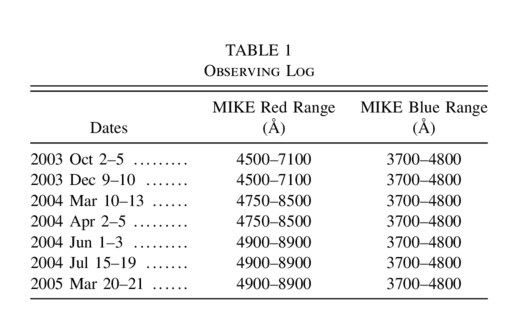
Data were collected at the Magellan telescopes on the nights listed in Table 1. The MIKE spectrograph (Bernstein et al. 2003) was used with the 0 35 slit, yielding a resolving power of ∼54,000 on the red chip and ∼70,000 on the blue chip. The red grating angle was offset twice during the course of these observations, and in Table 1 we list the wavelength ranges for each observing run. The blue chip was unchanged throughout the course of this investigation. No noticeable offset was observed between shifts of the spectrograph to within the errors of our technique. Observations were only recorded when seeing was less than 2
″. Exposures were constrained to 30 minutes or less to maximize velocity precision, with typical exposures ranging from 2 to 15 minutes. Only spectra with signal‐to‐noise ratios (S/Ns) greater than 50 were analyzed.
 |
Spectra were reduced using standard IRAF2 packages. After flat‐fielding and removal of the bias with the ccdproc routine, we used a suite of IRAF routines, mtools, specifically designed to handle MIKE spectra. The mtools routines were developed by J. Baldwin and are publicly available at the Las Campanas Observatory Web site.3 MIKE spectra have a tilt of the slit with respect to the orders (Bernstein et al. 2003). The mtools routines calculate the varying slope of the tilt using ThAr calibration spectra along the orders and across each chip. It is repeated for each of the ThAr spectra taken through the night. The tilt is then removed from all spectra during the extraction of the spectral orders. Once the spectra have been corrected for the tilt, a wavelength solution is applied using the IRAF package ecid.
In lieu of an I2 cell, we took advantage of the telluric oxygen band at 6900 Å for our velocity reference. Our reason for not using the I2 cell was that the intrinsic noise of these objects will exceed the few m s−1 precision one can achieve with the cell. However, longer term projects, investigating either the intrinsic and variable activity of the stars or the presence of longer period high‐mass companions, would benefit from the use of an I2 cell.
4. ANALYSIS
4.1. Radial Velocities and Errors
The MIKE spectrograph is not fiber‐fed, and thus the measurement of radial velocities to this precision is hindered by guiding errors that are not easily corrected for. Variable positioning of the stellar image on the slit illuminates the spectrograph nonuniformly. This variable illumination causes inherent shifts of the stellar absorption features. The use of telluric features as a velocity reference only corrects for part of this error, as the telluric features are themselves broad. Instrumental errors are also introduced by temperature fluctuations in the spectrograph, as it is not in a temperature‐controlled environment. These are removed by taking frequent ThAr spectra for contemporaneous wavelength solutions. As a check that this was necessary, we measured the relative velocity shifts of the ThAr spectra throughout the night. The maximum variation over the course of one observing night was 0.7 km s−1. Thus, ThAr spectra were taken between 10 and 20 times each night for wavelength calibration, and the wavelength solution nearest in time to the stellar spectrum was applied.
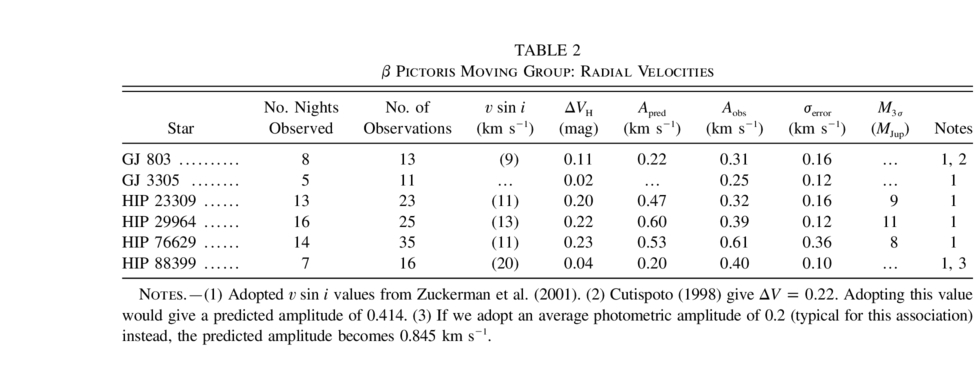
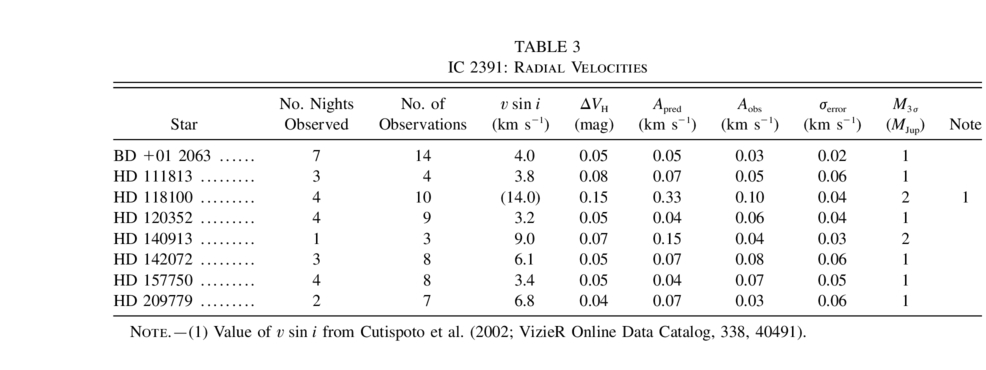
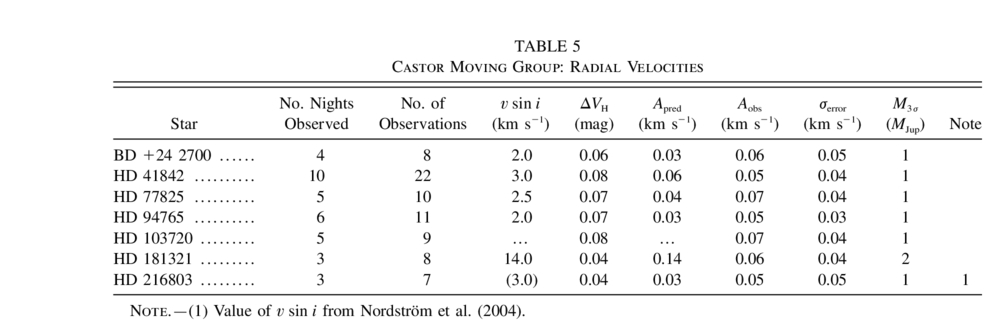
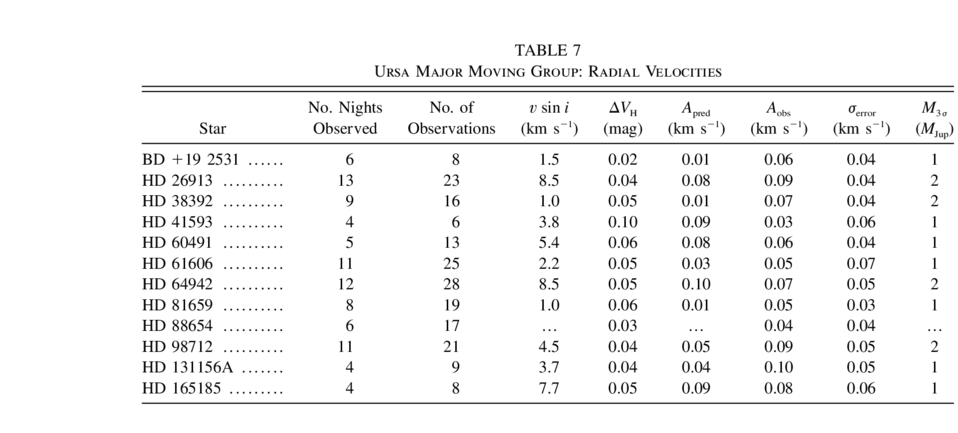
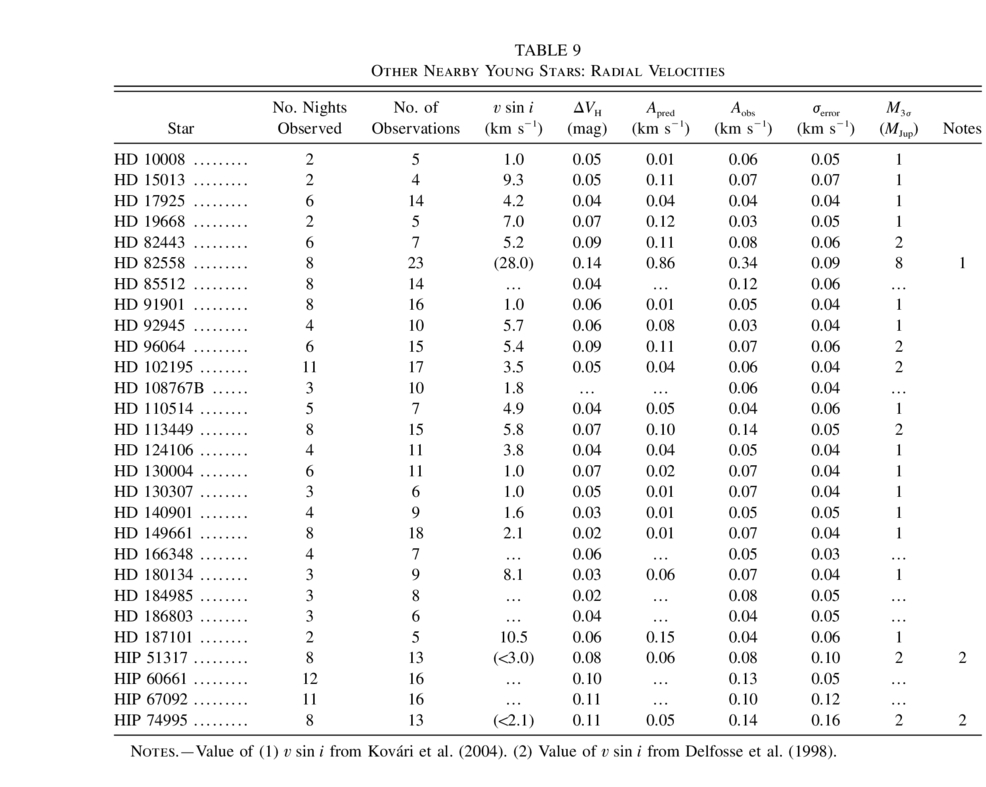
Radial velocities are measured via cross‐correlation of each observation with a “template” spectrum of that same star using the IRAF package fxcor. The template spectrum was chosen to be the spectrum with the highest S/N. We subtracted the differential velocity shift of the telluric lines from those of the stellar lines to obtain the final radial velocity for that observation in the heliocentric frame of reference (provided within fxcor). The value Aobs (in Tables 2, 3, 5, 7 and 9) is the 1 σ rms of all velocity measurements for each star. Each observation also includes an associated error, which is determined by adding in quadrature the cross‐correlation error derived in fxcor for the stellar lines with that of the telluric features. The error listed for each star, σerror in the tables and in Figure 1, is the rms of the errors for all observations of a given star.
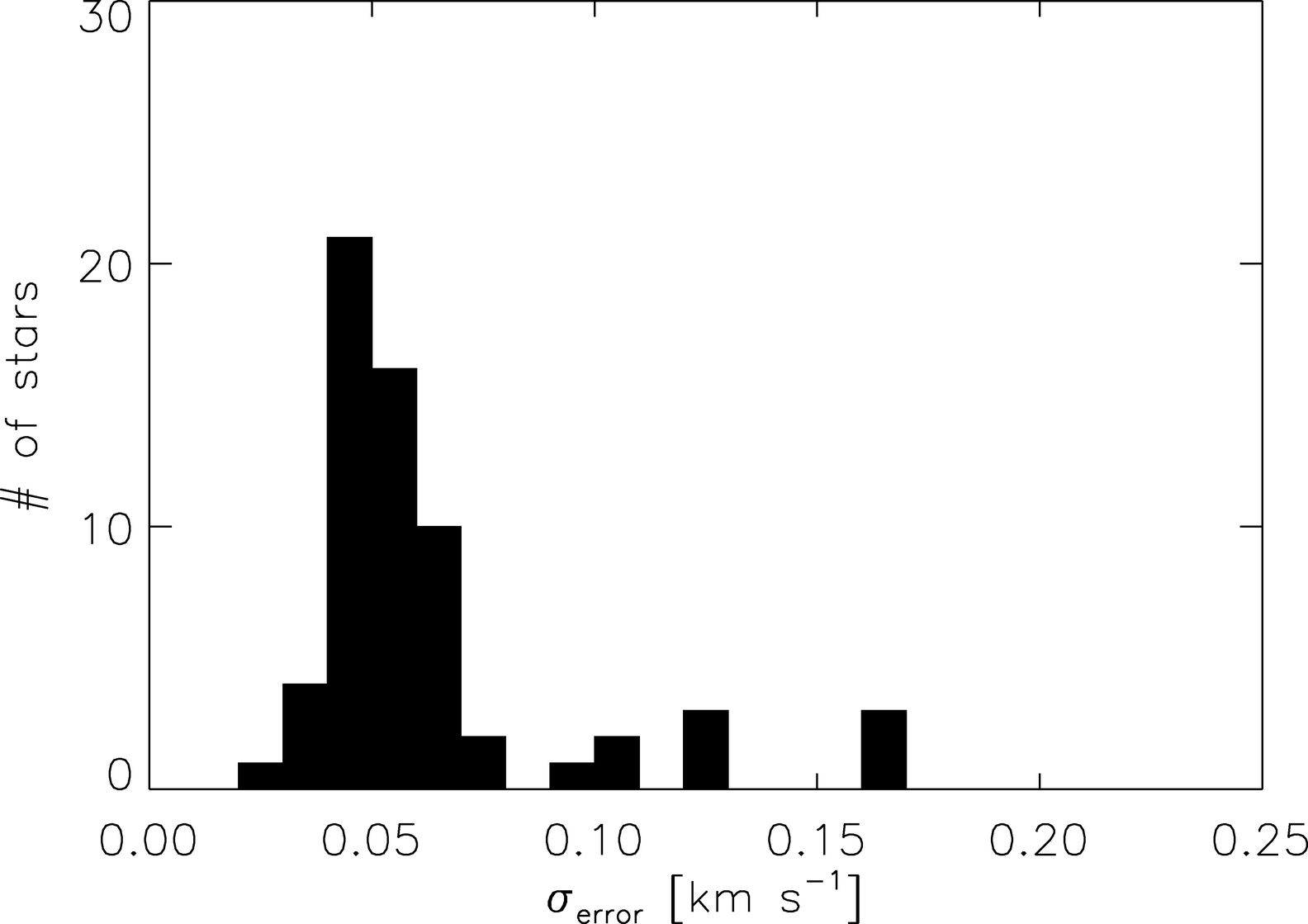
Fig. 1.— Histogram of the mean error for each star. Each component of this histogram is the rms of the errors from all observations of a given star.
 |
 |
Under good seeing conditions (∼05) and for bright (V ∼ 8), slowly rotating stars, we were able to obtain a velocity precision of 0.01 km s−1 for an individual observation, with an rms of 0.02–0.03 km s−1. Two stars known not to harbor hot Jupiters were observed, τ Ceti and HD 99109. We chose these to look for systematics during the course of observations, although no systematics were found at our detection threshold. These two stars also provide confirmation of our quoted errors. τ Ceti was observed 11 times over 7 nights and exhibited velocity variations Aobs = 0.03 km s−1 with σerror = 0.04 km s−1. HD 99109 was observed 16 times over 10 nights, with Aobs = 0.04 km s−1 and σerror = 0.04 km s−1. Our somewhat crude velocity precision is sufficient for detection of high‐mass, close‐in planets and brown dwarfs, since the velocity variations will exceed the combination of the intrinsic noise caused by stellar activity and the instrumental error (which includes the uncertainties arising from use of telluric features).
We adopt the empirical relationship of Saar & Donahue (1997), using our measured rotational velocities and Hipparcos photometry, to compare observations with predicted radial velocity amplitudes induced by the rotational modulation of starspots. According to the Saar & Donahue relationship, G‐type stars of Hyades age (∼650 Myr) will have a maximum predicted radial velocity amplitude of ∼30–40 m s−1, while G‐type stars of β Pic age (∼12 Myr) can exhibit radial velocity variations of ∼0.7 km s−1. It is apparent that the only detectable companions around the youngest stars will be close‐in brown dwarfs and stellar binary companions. Any information on the presence of companions (stellar or otherwise) around these young stars is useful for understanding the dynamics of post–T Tauri systems. For the calculation of predicted maximum amplitudes, Apred = 0.6f0.9Svsin i (where fS = ∼0.4ΔV is given as a percentage), we make use of our measured vsin i (§ 4.3), when available and the Hipparcos photometric database (ESA 1997), unless otherwise noted. The adopted and measured values are listed in Tables 2, 3, 5, 7 and 9. Hipparcos measures magnitudes in a slightly different bandpass from V, but the amplitude of the variability is similar. From the database, we take as the amplitude the difference between the 95% and the 5% photometric levels. We list these values as ΔVH. Observed versus predicted radial velocity amplitudes, including velocity errors, are shown in Figure 2. A 1:1 line is drawn for reference, as well as a dashed line representing the mean error for all observations. As can be seen from Figure 1, the spread in σerror is relatively small, so choosing the mean value provides a reasonable reference. Two stars have arrows, indicating the questionable Hipparcos photometry. The endpoints of these arrows are the values obtained if we assume photometry taken from ground‐based surveys.
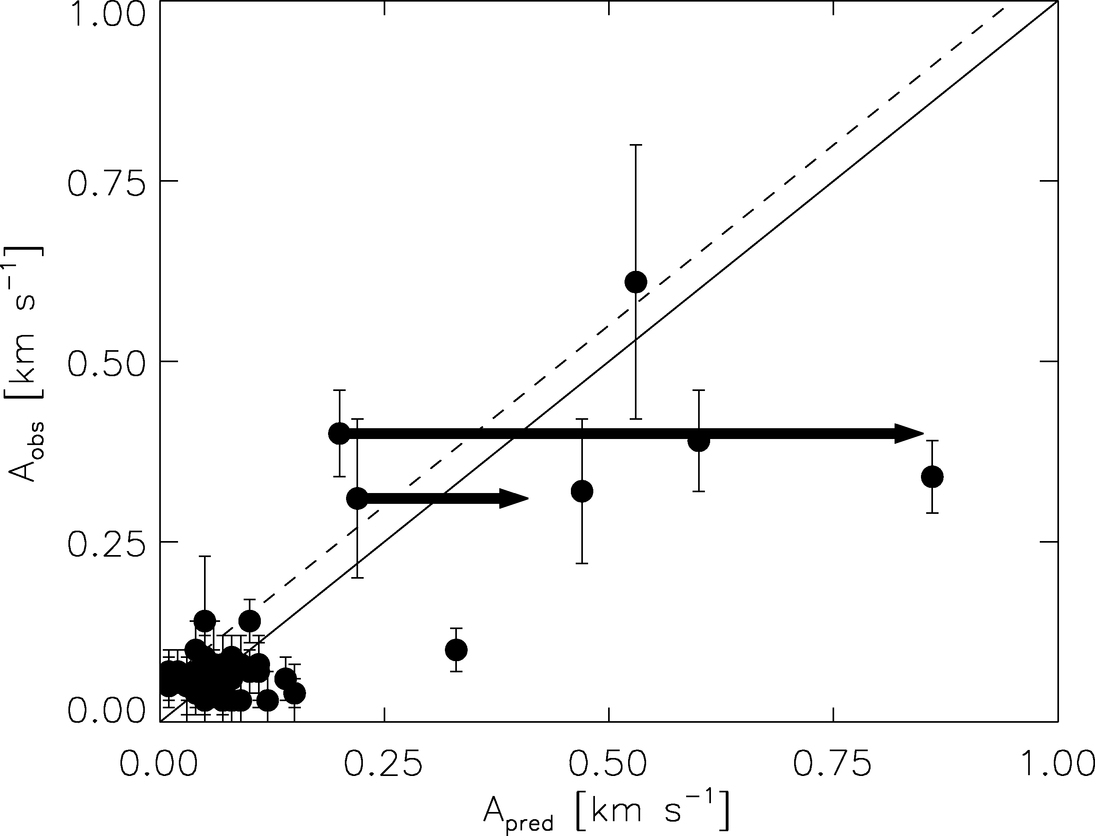
Fig. 2.— Observed vs. predicted radial velocity amplitudes. Arrows shown correspond to the two stars in β Pic that have questionable photometry, as discussed in the text. A 1:1 solid line is drawn, along with a dashed line corresponding to the mean error of all data.
4.2. Limits on Detectable Companions
Using the methods of Nelson & Angel (1998, hereafter NA98), as we did in Paulson et al. (2004), we determine limits on companions detectable given the data quantity and quality for each star. We derive the K‐velocity of our data based on equation (15) of NA98. The error we assume (σp in eq. [15] of NA98) is the predicted velocity caused by stellar activity, Apred, added in quadrature with the mean observational error, σerror. The number of independent frequencies sampled is given in equation (14) of NA98. We have assumed even sampling, but as our data are not uniformly sampled, it is possible to search much higher frequencies than then Nyquist frequency. The velocity that will be exceeded in a given frequency range, K, is dependent of [ln (1/N)]1/2, where N is the number of independent frequencies in a given frequency range (see eq. [15] in NA98). Thus, a change in the number of independent frequencies by a factor of 2 only results in a fractional change of K. And, as such, our assumption of evenly sampled data does not significantly affect the results of this analysis.
The value M3σ is the lower mass limit of companions (>1MJup) that can be ruled out at the 3 σ level in orbits of 6 or fewer days. The M3σ values have been derived by calculating the velocity induced by companion masses of decreasing mass until the velocity would be undetectable in our data, i.e., when the velocity of a companion of given mass and a given period (namely 6 days) falls below the K‐velocity calculated above. This value is then determined to be the lower mass limit of a detectable companion, and each of these parameters is listed in its respective table. It is clear from an inspection of the table that the most massive planets and brown dwarfs are ruled out for all stars. For most stars, planets as small as 1MJup can also be ruled out. The mass limit of companions around these stars can be decreased with an increased number of observations, as well as more precise radial velocities for the less active stars. However, the mass limits for the youngest stars (such as the β Pic members) remain limited by the intrinsic activity of the stars.
4.3. Stellar Parameters and Abundance Analysis
In order to measure rotational velocities, vsin i, for each star, we employ the curve‐of‐growth method to determine stellar parameters. These parameters are then used to model a small spectral section in order to extract line broadening resulting from stellar rotation.
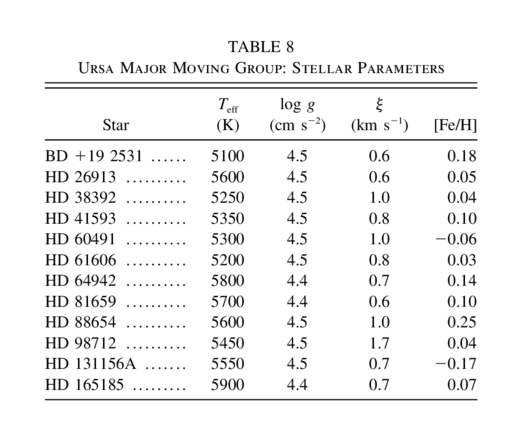
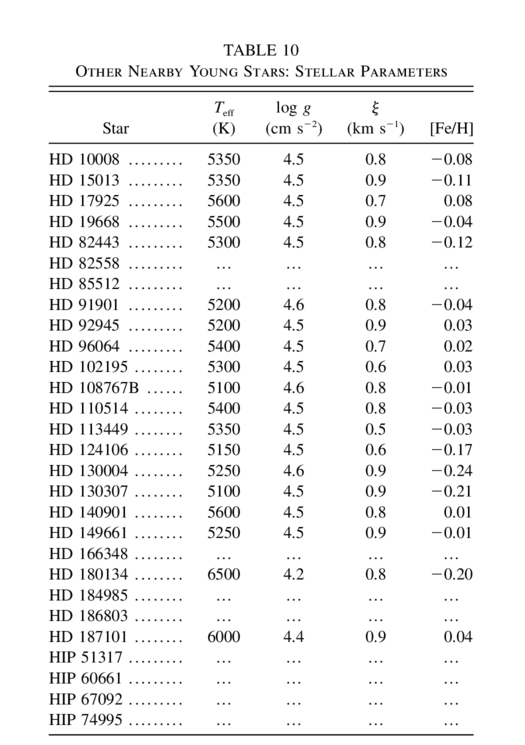
For the majority of stars in this sample, we have derived the stellar parameters and metallicity using the spectral synthesis code MOOG (Sneden 1973), in the same fashion as we did in Paulson et al. (2003). It has recently been shown that cooler stars exhibit an ionization imbalance that increases as the stellar temperature decreases (e.g., Allende Prieto et al. 2004; Yong et al. 2004). Allende Prieto et al. (2004) suggest that this (sometimes severe) departure from LTE stems from an increase in stellar activity (in cooler stars relative to warmer stars with shallower convective regions). If this is indeed the root cause of these discrepancies, then the increase in activity as a result of stellar youth would also require the use of non‐LTE stellar atmospheres. We did not attempt to measure stellar parameters for the β Pic members and stars cooler than K2 because of this issue. We also note that for some elements, the use of LTE models may result in incorrect abundances for all stars in this survey because of their youth.
We use stellar atmosphere models based on the (LTE) 1995 version of the ATLAS9 code (Castelli et al. 1997), and while newer non‐LTE models have recently become available (e.g., Hauschildt et al. 1999), they require too much computational time to obtain a reasonably large grid of atmospheres. We have thus adopted vsin i values from the literature (references are noted in the tables) for those stars for which we have not derived atmospheric parameters.
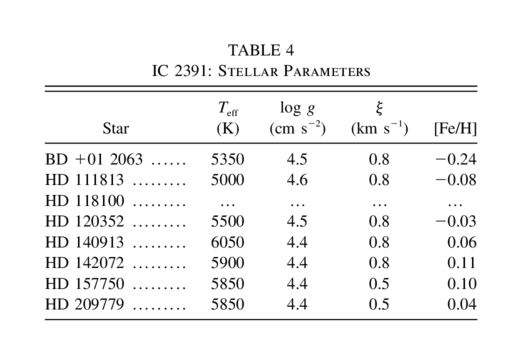
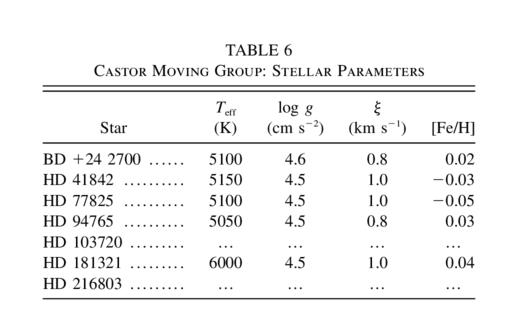
Within IRAF, equivalent widths (EWs) are measured by fitting Gaussians to Fe i and Fe ii lines (see Table 1 in Paulson et al. 2003 for the line list used). The EWs are input into MOOG drivers along with the individual line parameters to derive the effective temperature (Teff), surface gravity (log g), microturbulence (ξ), metallicity ([Fe/H]), and rotational velocity (vsin i). The vsin i values are measured by spectral synthesis after determining the appropriate stellar atmosphere model, via the curve‐of‐growth routine (lin), by employing the synth feature of MOOG. Our grid of models dictates the errors on Teff, log g, and ξ to be 50 K, 0.1 cm s−2, and 0.2 km s−1, respectively. In order to determine [Fe/H], we require that the Teff be independent of excitation potential for all Fe i lines, and that ξ be independent of the line strength. On fitting these two parameters, the surface gravity is determined by requiring ionization equilibrium between Fe i and Fe ii. These three parameters are iterated until these requirements are all met. An overall [Fe/H] abundance is then calculated based on a mean of the individual line abundances. Using this model, we synthesize a spectral region containing five Fe i lines of varying excitation potential. The only parameter that is varied is the rotational velocity. We do not deconvolve the macroturbulence from the rotational velocities, so the vsin i values listed in Tables 2, 3, 5, 7, and 9 include the effects of macroturbulence. Observing the solar spectrum and following the exact same analysis as we do for all stars in this paper enables us to compare our values to solar in a straightforward manner. This approach removes the possible systematics that may arise from this instrument, and thus we present absolute [Fe/H] values (with errors ∼0.08 dex) independent of the value of log (Fe)⊙. Our solar spectrum was taken from the asteroid Iris, since it closely resembles starlight through the combination of the telescope and the instrument. The final stellar parameters are listed in Tables 4, pasp_118_843_706tb5 6, pasp_118_843_706tb7 8, and pasp_118_843_706tb9 10.
 |
 |
 |
 |
 |
 |
 |
5. RESULTS
5.1. β Pic Moving Group
We included the β Pic members as a demonstration of the limiting factor of radial velocity measurements on the youngest stars. As seen in Table 2, the radial velocity amplitudes of these stars are quite large, 0.25–0.61 km s−1. The observed amplitudes are within the predicted values except for three stars; GJ 803, GJ 3305, and HIP 88399 have ΔVH magnitudes well below that of other members. For GJ 803, ground‐based photometry produced ΔV = 0.22 (Custipoto 1998). Using this value instead yields Apred = 0.41 km s−1. This rectifies the discrepancy between predicted and observed amplitudes. If we assume ΔVH to be 0.2 for HIP 88399, in line with other members' ΔVH, then Aobs becomes 0.85 km s−1, in good agreement with observations. GJ 3305 also has a remarkably low photometric amplitude. Because of the lack of vsin i information, a comparison of Apred with Aobs is not possible. If the low photometric amplitudes for GJ 3305 and HIP 88399 are indeed real, this would suggest that the stellar inclinations are almost pole‐on. However, at least in the case of HIP 88399, the rotational velocity indicates otherwise, so it is probable that the photometry is not accurate. Four of the stars in our survey, GJ 803, HIP 23309, HIP 29964, and HIP 76629, have been surveyed with adaptive optics by Neuhäuser et al. (2003) and were shown to harbor no distant binary companions. Thus, we can rule out brown dwarf companions and stellar companions in very close orbits as well as in orbits of several AU.
5.2. IC 2391
Solar analogs in the IC 2391 cluster will have just arrived on the main sequence and are thus an important sample of stars for multiplicity studies. The X‐ray levels of stars in this cluster confirm the age of 30 Myr (Marino et al. 2005), and the rotation of members is also consistent with that age. Despite its youth, IC 2391 has fairly low activity levels as measured by photometric variability. This is likely caused by somewhat uniform coverage of starspots. Thus, the radial velocity variations caused by photospheric activity are also lessened. As a result, there seems to be a division in the accessibility of planet and brown dwarf detection via the radial velocity method between the ages of β Pic and IC 2391. Members of IC 2391 are good candidates for longer term follow‐up (i.e., for substellar‐mass companions in orbits of a few weeks to months). The observed radial velocities (Table 3) agree to within the error of the predicted amplitude, and companions of mass >1MJup–2MJup with orbital periods less than 6 days can be ruled out.
The stellar parameters for observed IC 2391 members are listed in Table 4. The average [Fe/H] of IC 2391 is −0.01 ± 0.12. We note, however, that BD +01 2063 is much lower in abundance than the remaining cluster members, with an [Fe/H] of −0.24. If this star is truly a member of IC 2391, as indicated by the positive results of the two membership tests performed by Montes et al. (2001), then further studies into the depletion of metals in this star are warranted. However, it is more likely that this star is an interloper whose stellar history is vastly different from the surrounding cluster. Removing BD +01 2063 from the group results in a mean [Fe/H] = 0.03.
5.3. Castor Moving Group
The members of the Castor moving group we surveyed also show remarkable photometric stability and thus stability in the radial velocity measurements. Despite their youth, stars in the Castor group, like IC 2391, are good candidates for more precise and longer term radial velocity searches. None of the members of the Castor moving group show radial velocity variability indicative of short‐period companions (Table 5), and companions as small as 1MJup with short periods are not detected. We measure a mean [Fe/H] of 0.00 ± 0.04 for Castor members. While our sample (five stars) is small, there is very little scatter in the abundances.
5.4. Ursa Major Moving Group
As for the previous groups, there are no stars whose Aobs significantly exceeds Apred. As a result, companions with mass >1MJup–2MJup in close orbits are ruled out. The previously measured [Fe/H] of this association is between −0.05 and −0.09 (§ 2). We determine an [Fe/H] of 0.06 ± 0.11. We attribute the difference between our measurement and previous measurements to the samples of stars chosen for each survey. There is a scatter in the abundances of “members” of 0.42 dex (σ = 0.11 dex). We assume (perhaps incorrectly?) that these stars were formed from homogeneous material. The spread of [Fe/H] of these stars is not easily explained for a common group; scatter is ±0.04 dex in the Hyades ([Fe/H] = 0.13; Paulson et al. 2003), and ±0.05 in the younger Pleiades ([Fe/H] = 0.06; King et al. 2000). Four of the stars we include have abundances that are >0.10 dex higher (or lower) than the cluster median: BD +19 2531, HD 64942, HD 88654, and HD 131156A. The membership of these stars in the Ursa Major association, their overall metallicities, and the overall abundance variations throughout the entire association should be explored further.
5.5. Other Nearby Young Stars
Some of the stars we include here have confirmed binary companions noted in the literature, although our data indicate that none of them have high‐mass, short‐period orbiting companions (stellar or substellar). Those stellar companions cited in the literature include only distant companions, whose radial velocity effects would be undetectable in our data. Balega et al. (2002) found a companion to HD 15013 with a separation of 127 mas. Gaidos (1998) suggest that HD 96064 has a probable M dwarf companion at 270 AU. Lowrance et al. (2005) find that HD 82443 has a binary companion at a distance of 686. The only star with large Aobs is HD 82558, which has a vsin i = 28.0 km s−1 (Kovári et al. 2004). The vsin i is accounted for in the calculation of Apred and is therefore much greater than Aobs. None of these stars has a companion with mass >1MJup–2MJup in a close orbit.
6. DISCUSSION
In this paper we present both an initial search for substellar‐mass companions around young stars at different ages and a census of stellar parameters and metallicity for these stars. While no companions are detected in this sample, we list mass limits for rejected planets and brown dwarfs. Stars of the same age as IC 2391 and older are suitable for long‐term radial velocity surveys for high‐mass, short‐period (∼few months) companions based on their relatively stable activity levels. For younger stars, such as β Pic members, we are limited to searches for short‐period brown dwarf companions. For these stars, the velocity technique employing telluric lines as a velocity reference is sufficient. The less than 5 m s−1 precision gained through use of an I2 cell provides little improvement for a star whose intrinsic activity levels are greater than 0.05 km s−1. Thus, for longer term follow‐up of stars in our paper, a velocity precision of 5–10 m s−1 is more than adequate.
With sufficient telescope allocation, it is possible to look for longer period planetary‐mass companions using the radial velocity technique. In order to do so, one could average the velocity over the course of a rotation cycle, since the velocity amplitude will be (or at least come close to) zero. Of course, small variations in total spot coverage may cause “zero‐point” offsets, but this technique should be able to allow for the detection of companions in orbits of a few weeks to months. Unfortunately, this type of project would be considerably less efficient than the current radial velocity planet searches, by lowering the number of stars that could be surveyed.
The lack of “hot Jupiters” in this sample is not surprising. Only 0.8% of stars have such objects within 0.1 AU of the parent star (Marcy et al. 2005b). Our sample is considerably smaller than what would be required to have a meaningful statistic. However, we can state that the incidence of such objects around young stars is less than 1.5% and likely much smaller, in agreement with the 0.8% incidence of companions around old stars. To build better statistics, a comprehensive and dedicated survey similar to the N2K project (e.g., Fischer et al. 2005) should be carried out for the youngest nearby stars.
We further recommend combining radial velocity surveys for close‐in companions with imaging surveys for distant companions. The radial velocity technique is limited to detection of only high‐mass, close‐in companions, whereas AO and other imaging techniques are only sensitive to more distant, young, high‐mass companions. Combining these types of surveys on the same set of young stars is the best way to begin to understand the evolution and formation of planets and brown dwarfs at young and intermediate ages.
This research made extensive use of the SIMBAD astronomical database, operated at the Centre de Données Astronomiques de Strasbourg, France, and NASA’s Astrophysics Data System, and the arrow.pro procedure written and copyrighted by Johns Hopkins University/Applied Physics Laboratory. Data presented here were obtained at the Magellan telescopes at the Las Campanas Observatory, operated by the Observatories of the Carnegie Institution of Washington, the University of Arizona, the University of Michigan, Harvard University, and the Massachusetts Institute of Technology. D. B. P. wishes to thank the Department of Astronomy at the University of Michigan for granting the telescope time needed for this project, and the telescope operators and instrument scientists for making sure that our observations ran smoothly. D. B. P. wishes to thank W. Cochran for his continuing support and useful discussions on planet searches. D. B. P. is currently a National Research Council fellow working at the NASA Goddard Space Flight Center. D. B. P. would also like to acknowledge the financial support from E. Bergin (NASA grant NAG5‐9227 and NSF grant AST 98‐08980) during a portion of this research.
Footnotes
- 1
We also would like to note the simultaneous efforts of Esposito et al. (2006) in carrying out a similar radial velocity search for extrasolar planets around young stars.
- 2
IRAF is distributed by the National Optical Astronomy Observatory, which is operated by the Association of Universities for Research in Astronomy, Inc., under cooperative agreement with the National Science Foundation.
- 3
See http://www.lco.cl.
