
ABSTRACT
The Type II Cepheids include most intrinsic variables with periods between 1 and about 50 days, except for the classical Cepheids and the shortest semiregular variables of type M. The Type II Cepheids may be divided in groups by period, such that the stars with periods beween 1 and 5 days (BL Her class), 10–20 days (W Vir class), and greater than 20 days (RV Tau class) have differing evolutionary histories. The chemical composition of Type II Cepheids reflects the material they were made from as modified by their internal nuclear evolution and mixing. Finally, RV Tau stars are affected by mass loss by dust and species attached to the dust. The populations to which the various classes of Type II Cepheids are assigned constitute important clues to the origin and evolution of the halo of our Galaxy and the dwarf spheroidal systems from which at least part of the halo seems to have been accreted.
1. INTRODUCTION
When Baade announced his revision of the extragalactic distance scale at the 1952 Rome meeting of the IAU, he was implicitly calling attention to the difference in the period‐luminosity relation of the Cepheids in the globular clusters and the classical Cepheids (Baade 1953). At about the same time Blaauw & Morgan (1954) announced a revision of the period‐luminosity relation of the classical Cepheids based on new proper motions of the Cepheids. As with many discoveries in astronomy, there had been hints that W Vir, the prototype of Type II Cepheids, was quite different from the classical Cepheids of similar periods (Joy 1937). While the Type II Cepheids have never been used, as have the classical Cepheids, as primary distance indicators, they have provided many interesting clues to both stellar and Galactic evolution not envisioned a half‐century ago.
As a separate subject, the Type II Cepheids have only rarely been reviewed. Wallerstein & Cox (1984) reviewed the subject with some emphasis on the pulsation of the Cepheids. Also, H. C. Harris (1984) reviewed the Cepheids more from the viewpoint of their place in stellar populations and Galactic structure.
2. WHAT IS A POPULATION II CEPHEID?
The so‐called W Vir stars with periods of roughly 10–20 days are common in the globular clusters of the halo, but they are just the “tip of the iceberg.” Stars that are not members of the spiral‐arm population of our Galaxy fall into a number of subcategories. There are thin‐disk stars and thick‐disk stars. There are bulge stars and halo stars. Finally, there are stars in globular clusters, which may be subdivided into bulge clusters, disk clusters, inner halo clusters, outer halo clusters, and captured clusters. For some clusters it is uncertain as to which category they belong. Cepheids and their close relatives, the RV Tau stars, are found in all of these populations. The classical Cepheids, which we will not review, are closely associated with the spiral‐arm and thin‐disk populations. The Type II Cepheids are found in all of the remaining populations and their subclasses. The Cepheids themselves can be divided into subgroups, largely by period, and each period group can be assigned to one or more of the Galaxy’s population groups. In the General Catalogue of Variable Stars, 173 objects are listed as CWA, CWB, or CW. The vast majority lie at low to moderate Galactic latitudes and are likely to be thick‐disk stars. Sixty Type II Cepheids are found in globular clusters for which the indispensible catalog is by Clement et al. (2001). A detailed discussion of the period‐luminosity‐metallicity relations for Population II variable stars, most of which are members of globular clusters, has been published by Nemec, Nemec, & Lutz (1994). Both fundamental and first‐overtone pulsators were recognized. In addition to the globulars, the Magellanic Clouds have proved to be a gold mine for the discovery of variable stars.
A catalog of field Type II Cepheids has been published by Harris (1985). He lists 152 stars likely to be Type II Cepheids on the basis of their distance from the Galactic plane, but a few may be classical Cepheids that have drifted a few hundred parsecs from the plane. Seventy‐four have |z|>1 kpc, 41 have |z|>3 kpc, and only four show |z|>10 kpc. Considering that the mass ratio of halo/globulars is 50–100, field Cepheids in the halo are either very rare or still waiting to be discovered.
A full‐blown search for Type II Cepheids and RV Tau stars in the LMC by the MACHO Project has been reported by Alcock et al. (1998). Candidate stars had to fall within the following criteria to be included: 8 days < P < 100 days, (18.5 - 3log P)<R<18.0, 0.3<V−R<0.6. Shorter period Cepheids were excluded for reasons not given. The bright limit was chosen to exclude Type I Cepheids and the color limits to exclude other types of variables. Variables with symmetric light curves were found with periods between 8 and 11 days. Fourteen W Vir stars were found with periods from 12 to 18 days. RV Tau behavior, i.e., small alteration between even and odd cycles, started at 21.5 days out to 56 (112 using the double period) days, with a trend toward increasing instability for the longer periods. This paper establishes the fuzzy border between W Vir and RV Tau behavior as being close to 20 days. Among the Cepheids in the globular clusters, incipient RV Tau behavior is seen near 20 days (Arp 1955). A concentrated effort to establish the metallicity of the SMC and LMC Type II Cepheids with Washington (Harris 1981) or Strömgren (Williams 1966; Meakes, Wallerstein, & Opalko 1991) photometry would be rewarding.
In summary, the Type II Cepheids are low‐mass variables whose luminosities lie below those of the classical Cepheids and above those of the RR Lyrae stars.
2.1. Short‐Period Stars
Type II Cepheids with periods between 1 and 7 days are often referred to as BL Her stars. They are common in globular clusters and the Galaxy’s disk. Multicolor photometry on the Washington system by Harris (1981) showed that of 12 such field stars, four showed [Fe/H] values less than −1.5, identifying them with a halo population. Their mean distance from the Galactic plane is 1.8 kpc. The remaining eight showed metallicities near or possibly above solar. Two such stars, V553 Cen and RT TrA, have nearly solar abundances of the metals and a carbon excess resulting in a suppression of the M and C bands of the Washington system. The mean distance from the Galactic plane of the solar metallicity stars is 0.25 kpc, characteristic of the thick disk or even the thin disk. In two papers, Diethelm (1986, 1990) has discussed the properties of the short‐period Cepheids in the general field. He used the Walraven VBLUW system of photometry to derive metallicities of 57 short‐period stars. After eliminating eight stars that appeared to be classical Cepheids, he found metallicities for 45 objects, 30 of which showed [Fe/H]> -0.3 and only eight with [Fe/H]< -1.0. Stars with [Fe/H]> -0.3 have a mean Galactic latitude |b| = 8 0 ± 13; stars with [Fe/H]< -1.0 have |b| = 333 ± 53. Only four stars are located at |b|>30°. Cepheids with periods less than 5 days are common in globular clusters of the inner and outer halos but are not found in the more metal rich clusters of the bulge or disk populations. This raises the question of the origin of the short‐period stars of solar metallicity. The same problem exists with the metal‐rich RR Lyrae stars of the field. Neither type of variable is found in the metal‐rich globular clusters.
The properties of Cepheids with periods between 0.8 and 3 days (with a few longer period stars) in the general field, globular clusters, and nearby spheroidal galaxies have been thoroughly discussed by Sandage, Diethelm, & Tammann (1994). By restricting themselves to stars with strongly asymmetric light curves such as those of RR Lyrae AB variables, they deal with metallicities from [Fe/H] between −1.0 and −2.5. The anomalous Cepheids, found mostly in external systems such as Leo I, are included, but their origins may be quite different from those of the ordinary short‐period Cepheids that are post–horizontal‐branch (HB) stars. By comparing the variables in external galaxies, both loose systems in UMi and Leo I, and the more compact ellipticals NGC 147, NGC 185, and NGC 205, Sandage et al. (1994) demonstrated the similarity of the variables in these systems with those in the globular clusters and field of our Galaxy. In Figure 1 we reproduce their Figure 5. An interesting group of seven variables have periods less than 0.8 days and Mv values above those of the RR Lyrae stars in the UMi dSph. In the Fornax system Bersier & Wood (2002) found six Type II Cepheids, including one with a period of 15 days, and 17 anomalous Cepheids. Although not a dwarf spheroidal (dSph) but rather an irregular galaxy with substantial current star formation, IC 1613 has at least two Type II Cepheids (Antonello et al. 2000).
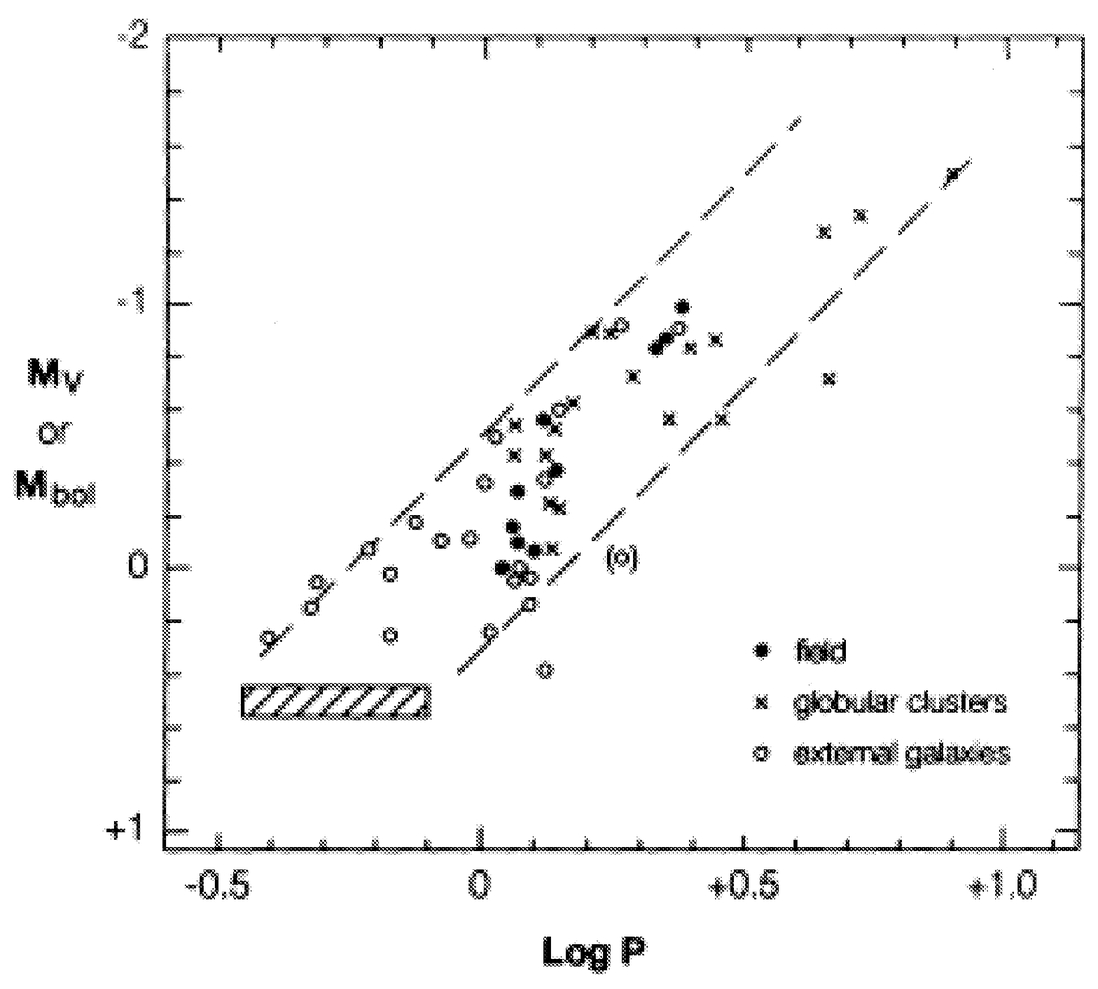
Fig. 1.— Comparison of variables in nearby dwarf spheroidals and ellipticals with stars in globular clusters (Sandage et al. 1994). Reproduced from the original article with permission of the author.
Harris (1981) obtained photometry of 42 W Vir stars in the general field. Their distribution in [Fe/H] is shown in Figure 2. The important conclusion from Figure 2 is that only one star showed [Fe/H]< -1.5, which is characteristic of the halo and its globular clusters. The 33 stars with [Fe/H]> -1.0 are disk stars, while the eight stars with [Fe/H] between −1.0 and −1.5 may be thick‐disk or inner halo objects. Many of Harris’s stars are in the Galactic bulge rather than the halo. Hence, it is clear that halo Cepheids other than those in globulars are largely undiscovered if they are as common as expected, from the ratio of globular cluster stars to halo field stars. About 100 times as many halo field Cepheids as cluster Cepheids should be present in the Galaxy. Only a handful of the hypothesized 6000 halo Cepheids and RV Tau stars are known (Clement et al. 2001). Neither Type II Cepheids nor any RV Tau stars are found in nearby spheroidal galaxies such as Sculptor and Draco despite searches that have reached the RR Lyrae stars without difficulty. Except for Fornax, dwarf spheroidals have only anomalous Cepheids (which are discussed in § 7).
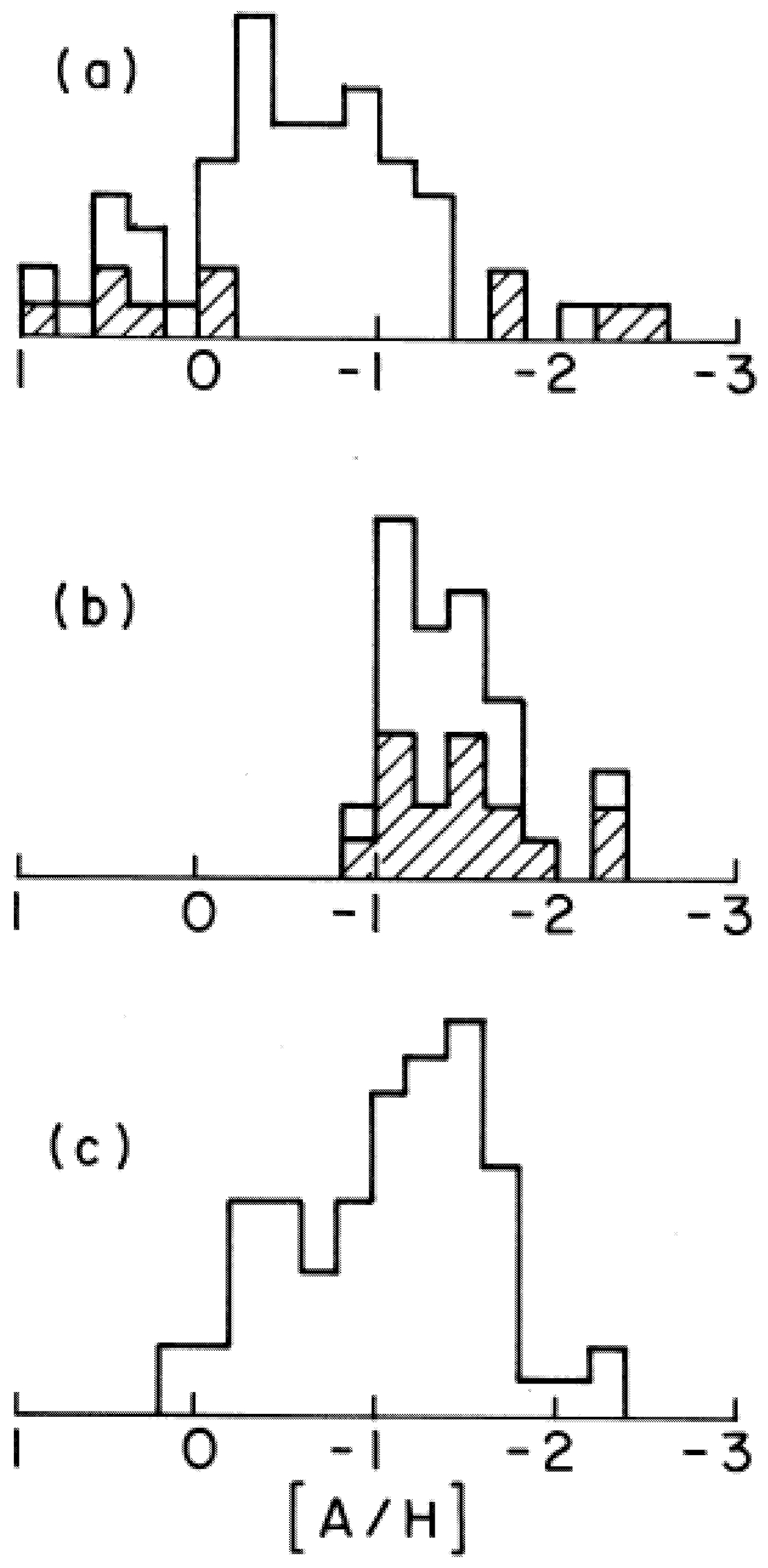
Fig. 2.— Distribution of metallicity of field Type II Cepheids from Washington photometry of Harris (1981). Reproduced from the original article with permission of the author.
2.2. The RV Tau Stars
The RV Tau stars were first recognized by their alternating deep and shallow minima. Their semiperiods range from about 20 to well over 50 days. While the phenomenon of alternating minima is seen in eclipsing binaries of unequal type, the light curves of almost all RV Tau stars show marked irregularities. Many stars switch deep and shallow minima and some revert to low‐amplitude irregularity, a sort of fibrillation, followed by a return to deep and shallow minima in phase with their prior pulsation. Their kinematics associates many with the thick, and possibly even the thin, disk while a few are of the halo population. Some are found in globular clusters, e.g., ω Cen, Var 1; M2, Var 11; M56, Var 6; M28, Var 17; and M5, Var 84. Zsoldos (1998) has questioned whether these variables in globulars should be called RV Tau stars. If Helen Sawyer Hogg and Cecilia Payne Gaposchkin called them RV Tau stars, they are RV Tau stars (and when General Motors calls a car a Chevrolet, it is a Chevrolet). A light curve for M2 V11 is shown in Figure 3.
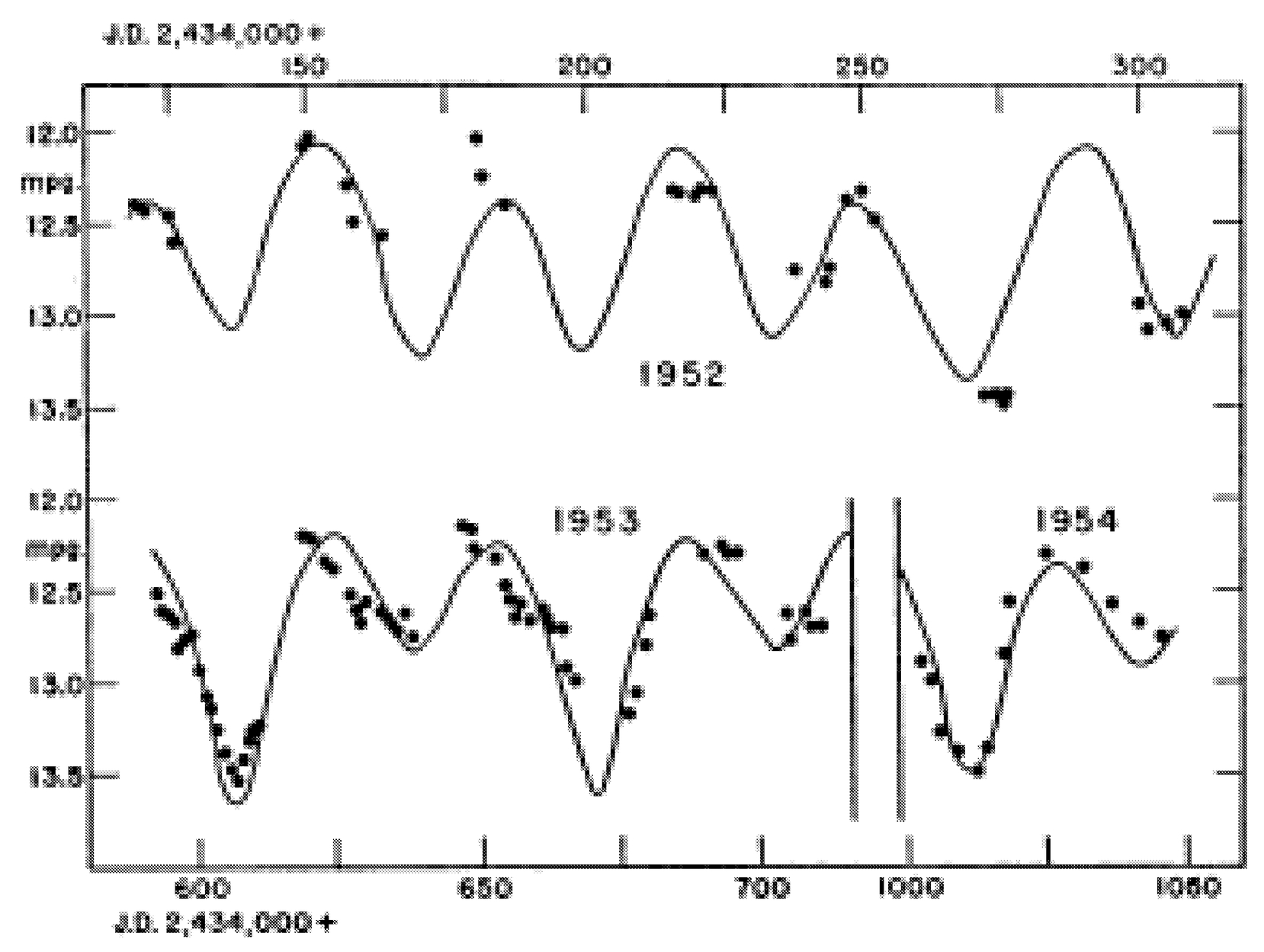
Fig. 3.— Light curve of the RV Tau star M2 V11 (Arp & Wallerstein 1956). Reproduced from the original article with permission of the author.
The low‐dispersion spectral classification of RV Tau stars by Preston et al. (1963) showed that a useful subdivision into three subtypes could be made. Group A have spectral types of G or K and may show TiO bands at minimum light. Group B have weak metal lines and show strong CN bands at certain phases. Group C have weak metal lines but do not show either TiO or enhanced CN. The RV Tau stars in globular clusters belong to this group. Groups A and B show thick‐disk kinematics.
Unlike the Type II Cepheids, most RV Tau stars show large infrared excesses (Gehrz 1972). Observations from 2.2 to 22 μm showed that most RV Tau stars showed strong excesses in the 2.2 and 3.6 μm bands. About half of those investigated at 11.3 μm were detected, and the three brightest stars at 11.3 μm were detected all the way out to 22 μm. Evidently they have dusty envelopes with a range of temperatures, probably due to a range of distance between the star and its cool circumstellar envelope.
A number of RV Tau stars show long period changes in their radial velocities in addition to their pulsation variations. Spectroscopic orbits have been derived for three stars: AC Her, U Mon, and EN TrA.
3. ANALYSIS OF LIGHT CURVES
The analysis of light curves of variable stars with Fourier series was revived by Simon & Schmidt (1976) and Simon & Lee (1981). Fourier analyses yield up to three or four amplitudes—i.e., of the fundamental, first, second, and third overtones—and phase differences between each overtone and the fundamental period. Hence, for most stars at least five parameters are used to describe the light curve. At the same time, pulsation theory is very successful in predicting fundamental periods, overtones, and phases of variable stars given the radius, luminosity, and evolutionary history of the star. Light‐curve amplitudes and shapes are much more difficult to predict. Hence, a full comparison of theory and observation can be made readily only if all of the atmospheric effects that determine the shape of the light curve can be taken into account.
Fourier analyses for short‐period Type II Cepheids were carried out by Peterson & Diethelm (1986) and by Simon (1986). The latter author compared his parameters with those derived by Hodson, Cox, & King (1982). Plots of the various Fourier parameters against each other, e.g., Φ21 against P2/P0, showed rather good agreement of theory and observation. The variables in ω Cen were analyzed similarly by Gonzalez (1994).
Fernie & Ehlers (1999) applied the Fourier technique to stars of periods 9–25 days selected so that their height above the Galactic plane would be at least 2 kpc if they are classical Cepheids. This requirement excluded all but one of the possible field Cepheids with periods less than 9 days. For some reason, stars in globular clusters were not included. Between 12 and 20 days, Φ21 separates out the Type II from Type I stars. The P31 parameter works around 10 days but not as well for stars with periods between 15 and 30 days. After examining the various diagrams, they conclude that Type I Cepheids may be found up to 2 kpc above the Galactic plane even though the half‐thickness of Type I Cepheids is usually noted to be only about 70 pc. The high‐latitude Type I suspects may be descendants of B‐type runaway stars or may be products of mass transfer in binaries.
4. EVOLUTION OF TYPE II CEPHEIDS
The evolution of Type II Cepheids has been reviewed by Gingold (1985) largely on the basis of his earlier work (Gingold 1976). Schwarzschild & Härm (1970) discovered that stars of small mass evolving up the second giant branch (now usually called the asymptotic giant branch or AGB) suffer shell flashes at the boundary between the CO core and the helium region. During shell flashes the stellar radius diminishes temporarily, thus moving the star to the left in the H‐R diagram and into the instability region. The calculations by Gingold described the evolution in detail.
Stars on the horizontal branch, bluer than the RR Lyrae gap, evolve toward higher luminosity and larger radius (just like stars leaving the main sequence) as they deplete the helium in their cores. In doing so they cross the instability strip at a luminosity that corresponds to a period between roughly 1 and 5 days. This accounts for the short‐period group of Type II Cepheids of low metallicity. The origin of short‐period Cepheids of near‐solar metallicity remains uncertain, since they are likely to originate from the red horizontal branch.
After reaching the AGB they advance to higher luminosity and begin to suffer helium shell flashes, which cause the star to make an excursion into the instability strip. The luminosity at which this occurs results in stars having periods between 12 and about 20 days. The paucity of Type II Cepheids with periods between 5 and 12 days, especially in the globular clusters, can be understood as the lack of shell flashes until the star’s luminosity reaches that which corresponds to a 12 day period.
Vassiliadis & Wood (1993) have modeled AGB evolution for a wide range of masses and metallicities. Their model for 1.0 M⊙ and z = 0.001 (or [Fe/H] = -1.3) is close to Type II Cepheid parameters. Thermal pulses are included, but they emphasize the evolution through the Mira stage rather than that of the Cepheids. They discuss the third dredge‐up, which brings 12C to the surface and may be relevant to the carbon Cepheids (Lloyd Evans 1983), which are stars of small mass but solar metallicity (Wallerstein & Gonzalez 1996; Wallerstein, Matt, & Gonzalez 2000).
As the star becomes more luminous, mass loss reduces the remaining hydrogen shell to around 0.01 M⊙, whereupon the star begins its “death march” across the top of the H‐R diagram around Mv = -3.5 to −4.5 en route to its doom as a white dwarf. While doing so it passes through the instability strip once again, now with a period of 20–50 days (which is often listed as twice that because of their behavior of alternating deep and shallow minima). These are the RV Tau stars.
Bono, Caputo, & Santolamazza (1997a) discuss the evolutionary state of the Type II Cepheids, emphasizing their pulsation properties rather than evolutionary tracks. Their models cover [Fe/H] = -1.3 to −2.3 and masses of 0.52–0.80 M⊙. They find that the Type II Cepheids are fundamental pulsators with masses between 0.52 and 0.59 M⊙. They find a correlation of mass with period in which the longer period stars have the smallest masses, 0.52 M⊙. This shows that the Type II Cepheids are losing mass as they evolve to higher luminosity. In this connection it appears that the rate of mass loss increases with luminosity, roughly as in Reimers’s formula, and reaches a maximum at the top of the AGB. As the star then evolves across the H‐R diagram as an RV Tau star, its circumstellar matter becomes visible as an infrared excess (if the metallicity is sufficient for dust to form) and the stellar mass is reduced to that of the central star of a planetary nebula and a low‐mass white dwarf.
During each stage there are predicted stellar properties that can be compared with observations. The simplest is the change of period. Since the period of pulsation is roughly proportional to the radius of the star, period changes correspond to radius changes. Stars moving to the right in the H‐R diagram should show increasing periods, and vice versa for stars moving to the left. Hence, the short‐period stars are expected to have increasing periods. The W Vir stars that are making temporary excursions from the AGB into the instability strip may show either increasing or decreasing periods. Finally, the RV Tau stars are expected to show only decreasing periods. While the data are somewhat scattered, there is a significant observational base to reach conclusions from period changes.
For the short‐period stars in globular clusters, Wehlau & Bohlender (1982) found sufficient data over 65 yr for 12 stars, nine of which showed increasing period while three showed no change. Two short‐period Cepheids in M14 also show increasing periods (Wehlau & Froelich 1994). For ω Cen, two stars showed increasing period, but one appeared to be decreasing (Gonzalez 1994). Score “one” for the theory.
For the W Vir subclass, with their excursions into and out of the instability strip, both decreasing and increasing periods are expected, with no change expected as the star reaches its minimum radius and reverses its evolution. Summarizing the data available at the time for Cepheids in globulars, Clement, Hogg, & Yee (1988) found eight examples of fluctuating periods, five stars with no period change, and one with an increasing period. For ω Cen, V29, the period is increasing. Wehlau & Froelich (1994) found two with increasing periods and one with a decreasing period in M14. The evolutionary theory does not predict fluctuating periods for Cepheids (nor does the theory of evolution of RR Lyrae stars predict the frequently seen fluctuating periods or changes that are much greater than predicted). According to Clement et al., of six stars in globular clusters with periods over 25 days, which we will arbitrarily call RV Tau stars, one shows a decreasing period, one shows fluctuations, two show no change, and two have remained constant.
For the field stars the data are less complete because fewer photographs were obtained in the “olden days” as compared with observations of globular clusters. Recently Percy & Hoss (2000) have found that the 6 day metal‐rich Cepheid TX Del has a decreasing period, which is consistent with shell‐flash evolution, but its period is below that of the shell‐flash variables in globular clusters. For W Vir, a 17 day star, the data do not support any change in period. W Vir is a difficult star because it suffers from phase jitter near rising light (Abt 1954).
For the RV Tau stars that are thought to be evolving toward smaller radii, the data are summarized by Percy (1999). For 13 of 16 stars investigated, the periods are decreasing, as predicted for shrinking stars. Score “two” for the theory. In summary, both the short‐period stars and RV Tau stars show period changes in agreement with stellar evolution predictions. For the stars of intermediate period, the agreement is poor but the predictions are complicated as a result of shell flashes.
It is not clear why the relatively metal rich globulars such as 47 Tuc do not produce W Vir or RV Tau stars. Since their horizontal branches are composed entirely (or almost entirely) of stars redder than the instability strip, stars evolving off the horizontal branch will not cross the instability strip. Hence, short‐period Cepheids will not be present. However, red horizontal branch stars are expected to evolve up the AGB and suffer shell flashes and mass loss. They should appear, at least briefly, as W Vir and RV Tau stars. However, the AGB stars of the bulge and disk globulars do not produce W Vir and RV Tau variables. A possible solution suggested by H. C. Harris (2002, private communication) to explain the absence of W Vir stars in clusters such as 47 Tuc is that their envelopes are too thick to produce blue loops that reach the instability strip.
5. THE CHEMICAL COMPOSITION OFTYPE II CEPHEIDS
In his groundbreaking analysis of W Vir, Abt (1954) estimated that the star showed a metal deficiency of a factor of 3 as compared to the Sun. Very few stars at that time had been analyzed for their composition, although the concept of a metal‐poor halo had been confirmed by Chamberlain & Aller’s (1951) discovery that the subdwarfs are grossly deficient in metals. In 1963 Rodgers & Bell analyzed high‐dispersion spectra of κ Pav, a star of 10 days' period whose kinematics indicated membership of the thick‐disk population. They found a metal deficiency of a factor of 3 and an additional deficiency of a factor of 7 of the s‐process elements from Sr to the light rare earths. Luck & Bond (1989) found [Fe/H] = 0.0 and [s/Fe] = -0.4, which is within the uncertainties of the Rodgers & Bell (1963) analysis of κ Pav. Kraft and coworkers analyzed spectra of TW Cap and W Vir (Barker et al. 1971; Anderson & Kraft 1971). For W Vir, the 17 day star, they used both a curve‐of‐growth analysis and a model atmosphere to derive a metal deficiency of [Fe/H] = -1.1 for most elements. However, for the s‐process elements they found an additional deficiency by 1.1 dex. For TW Cap, a 28 day star, they found a metal deficiency of [Fe/H] = -0.9. They concluded that the field Cepheids of Population II are of intermediate metallicity and not as extreme as stars in globular clusters. However, the low s‐process abundances in these three stars is in contrast with the s‐process enhancements found in the Type II Cepheids in ω Cen.
5.1. The Cepheids in ω Centauri
Of all the Galactic globular clusters, ω Cen has the largest number of Cepheids. According to Kaluzny et al. (1997), the number is now 10. Of these, one is a 29 day RV Tau star, one has a period of 14 days, and the rest have short periods. In addition, there is at least one post‐AGB F supergiant and a few blue loop stars near the instability strip that are not known to be variable. This collection of stars provides important clues to the late stages of evolution of stars in globular clusters and to the chemical evolution of their atmospheres.
Spectra of five post‐HB stars in ω Cen have been analyzed by Gonzalez & Wallerstein (1994). The brightest is the nonvariable ROA 24 (the only member of a globular cluster to appear in the HD catalog). With a spectral type described as FO Ibp, it is just outside the instability strip, having recently passed through the RV Tau phase. Recent light curves for the variables have been published by Gonzalez (1994).
We summarize the abundances in Table 1. We include the abundance ratios of Norris & Da Costa (1995) and of Smith et al. (2000) for the bright red giants, since it is likely that the Cepheids and post‐HB stars have evolved (presumably via the horizontal branch) from the bright red giant stage to the AGB. Since the Cepheids and ROA 24 show [Fe/H] near −1.8, we show the ratios for only the most metal poor red giants in the cluster.
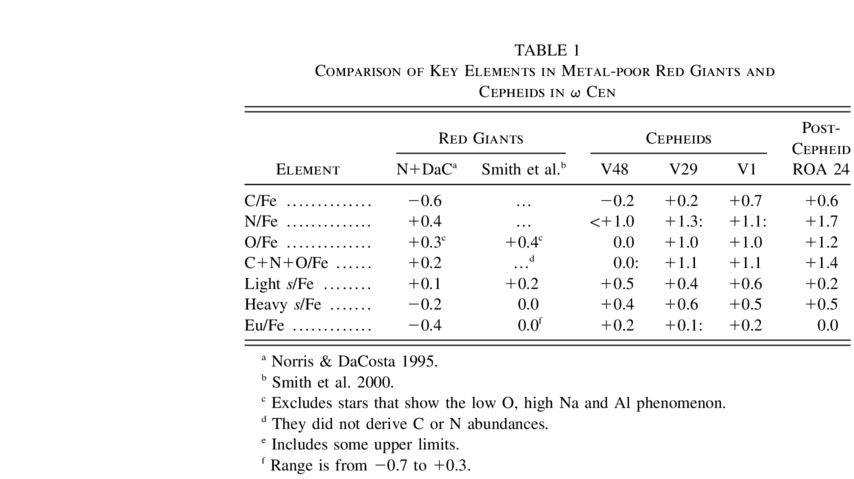 |
Table 1 traces the composition of metal‐poor (i.e., [Fe/H] ≃ -1.8) stars as they advance into the Cepheid region and just beyond the instability strip (for ROA 24). It is clear that new CNO nuclei reach the surface as the star evolves between 4.5 and 14 days, i.e., between V48 and V29. Some of the new C and O is reprocessed to N on the way to the surface. The gain of C+N+O is about a factor of 10. The s‐process elements were enhanced at an earlier stage because their excess is already visible in V48. Additional enhancement is not noticeable. As expected, europium, an almost pure r‐process element, is unaffected by evolution of the stars and reflects the abundance of r‐process elements with which the stars formed.
5.2. Cepheids in Other Globular Clusters
Gonzalez & Lambert (1997) have analyzed five Cepheids that are members of the globular clusters M2, M5, M10, and M28. Their [Fe/H] values closely follow the metallicity of their clusters as determined from their red giants and other members. Three of the five are actually RV Tau stars. None of them shows the depletion of nonvolatile species that are seen in many field RV Tau stars of moderate metal deficiency (see § 5.5). As with the field RV Tau stars of similar metallicity, no gas‐grain separation has occurred, probably because of the deficiency of grain‐forming material in a metal‐poor environment. No excess of s‐process elements is evident, as differing from the Cepheids in ω Cen whose [s/Fe] ≃ + 0.5. In M5 Var 84, oxygen is drastically depleted while Na and Al are enhanced, indicating that the CNO, NeNa, and MgAl cycles have been active either within the star (Cavallo, Sweigart, & Bell 1996) or possibly in the material out of which the star formed (Ventura et al. 2001). M5 Var 42 also shows an excess of Na. In addition, the latter star was found to have an unusually high Li abundance (Carney, Fry, & Gonzalez 1998). Two other Li‐rich stars are known in globular clusters, one in M3 (Kraft et al. 1999) and V2 in NGC 362, a red giant tip variable (Smith, Shetrone, & Keane 1999). A high Li abundance in a globular cluster red giant or Cepheid is a rare phenomenon indeed as shown by the survey of Pilachowski et al. (2000), which found no additional Li‐rich stars among 261 red giants in four globular clusters.
5.3. The Bulge Cepheids
Sixteen stars of the spectroscopic survey of Harris & Wallerstein (1984) lie within the arbitrary limits of ±10° in both l and b. We will call them bulge Cepheids. Their mean radial velocity dispersion is 97 ± 24 km s-1 and mean value of [Fe/H] is - 0.6 ± 0.17. The extreme values range from −1.4 to +0.6. This shows that the bulge Cepheids have properties similar to the thick disk and are not a concentration of halo stars. From the same reference, the velocity dispersion of 17 Cepheids whose distance from the Galactic center is at least 8 kpc is 100 ± 24 km s-1, while their mean value of [Fe/H] is - 0.5 ± 0.17 with a range from −2.2 to +0.2. Hence, these so‐called halo stars appear to be an extension of the bulge Cepheids but do not show the properties of the globular clusters of the halo except for the very few stars with [Fe/H]≲ -1.5.
5.4. The Carbon Cepheids
In 1983 Lloyd Evans called attention to Cepheids that have strong C2 bands and hence should be called carbon stars. Three of these, RU Cam, V553 Cen, and RT TrA, have been analyzed by high‐dispersion spectroscopy (Wallerstein 1968; Wallerstein & Gonzalez 1996; Wallerstein, Matt, & Gonzalez 2000). All three stars do indeed have higher carbon than oxygen abundances and enhanced total C+N+O abundances. They have apparently increased their atmospheric CNO levels by the 3α→ 12C reaction and reprocessed some of the 12C into 14N by proton capture. They do not show a significant enhancement of the s‐process elements. This relates them to the nonvariable R stars (Dominy 1984). No evolutionary sequences currently predict both the luminosity and the composition of the R stars except for sudden mixing induced by a helium core flash (Cole & Deupree 1980).
5.5. The RV Tau Stars
As mentioned earlier, there are a few RV Tau stars in globular clusters. They appear to be evolving to the left in the color‐magnitude diagram, having survived life on the red giant branch, horizontal branch, and the AGB. Throughout their long lifetimes they have had several opportunities to lose material from their surfaces and to bring nuclear‐processed matter into their atmospheres. As of this writing, quantitative abundance analyses are available for 21 field RV Tau stars as summarized by Giridhar, Lambert, & Gonzalez (2000; their Table 8). Their iron abundances range from solar, or slightly above solar, to values near [Fe/H] = -1.0, with one star, V453 Oph, as low as −2.2. However, their iron abundance is not a fundamental parameter. An examination of Table 8 of Giridhar et al. (2000) shows a huge range in abundances of light metals. The derived compositions cannot be explained by nucleosynthesis within these stars or in any combination of previous generations of stars. The deficiencies of the light elements correlate with the condensation temperature of the species in the same way as do the deficiencies in the gas phase in common interstellar clouds. Species with the highest condensation temperatures are the most deficient because they have condensed onto grains. Two metals, S and Zn, have low condensation temperatures and are the best indicators of the metallicity for the stars. In the sample of Giridhar et al. they cover a range from solar to about −1.0 in [S/H] and [Zn/H]. The three stars with [S/H] and [Zn/H] near −1.0 show no differential depletion, indicating that low metals means little dust on which the other elements may be condensed. One star, V453 Oph, shows [Fe/H] = -2.2, while the lines of S and Zn are too weak to measure. That places V453 Oph in the same category as the RV Tau stars in the metal‐poor globular clusters such as V1 in ω Cen and V11 in M2. Since they have not suffered depletion by grain formation, the metal‐poor RV Tau stars reveal the results of nucleosynthesis and mixing.
A few stars give a hint that the dust that has carried away the nonvolatiles is not graphite or another form of carbon. There are a few RV Tau stars that appear to be metal‐poor but not depleted. The best explanation has been that the lack of heavy elements results in a lack of grains. However, some of those stars do not lack carbon. For example, TW Cam has [C/H] = + 0.24, [Fe/H] = -0.50, [Al/H] = -0.41, and [Zn/H = -0.34 (Giridhar et al. 2000). The similar abundances of Fe, Al, and Zn indicate the absence of depletion while C is plentiful. At the same time, is is not clear if stars with low carbon and depleted nonvolatiles have lost both as carbon‐rich grains and nonvolatiles departed from the atmosphere, or if the nonvolatiles hitched a ride on silicate grains in the absence of carbon grains.
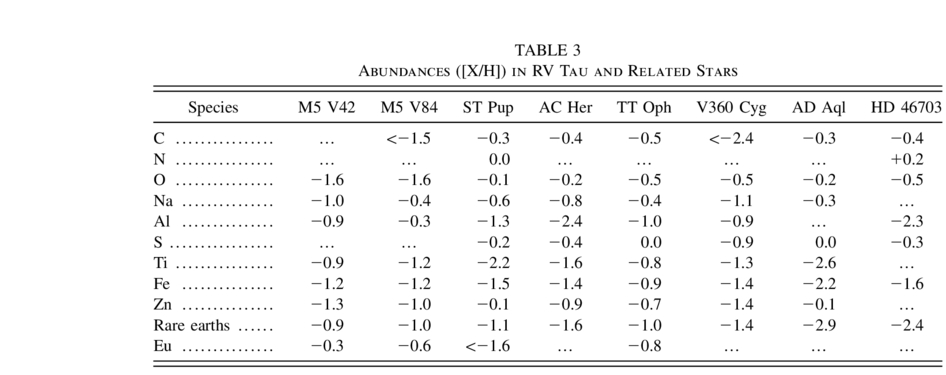
There is little evidence for s‐process enrichment despite the implication that the RV Tau stars are post‐AGB stars. Strangely, R Sct appears to be deficient in the heavy s‐process elements by over a factor of 10. However, the similar deficiency in Sc, which is not considered to be an s‐process species, makes one suspicious that second ionization of the rare earths and Sc may be responsible for the apparent anomalies (Luck & Bond 1989). In Table 2 we show a sample of abundances in RV Tau stars as well as the peculiar binary Cepheid ST Pup (see § 8) and the post‐AGB star HD 46703 as an example of a star that shows grain‐gas separation (Van Winkel 1997).
 |
6. THE DYNAMIC ATMOSPHERES OFTYPE II CEPHEIDS
The first hint that the atmosphere of W Vir, the prototype of the Type II Cepheids, was unusual was the discovery of hydrogen emission by Joy (1937) in its spectrum during rising light. In addition, Joy wrote “He i em?” on the envelope of at least one of his spectra.1 Classical Cepheids, observed since the time of Belopolsky (1895) and Jacobsen (1926), were never described as showing emission lines of H i or He i. At the Rome meeting of the IAU, Sanford (1953) reported that high‐resolution spectra of W Vir obtained with the Mount Wilson 100 inch coudé spectrograph showed doubled absorption lines during rising light, with the violet component yielding about the same radial velocity as did the H i emission. During the discussion of Sanford’s paper at the IAU meeting, Schwarzschild (1953) suggested that the double absorption lines and the hydrogen emission lines indicated the presence of a shock wave in the stellar atmosphere. Sanford’s spectra also showed the He i line at 5876 Å (Wallerstein 1959).
In his detailed study of W Vir, Abt (1954) considered two models for the double lines. Their radial velocity curves showed that the two layers either passed through each other or collided at supersonic velocity. The former is not possible because the pressures and temperatures derived by Abt showed that the atomic mean free path was much less than the thickness of the layers; hence, a supersonic interaction as the layers collided was unavoidable.
Evidence in favor of the shock model was presented by Wallerstein (1959), who combined a shock with new spectra that showed both H and He i in emission to derive a very rough ratio of H/He that was not very different from the solar value. The problem of modeling the shock was clarified by Whitney & Skalafuris (1963), who recognized that the shock structure could be represented by a series of layers as follows. In front of the shock is the cool gas falling in. This layer knows nothing about the shock except for the excess radiation that is emitted by the recombining gas behind the shock. Immediately behind the shock is an internal relaxation region of high temperature and high pressure where atoms are excited and ionized. Temperatures near 50,000 K are immediately achieved even after much of the shock energy is used to ionize both H i and He i. Behind this is the region of external relaxation where the ionized H and He recombine, emitting a recombination spectrum. This is a complicated process because of self‐absorption of the H and He lines as well as excitation and reionization by the intense radiation field. Although the gas is optically thick to Lyman and even Balmer lines, some radiation escapes through the shock to preexcite and preionize the cool gas in front of the shock. The simulation of the propagating shock is a complicated iterative problem in radiative hydrodynamics with non‐LTE thermodynamics. Although this is a solvable problem in classical astrophysics, using a modern computer it has never been fully solved.
Using approximate, static solutions and new data obtained with the 200 inch telescope, Raga, Wallerstein, & Oke (1989) were able to fit observational and theoretical line profiles of W Vir during rising light. They derived a ratio of NHe/NH = 0.12 with limits of 0.08–0.18 due to the uncertainties in the data and the models. Their lower limit is close to the value of NHe/NH in metal‐poor systems. Hence, there may have been some mixing of synthesized He into the stellar atmosphere.
7. THE ANOMALOUS CEPHEIDS
7.1. The Observations
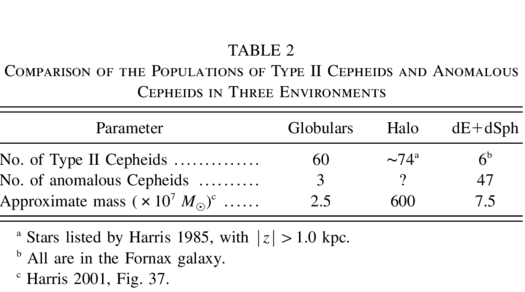
Despite the fact that the populations of the globular clusters and the dSphs are thought to be nearly the same with regard to metallicity and age, there are Type II Cepheids only in the Fornax system. This holds despite the fact that there are roughly as many stars in the dSphs of the local group as there are stars in the globular clusters of our Galaxy. In this respect, the dSphs are similar to the halo of our galaxy. In fact, the similarity of the dSphs and Galactic halo extends to the tendency for both to have red horizontal branches despite their low metallicity and to the presence of large amounts of dark matter in both populations. In some ways, the outer halo globular clusters, with the notable exception of NGC 2419 (which seems to have an anomalous Cepheid of period 1.58 days; Pinto & Rosino 1977), are metal‐poor with red horizontal branches. Mateo, Fischer, & Krzeminski (1995) list the known variables in nine dSph systems associated with the Milky Way. A total of 47 anomalous Cepheids are included.
It is interesting to compare the populations of Type II Cepheids and anomalous Cepheids in three environments: the globular clusters, the field stars of the Galactic halo, and the dSphs. We show the data in Table 2. The Cepheids in globular clusters are taken from Clement et al. (2001). The data for the halo (Harris 1985) must be affected by the sparcity of surveys tuned to detect variables with periods from roughly 1.0 to 30 days. However, a comparison of the luminous masses of each environment is revealing. For the dSphs, the baryon masses were estimated using their luminosities and assuming an M/L ratio of 3. For the globulars we used the compliation of Harris (2001). For the halo’s mass we used the luminosity of the spheroid as given by Binney & Tremaine (1994; their Tables 1–2). Their luminosity for the spheroid may overestimate the mass of the halo, since the bulge should not be considered to be part of the halo.2 However, the mass of the halo is certainly enormously larger than that of the globular clusters, probably by a factor near 100.
Once an adequate survey of halo Cepheids has been completed it may be possible to tell short‐period Type II Cepheids from RR Lyrae stars and anomalous Cepheids using their Fourier parameters. A halo dominated by anomalous Cepheids should be associated with the dwarf spheroidals. Such a relationship would strongly support the suggestion by Searle & Zinn (1978) that much of the halo was accreted from one‐time satellite systems that were captured by our Galaxy.
7.2. Pulsation and Evolution of the Anomalous Cepheids
The evolution and pulsation of the anomalous Cepheids have been most recently examined thoroughly by Bono, Caputo, & Santolamazza (1997b). There is a general consensus that they have masses near 1.5 M⊙, which is unexpected since they appear in systems whose turnoff mass is near 0.8 M⊙. Hence, they either are much younger than the vast majority of stars in the globulars or dwarf spheroidals in which they are found or are mass‐transfer binaries that have gobbled up most of their now unseen secondaries. The authors have derived the limits of the instability strip for pulsating stars of masses ranging from 0.58 to 1.5 M⊙. They cover roughly from log L/L⊙ = 1.6 to 2.0 and Teff from 7400 to 5600 K, which fits well with the observed values of luminosity and effective temperatures of the anomalous Cepheids.
Bono et al. also calculated evolutionary models for masses from 1.0 to 2.2 M⊙ and [Fe/H] = -1.7 and −2.3, starting on the zero‐age horizontal branch. The evolutionary tracks take the models into the instability region and allow the assignment of masses and pulsation mode for many of the stars. Models of mass 1.5–2.0 M⊙ fit most of the stars. For most of the dwarf spheroidals and NGC 5466, mass transfer in old binaries can explain most of these stars. However, in Carina, which has had at least two periods of star formation, the anomalous Cepheids may well be single stars with masses near 1.5 M⊙. Four anomalous Cepheids have been suggested to be in ω Cen. However, the photometry of Kaluzny et al. (1997) has shown that only V99 is significantly bright for its period. A detailed study of that star would be well worthwhile. While the high masses of some anomalous Cepheids may be due to mass transfer, some of the dSph systems show an age spread that includes main‐sequence stars up to about 1.5 M⊙.
8. BINARY CEPHEIDS
A few Type II Cepheids are known to be spectroscopic binaries. A search of the literature reveals the following stars with orbits: TX Del, IX Cas, AU Peg, and ST Pup.
Orbits for IX Cas and TX Del have been published by Harris & Welch (1989). They have pulsation periods of 9.15 and 6.17 days and orbital periods of 110 and 133 days. Their orbital dimensions indicate the possibility of mass transfer having taken place. Both stars are relatively metal rich and belong to the thick‐disk population. A somewhat stranger star is AU Peg, which has a fluctuating pulsation period of 2.4 days (Vinko, Szabados, & Szatmary 1993). The very short orbital period is only 53 days (Harris, Olszewski, & Wallerstein 1984). Its metallicity is approximately solar. McAlary & Welch (1986) have found a large infrared excess in AU Peg indicating mass loss at a rate of 10−6 M⊙ yr−1.
The most interesting of these pathological systems is ST Pup (Gonzalez & Wallerstein 1996). It has a fluctuating pulsation period near 19 days and an orbital period of 410 days. Its UBVRI light curves are presented by Kilkenny et al. (1993), and both its pulsation and orbital velocity curves are published by Gonzalez & Wallerstein (1996). They also describe the behavior of the H lines. It is metal‐poor with an apparent [Fe/H] = -1.5 and shows strong CH and CN near minimum light, as do many RV Tau stars. As with RV Tau stars and high‐latitude post‐AGB stars, elemental abundances show a clear correlation of abundance with condensation temperature ranging from [X/H] ≃0 for volatile elements S and Zn to [Ti/H] = -2.0. Hence, the apparent deficiency of iron was not intrinsic to the star at its birth. Evidently it has lost species that condense onto grains. Not surprisingly, the grains are still near enough to the star to emit a large excess of infrared radiation (McAlary & Welch 1986). Its radial velocity is near zero and its Galactic orbit is nearly circular despite its substantial height above the Galactic plane of 740 pc (Beers et al. 2000), so it is certainly not a halo object. We have included ST Pup in Table 3.
 |
9. SUMMARY
The Cepheids of Population II are a heterogeneous class of stars belonging to thick‐disk, old‐disk (=thick disk?), Galactic bulge, and halo populations. The related stars, called anomalous Cepheids, are common in the dwarf spheroidals but not in the Galaxy’s globular clusters. However, the dSph systems do not seem to have Type II Cepheids or their long‐period extension into the RV Tau regime. Systematic surveys such as the Sloan Digital Sky Survey that include the colors that reveal Teff and log g in F–G stars of high luminosity are badly needed to discover Type II Cepheids, RV Tau stars, and anomalous Cepheids throughout the halo of our Galaxy.
The evolution of Type II Cepheids is now rather well understood in terms of evolution from the blue horizontal branch to the AGB for the short‐period stars, blue loops off the AGB for the stars of intermediate period, and post‐AGB evolution for the longest period, RV Tau, stars.
Much remains to be done in the high‐resolution analyses of Type II Cepheids of all periods, especially for the longer period and RV Tau stars, to study their mixing and selective mass loss of grains and nonvolatile elements.
To some extent the abundance results depend on the atmospheric models used for their analysis. The models, in turn, depend on the dynamics of their moving atmospheres with velocity gradients and shock waves at certain phases. The radiative hydrodynamics needed to model the atmospheres involve difficult calculations but are necessary to understand the H/He ratio and other abundances that are sensitive to the ionizing radiative flux.
While much has been done in the past 50 years of research on the Type II Cepheids, much rewarding research remains to be accomplished.
I thank the late Robert Schommer for suggesting that I write this review, as well as many astronomers who have suggested references, supplied preprints, or discussed the Type II Cepheids with me via e‐mail. A preliminary version of this review was read by G. Gonzalez, H. C. Harris, and J. H. Lutz, all of whom made helpful comments that contributed to the final version. I have made extensive use of the SIMBAD system operated by the CDS, Strasbourg, France, and the ADS of NASA.
Note added in proof.—Two more strongly depleted RV Tau stars have been analyzed for abundances by T. Maas, H. Van Winkel, and C. Waelkens (2002, A&A, 386, 504).
Footnotes
- 1
All Mount Wilson and Palomar spectra were filed according to the right ascension of the star (and available for inspection and measurement) through the directorship of Horace Babcock. I have been told that the practice of archiving spectra was terminated thereafter.
- 2
There are many Cepheids that are members of the bulge; see § 5.3.
