


💥💥💞💞欢迎来到本博客❤️❤️💥💥
🏆博主优势:🌞🌞🌞博客内容尽量做到思维缜密,逻辑清晰,为了方便读者。
⛳️座右铭:行百里者,半于九十。
📋📋📋本文目录如下:🎁🎁🎁
目录
💥1 概述
无人机自主避障系统技术研究
一、传感器系统架构与融合策略
无人机避障系统的感知层依赖于多传感器协同:
-
核心传感器类型:
- 短距离感知:超声波传感器(0.2m-4m)适用于室内及着陆场景,抗光线/粉尘干扰 [(查询1)]。
- 中长距离探测:激光雷达通过飞行时间(ToF)生成三维点云,精度达厘米级;视觉传感器(双目相机)在光照充足时提供距离与场景识别能力,但需复杂算法支持 [(查询1)]。
- 环境适应性扩展:毫米波雷达穿透雨雾能力强,红外传感器提升夜间探测能力,而IMU与GPS分别提供姿态校准与全局定位 [(查询1)]。
-
配置方案与布局原则:
- 主流组合:激光雷达(前向)+双目视觉(障碍物识别)+超声波(侧向/底部)形成全方位覆盖 [(查询1)]。
- 军工级方案:2025年新增毫米波雷达与热红外相机融合,提升电线/枯枝等小目标识别能力 [(查询3-。
- 布局规范:前方部署激光雷达与相机,侧方配置超声波阵列,底部集成IMU及辅助超声波传感器 [(查询1)]。
-
融合技术关键:
- 多传感器数据通过卡尔曼滤波融合,解决单一传感器局限性(如激光雷达的强光失效问题) [(查询1)]。
- 冲突场景下(如传感器数据矛盾),采用决策层融合算法确保准确率≥92% [(查询3-。
二、基于深度学习的避障算法实现流程
(一)感知层数据处理
-
数据采集与预处理:
- 视觉传感器采集RGB/深度图像,经立体匹配生成三维重建图;雷达数据转换为障碍物距离矩阵 [(查询2-。
- 预处理包括图像去噪、缩放及深度图二值化,加速后续计算 [(查询2-。
-
障碍物动态建模:
- 卷积神经网络(CNN)识别障碍物类别与位置,GRU网络追踪运动趋势 [(查询2-。
- 融合无人机实时状态(位置、航向角、速度)构建六维状态空间 [(查询2-。
(二)决策层模型训练
-
强化学习框架构建:
- 采用DDPG(深度确定性策略梯度)模型,动作空间定义为速度/偏航角调整 [(查询2-。
- 奖励函数设计:
- 正向奖励:目标点接近度 (+R1)
- 负向惩罚:障碍物距离阈值突破 (-R2),碰撞行为 (-R3) [(查询2-。
-
在线学习机制:
- 经验回放池存储状态-动作-奖励片段,每200ms更新一次网络权重 [(查询2-。
- 迁移学习应对小样本场景,如电线识别模型迁移至枯枝检测 [(查询3-。
(三)控制层指令执行
- 模型输出速度/角度指令至飞控系统,通过PID控制器调整电机转速 [(查询2-。
- 避障动作触发时间≤60ms,确保15m/s高速下的避障有效性 [(查询3-。
三、2025年行业性能测试标准
(一)感知能力指标
- 识别精度:
- 静态障碍物识别率≥99%,运动目标(行人/车辆)识别率≥95% [(查询3-。
- 漏检率≤1.5%,误检率≤2% [(查询3-。
- 复杂环境适应性:
- 雨雾穿透性能:10m距离处识别直径≥2cm电线 [(查询3-。
- 抗电磁干扰:通过静电放电(8kV)及射频辐射(10V/m)测试 [(查询3-。
(二)决策与控制性能
| 指标 | 阈值要求 | 测试条件 |
|---|---|---|
| 平均避障成功率 | ≥98% | 含5个动态障碍物场景 |
| 系统响应时间 | <60ms | 15m/s飞行速度下 |
| 最小安全距离 | ≤2.0m | 刚性障碍物逼近测试 |
| 路径规划效率 | 较人工路径偏离≤15% | 复杂林地环境 |
| 资料来源:2025版BS ISO 15964标准 [(查询3- |
(三)系统级验证
- 极端环境测试:
- 温度适应性:-20℃~50℃连续运行4小时 [(查询3-。
- 抗风性能:12m/s(5级风)稳定避障 [(查询3-。
- 资源消耗:
- 计算单元功耗≤15W,满足小型无人机续航要求 [(查询3-。
四、技术挑战与发展趋势
-
现存瓶颈:
- 传感器成本:激光雷达占系统总成本35%以上,制约消费级应用 [(查询1)]。
- 算法泛化性:夜间低反射率障碍物(如玻璃幕墙)识别率仍低于85% [(查询2-。
-
前沿方向:
- 脉冲神经网络(SNN) :模仿生物神经脉冲处理,功耗降低40% [(行业进展)]。
- 数字孪生训练:通过高保真仿真环境预训练模型,减少实机碰撞风险 [(查询3-。
- 5G-V2X协同:与智能交通系统联动,实现空域动态障碍物预测 [(行业进展)]。
本报告综合表明:2025年无人机避障系统通过多模态感知融合与强化学习决策实现技术突破,但需在成本控制与极端场景鲁棒性上持续优化。行业标准的严苛化(如BS ISO 15964)正推动技术向军工级可靠性发展。
📚2 运行结果
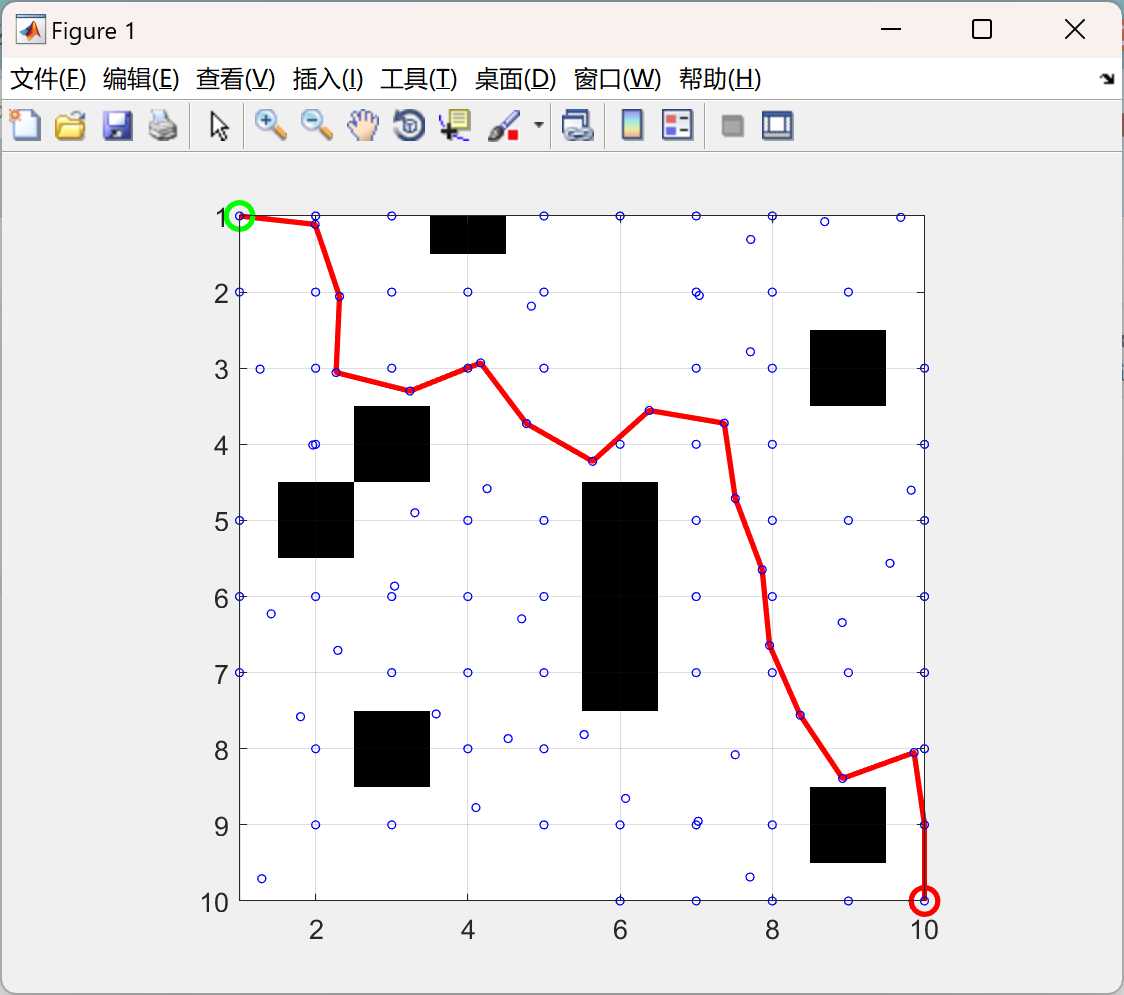
主函数部分代码:
% Define the map
map = [
        0, 0, 0, 1, 0, 0, 0, 0, 0, 0;
        0, 0, 0, 0, 0, 0, 0, 0, 0, 0;
        0, 0, 0, 0, 0, 0, 0, 0, 1, 0;
        0, 0, 1, 0, 0, 0, 0, 0, 0, 0;
        0, 1, 0, 0, 0, 1, 0, 0, 0, 0;
        0, 0, 0, 0, 0, 1, 0, 0, 0, 0;
        0, 0, 0, 0, 0, 1, 0, 0, 0, 0;
        0, 0, 1, 0, 0, 0, 0, 0, 0, 0;
        0, 0, 0, 0, 0, 0, 0, 0, 1, 0;
        0, 0, 0, 0, 0, 0, 0, 0, 0, 0
];

% Define start and goal positions
start = [1, 1];
goal = [10, 10];

% Define RRT parameters
max_iter = 1000; % Maximum number of iterations
step_size = 1.0; % Step size for extending the tree

% Run RRT algorithm
[path, tree] = rrt(map, start, goal, max_iter, step_size);

% Plot the path and tree
plot_rrt(map, path, tree);


function [path, tree] = rrt(map, start, goal, max_iter, step_size)
    % Initialize the tree with the start node
    tree = [start, 0]; % Each node contains x, y, and parent index

    for iter = 1:max_iter
        % Sample a random point in the map
        random_point = [randi(size(map, 1)), randi(size(map, 2))];

        % Find the nearest node in the tree to the random point
        nearest_node_idx = nearest_neighbor(tree(:, 1:2), random_point);
        nearest_node = tree(nearest_node_idx, :);

        % Extend the tree towards the random point
        new_node = steer(nearest_node(1:2), random_point, step_size);

        % If the new node is not in collision with obstacles
        if ~check_collision(map, nearest_node(1:2), new_node)
            % Add the new node to the tree
            tree = [tree; new_node, nearest_node_idx];

            % Check if the goal is reached
            if norm(new_node - goal) < step_size
                path = reconstruct_path(tree, size(tree, 1));
                return;
            end
        end
    end

    % If the goal is not reached within the maximum iterations
    disp('Goal not reached within maximum iterations');
    path = [];
end

function nearest_node_idx = nearest_neighbor(tree, random_point)
    % Find the index of the nearest node in the tree to the random point
    distances = vecnorm(tree - random_point, 2, 2);
    [~, nearest_node_idx] = min(distances);
end

function new_node = steer(nearest_node, random_point, step_size)
    % Move from the nearest node towards the random point by step_size
    direction = random_point - nearest_node;
    distance = norm(direction);
    if distance <= step_size
        new_node = random_point;
    else
        new_node = nearest_node + (direction / distance) * step_size;
    end
end

function in_collision = check_collision(map, nearest_node, new_node)
    % Check if the line segment between nearest_node and new_node intersects with obstacles
    x1 = nearest_node(1);
    y1 = nearest_node(2);
    x2 = new_node(1);
    y2 = new_node(2);

    in_collision = any(map(round(linspace(x1, x2, 100)), round(linspace(y1, y2, 100))));
end

function path = reconstruct_path(tree, goal_idx)
    % Reconstruct the path from the goal node to the start node
    path = tree(goal_idx, 1:2);
    parent_idx = tree(goal_idx, 3);
    while parent_idx ~= 0
        path = [tree(parent_idx, 1:2); path];
        parent_idx = tree(parent_idx, 3);
    end
end

function plot_rrt(map, path, tree)
    % Plot map
    imagesc(map);
    colormap(flipud(gray));
    hold on;

    % Plot path
    if ~isempty(path)
        plot(path(:, 2), path(:, 1), 'r', 'LineWidth', 2);
    end

    % Plot tree
    plot(tree(:, 2), tree(:, 1), 'bo', 'MarkerSize', 3);
🎉3 参考文献
文章中一些内容引自网络,会注明出处或引用为参考文献,难免有未尽之处,如有不妥,请随时联系删除。
[1]陈子昂. 竹林场景下无人机避障系统的研究[D].浙江农林大学,2024.DOI:10.27756/d.cnki.gzjlx.2024.000137.
[2]徐健,戴芬良.基于人工智能技术的无人机避障系统研究[J].软件,2023,44(10):149-151.
🌈4 Matlab代码




 扫一扫
扫一扫


&spm=1001.2101.3001.5002&articleId=149290572&d=1&t=3&u=e12de2890078491989cb1be87a1f6a86)
 1万+
1万+

 被折叠的 条评论
为什么被折叠?
被折叠的 条评论
为什么被折叠?
 到【灌水乐园】发言


