



 本文详细介绍了机器学习中常用的五种距离度量方法:欧式距离、曼哈顿距离、夹角余弦、切比雪夫距离和汉明距离,并分别给出了它们的数学公式和Python实现示例。
介绍的五种距离度量方法是:欧氏距离(Euclidean Distance),曼哈顿距离(Manhattan Distance),夹角余弦(Angle Cosine),切比雪夫距离(Chebyshev Distance),汉明距离(Hamming Distance)。
1.欧式距离(Euclidean Distance)
1.1数学公式
Euclidean Distance,即两点之间的直线距离,数学公式如下所示。
(1)二维平面上两点a(x1,y1),b(x2,y2)之间的欧式距离公式

(2)n维空间上两点a(x1,x2……..xn),b(y1,y2……..yn)的欧式距离公式

1.2Python实现
欧氏距离的实现用了三种方法:
1)lambda+[]
2)function + np.frompyfunc
3)lambda + np.frompyfunc
lambda + np.frompyfunc是最舒服的一种实现(多个)序列之间相互操作的方法。
   # -*- coding: utf-8 -*-
"""
@author: 蔚蓝的天空tom
Aim:五种度量距离方法实现
"""
import numpy as np

def EM1(p):#数学公式法
    '''EuclideanMetric, 欧几里得距离, 也称欧氏距离'''
    y = lambda a,b : np.power(a-b,2)
    s = sum([y(a,b) for (a,b) in zip(p[0], p[1])])
    em = np.sqrt(s)
    return em

def e_func(a,b):
    '''求两个数的差的平方'''
    return np.power(a-b,2)
def EM2(P):#function + np.frompyfunc方法
    '''EuclideanMetric, 欧几里得距离, 也称欧氏距离'''
    func = np.frompyfunc(e_func, 2, 1)
    s = sum(func(P[0],P[1]))
    em = np.sqrt(s)
    return em

def EM3(P):#lambda + np.frompyfunc方法
    e_func = lambda a,b : np.power(a-b,2)
    func = np.frompyfunc(e_func, 2, 1)
    s = sum(func(P[0],P[1]))
    em = np.sqrt(s)
    return em

def EM4(P):#向量法
    P = np.array(P)
    K = P[0] - P[1]
    em = np.sqrt(sum(K * K.T))#向量乘
    return em

if __name__=='__main__':
    #二维空间,(1,2), (3,4)
    p = [[1,2], #p1 = (1,2)
         [3,4]] #p2 = (3,4)
    print('em:', EM1(p), EM2(p),EM3(p), EM4(p))

    #4维空间,(1,2,3,4), (5,6,7,8)
    p = [[1,2,3,4], #p1 = (1,2,3,4)
         [5,6,7,8]] #p2 = (5,6,7,8)
    print('em:', EM1(p), EM2(p), EM3(p), EM4(p))
运行结果:
runfile('C:/Users/tom/5_distance.py', wdir='C:/Users/tom')
em: 2.82842712475 2.82842712475 2.82842712475 2.82842712475
em: 8.0 8.0 8.0 8.0
2.曼哈顿距离(Manhattan Distance)
2.1数学公式
ManhattanDistance,就是相同数轴坐标差的绝对值的和
(1)二维平面上两点a(x1,y1),b(x2,y2)之间的曼哈顿距离

(2)n维空间上两点a(x1,x2……..xn),b(y1,y2……..yn)的曼哈顿距离公式:

2.2Python实现
# -*- coding: utf-8 -*-
"""
@author: 蔚蓝的天空tom
Aim:用尽可能多的方法实现曼哈顿距离Manhattan Distance
"""
import numpy as np
def MD1(P):#数学公式法
    y = lambda a,b : np.abs(a-b)
    md = sum([y(a,b) for (a,b) in zip(P[0], P[1])])
    return md

def e_func(a,b):
    return np.abs(a-b)
def MD2(P):#function + np.frompyfunc方法
    func = np.frompyfunc(e_func, 2, 1)
    md = sum(func(P[0], P[1]))
    return md

def MD3(P):#lambda + np.frompyfunc方法
    e_func = lambda a,b : np.abs(a-b)
    func = np.frompyfunc(e_func, 2, 1)
    md = sum(func(P[0], P[1]))
    return md

def MD4(P):#
    e_func = lambda x: np.abs(x)
    func = np.frompyfunc(e_func, 1, 1)
    #md = sum(func(P[0] - P[1])) #error:list不支持-运算符
P = np.array(P)运行结果:
runfile('C:/Users/tom/Manhattan_Distance.py', wdir='C:/Users/tom')
md: 4 4 4 4
md: 16 16 16 16
3.夹角余弦
3.1数学公式
(1)二维平面上两向量a(x1,y1),b(x2,y2)之间的夹角余弦公式

也可以使用向量方法计算:
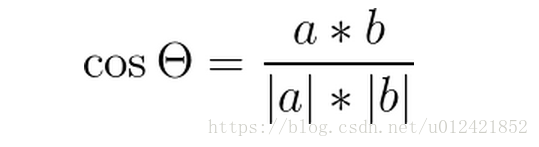
(2)n维空间上两点a(x1,x2……..xn),b(y1,y2……..yn)的夹角余弦公式

3.2Python实现
# -*- coding: utf-8 -*-
"""
@author: 蔚蓝的天空tom
Aim:用尽可能多的方法实现夹角余弦angle cosine
"""

import numpy as np

def AC1(P):
    '''数学公式法'''
    #分子
    numerator = sum([(a*b) for (a,b) in zip(P[0], P[1])])
    #分母
    sq1 = np.sqrt(sum([np.power(e,2) for e in P[0]]))
    sq2 = np.sqrt(sum([np.power(e,2) for e in P[1]]))
    denominator = sq1 * sq2
    #夹角余弦公式
    ac = numerator * 1.0/denominator
    return ac

def e_func(a,b):
    '''实现a*b,如果计算a*a,可以传入a,a'''
    return a*b
def AC2(P):
    '''function + np.frompyfunc方法'''
    func = np.frompyfunc(e_func, 2, 1)
    #分子
    numerator = sum(func(P[0], P[1]))
    #分母
    denminator = np.sqrt(sum(func(P[0], P[0]))) * \
                 np.sqrt(sum(func(P[1], P[1])))
    #夹角余弦
    ac = numerator * 1.0/denminator
    return ac

def AC3(P):
    '''lambda + np.frompyfunc方法'''
    e_func = lambda a,b : a*b
    func = np.frompyfunc(e_func, 2, 1)
    numerator = sum(func(P[0], P[1]))
    denminator = np.sqrt(sum(func(P[0], P[0]))) *\
                 np.sqrt(sum(func(P[1], P[1])))
    ac = numerator * 1.0/denminator
    return ac

def AC4(P):
    '''向量法'''
    #numberator = sum(P[0]*P[1].T)#error:'list' object has no attribute 'T'
    P = np.array(P) #先转化为np.ndarray
    numberator = sum(P[0]*P[1].T)#向量乘
    denminator = np.sqrt(sum(P[0]*P[0].T)) *\
                 np.sqrt(sum(P[1]*P[1].T))
    ac = numberator * 1.0/denminator
    return ac

if __name__=='__main__':
    #二维空间,(1,2), (3,4)
    P = [[1,2], #p1 = (1,2)
         [3,4]] #p2 = (3,4)
    print('ac:', AC1(P), AC2(P), AC3(P), AC4(P))
    #n维空间,(1,2,3,4), (5,6,7,8)
    P = [[1,2,3,4], #p1 = (1,2,3,4)
         [5,6,7,8]] #p2 = (5,6,7,8)
    print('ac:', AC1(P), AC2(P), AC3(P), AC4(P))
运行结果:
runfile('C:/Users/tom/angle_cosine.py', wdir='C:/Users/tom')
ac: 0.9838699101 0.9838699101 0.9838699101 0.9838699101
ac: 0.968863931627 0.968863931627 0.968863931627 0.968863931627
4.切比雪夫距离(Chebyshev Distance)
4.1数学公式
(1)二维平面上两点a(x1,y1),b(x2,y2)之间的切比雪夫距离公式

(2)n维空间上两点a(x1,x2……..xn),b(y1,y2……..yn)的切比雪夫距离公式

4.2Python实现
# -*- coding: utf-8 -*-
"""
@author: 蔚蓝的天空tom
Aim:用尽可能多的方法实现切比雪夫距离(Chebyshev Distance)
"""

import numpy as np

def CD1(P):
    '''数学公式法'''
    y = [np.abs(a-b) for (a,b) in zip(P[0],P[1])]
    cd = max(y)
    return cd

def e_func(a,b):
    return np.abs(a-b)
def CD2(P):
    '''function + np.frompyfunc方法'''
    func = np.frompyfunc(e_func, 2, 1)
    cd = max(func(P[0], P[1]))
    return cd

def CD3(P):
    '''lambda + np.frompyfunc'''
    e_func = lambda a,b : np.abs(a-b)
    func = np.frompyfunc(e_func, 2, 1)
    cd = max(func(P[0], P[1]))
    return cd

def CD4(P):
    '''向量法'''
    P = np.array(P)
    cd = max(np.abs(P[0] - P[1])) #向量减和元素取绝对值
    return cd

if __name__=='__main__':
    #二维空间,(1,2), (3,4)
    P = [[1,2], #p1 = (1,2)
         [3,5]] #p2 = (3,5)
    print('cd:', CD1(P), CD2(P), CD3(P), CD4(P))
    #n维空间,(1,2,3,4), (5,7,9,11)
    P = [[1,2,3,4], #p1 = (1,2,3,4)
         [5,7,9,11]] #p2 = (5,7,9,11)
    print('cd:', CD1(P), CD2(P), CD3(P), CD4(P))
运行结果:
runfile('C:/Users/tom/cd.py', wdir='C:/Users/tom')
cd: 3 3 3 3
cd: 7 7 7 7
5.汉明距离(Hamming Distance)
5.1数学公式
1001101与1011001之间的汉明距离就是2
95271314与95371234之间的汉明距离就是3
hello与Xello之间的汉明距离就是1
5.2Python实现
# -*- coding: utf-8 -*-
"""
@author: 蔚蓝的天空tom
Aim:尽量多的方法实现汉明距离(Hamming Distance)
"""

import numpy as np

def HD1(S):
    '''数学公式法'''
    diff = lambda a,b : (a != b and [1] or [0])[0]
    d = [diff(a,b) for (a,b) in zip(S[0], S[1])]
    hd = d.count(1)
    return hd

def e_func(a,b):
    return ((a!=b) and [1] or [0])[0]
def HD2(S):
    '''function + np.frompyfunc方法'''
    func = np.frompyfunc(e_func, 2, 1)
    y = func(list(S[0]), list(S[1]))
    hd = list(y).count(1)
    return hd

def HD3(S):
    '''lambda + np.frompyfunc方法'''
    e_func = lambda a,b : (a!=b and [1] or [0])[0]
    func = np.frompyfunc(e_func, 2, 1)
    y = func(list(S[0]), list(S[1]))
    hd = list(y).count(1)
    return hd

def HD4(S):
    '''向量法,先实现了数字字符串'''
    s1 = np.array(list(S[0]), dtype=int)#向量法的必要条件:str--->list--->array
    s2 = np.array(list(S[1]), dtype=int)
    d = list(s1 - s2) #1)向量法,2)使用list的count(e)方法,所以array--->list
    hd = d.__len__() - d.count(0) #list的元素总数方法__len__()
    return hd

if __name__=='__main__':
    #两个字符串'1001101'与'1011001'
    S = ['1001101', '1011001']
    print('hd:', HD1(S), HD2(S), HD3(S), HD4(S))

    #两个字符串'95271314'与'95371234'
    S = ['95271314', '95371234']
    print('hd:', HD1(S), HD2(S), HD3(S), HD4(S))

    #'ideal'与‘dream’
    S = ['ideal', 'ideal']
    print('hd:', HD1(S), HD2(S))

    #‘study’与‘Student’
    S = ['study', 'Student']
    print('hd:', HD1(S))
运行结果
runfile('C:/Users/l13277/hd.py', wdir='C:/Users/l13277')
hd: 2 2 2 2
hd: 3 3 3 3
hd: 0 0
hd: 2
(end)


 扫一扫
扫一扫


 4827
4827

 被折叠的 条评论
为什么被折叠?
被折叠的 条评论
为什么被折叠?
 到【灌水乐园】发言


