


凸包
定义
平面上 N 个点的凸包是包围这 N 个点的最小多边形

应用
- 机器人运动路径规划:找到起点 S 到终点 T 之间的最短路径,而且需要避开一个多边形路障
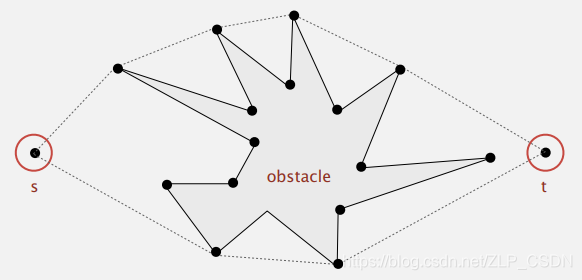
s 和 t 之间的最短路径就是 s 和 t 之间的直线距离,或者凸包中上下折线中的其中之一
- 最远的两点:平面上有 N 个点,希望找到这 N 个点中,距离最远的那一个点对
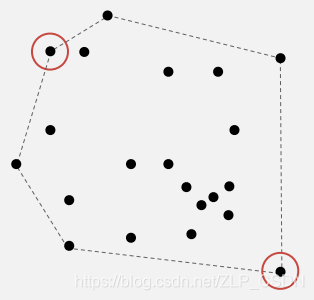
距离最远的那一对点,一定在凸包上
属性
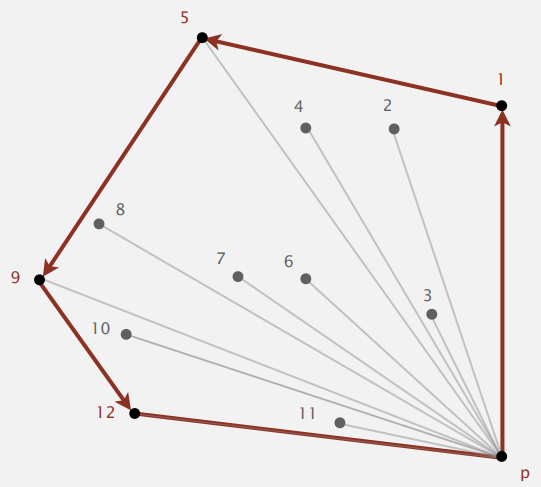
- 在凸包上,可以只通过做逆时针转弯而遍历闭凸包
- 以最小的 y 值点 p 为原点,与其他点的连线的极角逐渐增大
凸包算法-Graham scan
算法思想
Graham scan 算法思想是基于凸包的两个属性:
- 求取 N 个点中,y 值最小的点 p
- 将剩余的 N - 1 个点,按照与点 p 的极角值进行排序
- 遍历排序后的 N - 1 个点,只保留那些进行逆时针旋转的点
逆时针旋转点
现在有三个点,a, b, c。如何确定 a -> b -> c 是逆时针旋转点?
只有当 c 在 a -> b 连线的左侧的时候,c 才是逆时针旋转点
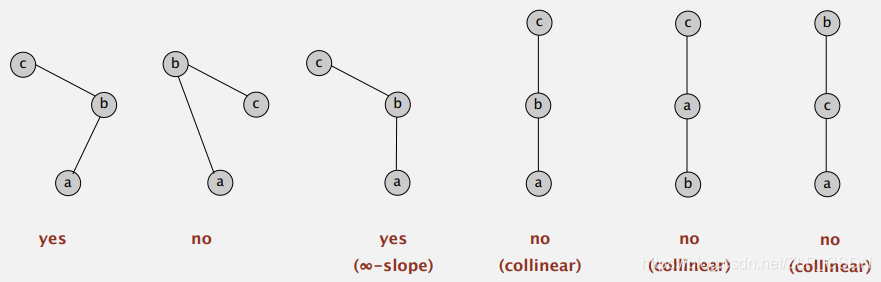
当 c 是逆时针旋转点的时候,数学上有:
ab⃗×bc⃗=[abxbcy−abybcx]
\vec {ab} \times \vec{bc} = \begin{bmatrix} ab_xbc_y-ab_ybc_x \end{bmatrix}
ab×bc=[abxbcy−abybcx]
其中, abxbcy - abybcx > 0
这个用右手法则也很好想,当 c 是逆时针旋转点的时候,从 ab 扫到 bc ,大拇指指向一定是正向;相反,则一定是反向;
代码实现
struct Point
{
	float x;
	float y;

	Point() {
		x = 0;
		y = 0;
	}

	Point(float xi, float yi) {
		x = xi;
		y = yi;
	}

	bool operator==(const Point& other) {
		if (std::abs(other.x - x) < 0.000001 && std::abs(other.y - y) < 0.0000001)
			return true;
		return false;
	}

	bool operator!=(const Point& other) {
		return !(*this == other);
	}

	friend std::ostream& operator <<(std::ostream& out, const Point& p) {
		out << p.x << ", " << p.y;
		return out;
	}
};

//return the cos value of the polar angle
float calPolarAngle(const Point& base, const Point& another) {

	float xDistance = another.x - base.x;
	float yDistance = another.y - base.y;
	float distance = std::sqrtf(xDistance * xDistance + yDistance * yDistance);
	return xDistance / distance;
}

struct  YLess
{
	bool operator()(const Point& lhs, const Point& rhs) {
		return lhs.y < rhs.y;
	}
};

struct PolarAngleLess
{
	PolarAngleLess(const Point& p) : base(p) {}

	bool operator()(const Point& lhs, const Point& rhs) {
		return calPolarAngle(base, lhs) > calPolarAngle(base, rhs);
	}
	Point base;
};


bool ccwTurn(const Point& a, const Point& b, const Point& c) {
	Point ab(b.x - a.x, b.y - a.y);
	Point bc(c.x - b.x, c.y - b.y);
	return ab.x*bc.y - ab.y*bc.x > 0;
}

std::vector<Point> convecHull(std::vector<Point>& points) {

	if (points.size() <= 3) return points;

	std::vector<Point> backPoints(points);
	auto yMinItr = std::min_element(backPoints.begin(), backPoints.end(), YLess());
	//put the yMinPoint to the front
	std::iter_swap(yMinItr, backPoints.begin());
	//sort the left n-1 points based polar angle
	std::sort(backPoints.begin() + 1, backPoints.end(), PolarAngleLess(backPoints.front()));


	for (auto it = backPoints.begin(); it != backPoints.end() - 2; ++it) {
		while (!ccwTurn(*it, *(it + 1), *(it + 2))) {
			backPoints.erase(it + 1);
			it = it - 1;
		}
	}
	return backPoints;
}

 4893
4893


 扫一扫
扫一扫


 被折叠的 条评论
为什么被折叠?
被折叠的 条评论
为什么被折叠?
 到【灌水乐园】发言


