
Visual Complexity — The Book
A curated atlas of how people map relationships: networks, hierarchies, flows, and cycles. Nearly three hundred examples show structure over spectacle and explain why form must follow mechanism.
Overview
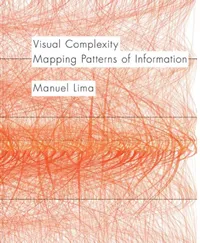
What the book does
Visual Complexity: Mapping Patterns of Information documents a long lineage of diagramming—from cosmograms and genealogies to modern network maps, matrices, radial layouts, and bundled routes—then distills practical lessons for today’s designers and researchers.
You’ll see how different structures carry different claims: trees for hierarchy, node-link vs. matrix for density trade-offs, radial layouts for cycles and hubs, and small multiples for time. Essays explain perceptual limits (angle and area vs. position and length), labeling discipline, and when restraint beats ornament.
Inside the Book
History & Context
From early symbolic maps to contemporary information graphics: how cultures encoded space, time, and knowledge before “data viz” was a term.
Structures & Layouts
When to choose node-link vs. matrix, trees vs. treemaps vs. sunbursts, polar plots for periodic data, and edge bundling for complex routes.
Perception & Craft
Readable encodings, label strategy, color as a secondary cue, and why legends are part of design—not an afterthought.
Case Patterns
Social, biological, technological, and cultural networks: what makes them legible, and common pitfalls to avoid (hairballs, misleading scales).
Who It’s For
Information designers
Need precedents and a vocabulary for complex structures.
Data journalists
Turn dense relational data into clear, publishable stories.
Researchers & students
Bridge method and communication; critique visuals with shared terms.
Product & policy teams
Explain systems, risks, and flows with diagrams people can parse fast.
About the Author
Manuel Lima
Designer, researcher, and founder of VisualComplexity.com. A leading voice in information visualization, he has presented widely and contributed to the field’s practical vocabulary of structures and encodings.
Editorial stance
Structure first, spectacle second. Prefer encodings that respect perception, and document the method and limits behind every picture.
