First published in The Traditional Astrologer magazine, issue 14; May 1997.
NOTE: The following was published in The Traditional Astrologer, before the UK election of 1997, as comet Hale Bopp was brightly visible in the sky. That year saw a spectacular defeat to the Conservative Party's 18-year majority, with an overwhelming Labour victory that gave Britain a new Prime Minister in Tony Blair. The same year saw the tragic death of Princess Diana, the return of Hong Kong to Chinese rule and a devastating collapse of the Asian economy.
The hour arrived - and it became
A wandering mass of shapeless flame,
A pathless comet - and a curse,
The menace of the universe;
Still rolling on with innate force,
Without a sphere, without a course,
A bright deformity on high,
The monster of the upper sky!
– Lord Byron Manfred, I.1

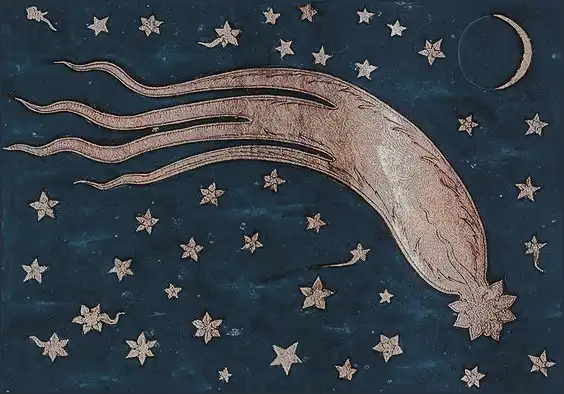
 he recent interest in comet Hale Bopp brings a reminder of how little is understood about the use of ‘celestial omens’ in astrology. With media interest at a peak, sunsign columnists babble about the marvellous opportunities trailing in its wake, but one wonders where they get their information from? Certainly not from observations of the past, for comets have a dreadful reputation as portents for social unrest, collapse of government, outbreaks of violence and ‘the death of princes’.
In a tradition that extends to the ancient Babylonians, comets have been viewed as the cause of just about every calamity that could afflict mankind. The Greeks and Romans noted them as a sure sign of bloody warfare and disaster, with Cicero, writing of the civil war between Augustus and Antony, that “blazing stars, by the Greeks called cometae ... were foreboders of great calamities” (Nat. D., I.2.5). The Roman historian Pliny shared his view, observing that a comet in the western sky is:
– Pliny H. N. , 2.23 (tr. Rackham, 1952)
The word comet comes from the Greek term Kometes meaning ‘long haired’ – a reference to the characteristic tail, and at least one Roman Emperor took some comfort from this. When a ‘hairy star’ appeared over Rome in 79 AD, Emperor Vespasian bravely remarked, “This is an omen, not for me, but for the Parthian king; for he has long hair, whereas I am bald”; misplaced bravado from a ruler who was to die the same year (Cass Dio R. H. , LXVI.17).
Comets were thought to accompany the birth and death of kings, and also to carry their souls to and from the Earth. Seven days after the death of Julius Caesar, a comet appeared in the northern sky that was so bright it could be seen in daylight – named Caesaris astrum (‘Star of Caesar’), this was taken to mean that Caesar had become immortal and received into the realm of heaven. Fifty years later, of course, the birth of Christ would be proclaimed in a similar manner by a magnificent star appearing in the East. Perhaps sheer arrogance has fostered this belief as a soother to the ruler’s ego; after all, as Shakespeare wrote: “When beggars die, there are no comets seen; the Heavens themselves blaze forth the death of princes” (Julius Caesar, II.2).
Possibly in recognition of his own importance the writer Mark Twain was able to be flippant about his celestial connections, telling his readers in 1909: “I came in with Halley’s Comet in 1835. It is coming again next year, and I expect to go out with it”. He did. He breathed his last at 6:22pm, 21 April 1910, within 24 hours of the comet’s perihelion.
Despite one man’s demise being the cause of another’s rise, comets are usually seen as bringing an end to rule, whereas a more positive perspective is to see them introducing a new one. Almost 1000 years after Halley’s comet was taken as the portent of doom that ushered in the Norman Conquest, we no longer see that as a tragedy, but whether the Conservatives can take such an enlightened view to this ‘omen in the sky’ displayed on the verge of their general election is another matter. Let’s also remember that Britain is currently wrapped up in a heated debate over the European Union, which could lead to radical changes in the way our country is governed in the not-too-distant future.
Interestingly, most comets appear in the northern hemisphere, and history records that they are usually succeeded by an unseasonable warmth in the atmosphere, as witnessed by the remarkably pleasant spring that Britain has enjoyed this year. This is probably derived from their ‘fiery’ reputation and association with drought, besides a widespread belief that the luminous gas and dust particles spread new diseases and infections to mankind. In latter days, they were the heralds of plague, whilst modern scientists now theorise about modern ailments such as the aids virus originating from their visitation.
Even in our less God-Fearing age, predictions of doom and gloom make natural bedfellows with comets, and those who dismiss their ominous symbolic significance still seem to dwell on thoughts of catastrophic possibilities. What about collision? Not a concern with Hale Bopp, but in 1994 the collisions on Jupiter with the fragments of comet Shoemaker-Levy witnessed impacts that were equivalent to detonating millions of nuclear warheads simultaneously, stirring us all up into thoughts of what could be, and what may have been, with suggestions that collisions in the astronomical past had played a climatic role in the extinction of dinosaurs. Yet if comet collisions do pose any threat to earth, it could be the biggest cosmic irony of all –astronomers studying the origins of the solar system believe that, millions of years ago, it was cometary impacts with ‘proto-earth’ that supplied our planet with the chemical ingredients necessary for life to develop in the first place!



Deborah Houlding, based in the UK, is the creator of this website (Skyscript) and has worked as an astrological consultant / researcher / lecturer / author since the late 1980s. Past editor of The Traditional Astrologer (1993 to 2000) and founder of the STA School of Traditional Astrology, she is best known as author of the STA Practitioners-Level Horary Course and the Wessex Astrologer book The Houses: Temples of the Sky. Besides numerous articles published in international journals, she is also the editor of a modern type, annotated edition of William Lilly's Christian Astrology, Anthony Griffin's Astrological Judgement Touching Theft, various other annotated historical works, and the co-author (with Oner Doser) of the Turkish language horary textbook Soru Astrolojisi: Horary Astrology (2015). Deborah's astrological work has been noted for outstanding achievement and excellence amongst her peers. In 2010 she was awarded the Charles Harvey Award by the Astrological Association of Great Britain "in recognition of exceptional service to astrology"; in 2011 she was made an Honorary Member of the Astrological Association of Romania for "acknowledged sustained contributions to the promotion of astrology". In 2012 she was honoured as the first recipient of the Jayavidya International Astrology Award instituted by the Cultural Association Jayavidya for "cultural contributions to the field of astrology", and in 2018 Deborah received the UAC Marion March Regulus Award for "advancing the theory and understanding of astrology".