Dicey Claims

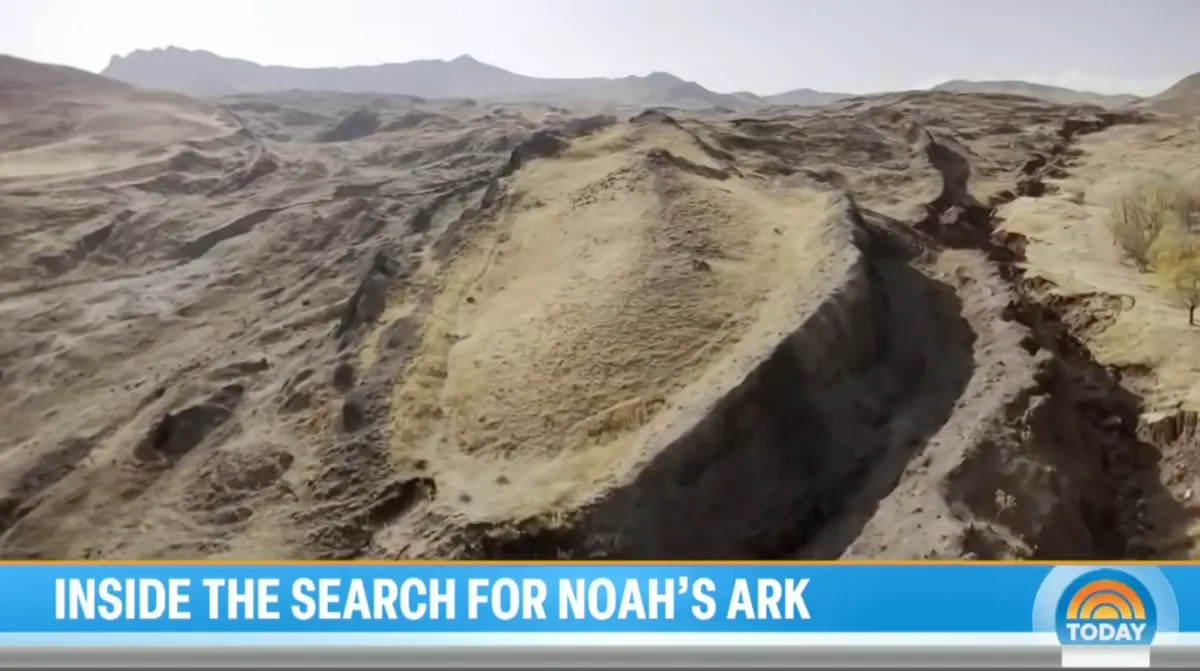
  • No, Noah’s Ark has not been found, again;
  • Evidence suggests Trump wanted the Kennedy Center to fall into ruin;
  • Lenders around the world don’t trust the US;
  • An example of how AI is making things worse, by claiming credit for mathematical results that cannot be easily confirmed;
  • Thoughts about mathematics, AI, and the limits of human cognition.
– – –

This kind of story pops up every few years, and it’s no truer now than it has ever been. The searchers have had 2000 years. But gullible people feel confirmed by it every time.
Friendly Atheist, Hemant Mehta, today: Scientists have not “100% confirmed” the resting place of Noah’s Ark, subtitled “The Daily Mail turned a Christian company’s dubious claims about Turkey’s Durupınar Formation into a wildly misleading story”

(The Daily Mail, says Google, is “a middle-market tabloid-size conservative newspaper.”)

Did you know Noah’s Ark was real and scientists just confirmed it?

That’s what you might think if you just read the headline from a Daily Mail article which says Noah’s Ark’s resting place has been “100% confirmed” after 4,300 years.

And

You’ll be shocked to learn the actual story doesn’t back any of that up. But will anyone read the story? Probably not. It doesn’t help that the article is behind a paywall, so most people will only ever be able to see the headline.

They also won’t learn that the group behind this story got NBC’s Today to cover the exact same story last year.

Needless to say, the only thing that has been confirmed is how easily Christian propaganda can spread.

Mehta goes on to describe how stories like this get promoted.

This isn’t about faith, or the gullibility of Christians. It’s about basic literacy about how the world works, and how therefore the whole Noah’s Ark story is absurd on its foundations. It’s completely implausible. That all the animals in the world were saved on the Ark and then propagated to their current positions? People searching for the remains of Noah’s Ark are wasting their time.

Mehta concludes,

So who the hell said this was Noah’s Ark and that’s “100 percent confirmed”? The Daily Mail. Which was spurred to do so by a Christian group with a vested interest in proving Noah’s Ark was real—or at least making people think it’s a possibility.

Not scientists.

The Christians here wanted headlines so they could raise money, and they knew exactly which tabloid would run with it.

Noah’s Ark isn’t real. But Christian grifting is still alive and well.

Are they that cynical to be merely trying to make money? Perhaps. I think they’re just grasping at straws, anything to confirm their faith.

\\\

Today’s paper.

NY Times, today, posted yesterday: Kennedy Center Shelved Repairs Now Cited for Closure, Whistle-Blowers Say, subtitled “In a letter to Congress, former employees say the center delayed a plan to address the leaks that its officials now cite as a serious safety risk.”

It’s almost as if they wanted a reason to demolish it.

\\\

Continuing a theme.

The Atlantic, David Frum, today: Lenders Don’t Trust the United States Anymore, subtitled “Blame Trump for rising borrowing costs.”

All over the world, lenders are demanding higher interest rates. The global bond market is extracting higher yields from every borrower, starting with the biggest borrowers of all: national governments. But not every government is paying equally.

Trustworthy borrowers with solid finances and honest leadership pay less. Distrusted borrowers with disordered finances and corrupt leaders pay more. In times past, the United States would have headed that first list. Under President Trump, the United States has tumbled onto the second one.

\\\

Here’s a rebuke to optimistic thinking about AI.

NY Times, guest essay by Zeynep Tufekci, yesterday in print, posted 22 Sep 26: This Is a Rare Arena in Which People Think A.I. Is Helping. It’s Making Things Worse.

This is about the AI proof of a certain mathematical conjecture.

It was one of the most famous challenges in the history of mathematics: the fluid dynamics problem known as Navier-Stokes, whose solution had proved so elusive that a million-dollar prize had been posted for the genius or geniuses who could finally crack it. Until the other day, that is, when OpenAI announced that one of its advanced models had found an answer at last. And it had taken only half a week.

The problems are, in a nutshell, is that OpenAI may have stolen the work of two human mathematicians working on the problem, and, that the claim of a solution is extremely difficult to verify.

\

So beware claims like this.

Scientific American, 24 Sep 26: AI solves 79-year-old mathematical mystery, subtitled “Can a six-dimensional sphere be described using imaginary numbers? For decades, experts puzzled over this question. Now an AI has apparently answered it”

He’s done it again: mathematician Levent Alpöge, at Anthropic, has solved yet another open math problem using artificial intelligence. He had already tackled the Jacobian conjecture and found two new elliptic curves. Now add to these the 1947 Hopf problem. It asks whether a six-dimensional sphere can be completely described using complex numbers, which include the (seemingly impossible) square root of –1. According to Alpöge, the answer is yes, though the result remains unverified.

OK, maybe. We need to temper our enthusiasm. I suggested here just recently that these AI results illustrate the limitations of human cognition. Perhaps they do. The difficulty we have verifying AI results may just be another illustration. Or perhaps we’re being fooled, fooling ourselves. AI only knows what we know, in a sense.

\

So maybe mathematics is the case study about the range of human cognition. At one extreme are those savants I’ve discussed. At the other are most folks who admit they’re “bad at math” or simply don’t like it, and have no intuitive understanding about sizes or ranges. But at the higher extreme are those problem humans can’t seem to figure out, but which may or may not are being solved by AI. Can AI reveal to humans a realm we cannot intuitively understand? That would be the optimistic possibility.

Posted in conservatives, Lunacy, Mathematics, Religion | Leave a comment

There Is Only So Much Land

A similar broad theme today. This goes along with the item two days ago about J.D. Vance’s notion of “Heritage Americans” who, in his fascist, hierarchical mindset, are more deserving to run America than others.

Jerry Coyne, yesterday: The two-state delusion

Coyne, the author of Why Evolution Is True and Faith vs. Fact, both of which I’ve reviewed here, is Jewish and occasionally addresses this topic. I studiously ignore it, most of the time; I can’t admire either side. I do understand why Christians support Israel, but their reasons, based on religion, are part of the problem. This kind of thing can’t go on. The world is filling up, with more and more people who seem unable to get along with each other, i.e. live in a non-tribal manner.

Coyne points out that neither Israel nor Palestine wants a two-state solution. For similar reasons. I’m quoting someone he quotes.

One of the top reasons that Israelis and Palestinians alike say peaceful coexistence is not possible is disagreement over the land.

Some think there is not enough land to split. For example, one Palestinian woman said that “Palestine cannot be divided into two states.” Another said that “there cannot be two peoples when there is no room for two peoples.” Israelis express similar sentiments – saying, for example, that “Israel does not have enough territory to divide into two states” or that “there is no land to establish a Palestinian state.”

In both places, there are people who believe they are the only rightful owners of the land. One Jewish Israeli woman said, “This is our land alone,” and another stated that “the Holy Land belongs only to the Jewish people and was given to them by God.” Similarly, some Palestinians say Israel “stole our land” and that “the homeland belongs to the Palestinians.”

Look people. The world is filling up with humanity. There is only so much land. If rival tribes can’t figure out how to live in peace, then conflict and killings will continue, reducing the size of each tribe. Whereas tribes who learn to get along and cooperate — much of the rest of the world — will survive preferentially. That’s how it works.

The same principle applies to the “Heritage Americans” who try not to be offended by immigrants who aren’t white but in their hearts think they are the ones who should rule.

\\\

Similarly.

Washington Post, opinion by Fareed Zakaria, today: Trump and Xi wrestle with the laws of nature

Note the subtitle: “Survival depends on adaptation. For the U.S. and China, that may include cooperation.”

As the summit this week demonstrated, Presidents Donald Trump and Xi Jinping are searching for ways to work together despite the growing rivalry between the two countries. They might take a look at a striking, somewhat unnoticed case of quiet cooperation involving American and Chinese technologies.

Recalling the Hugging Face AI attack.

To summarize: An American AI broke into an American technology company. To figure out what happened, the company ended up using a Chinese AI.

Many examples. Discussion of a book called Darwin’s Lock by Joshua Cooper Ramo. And acknowledgement of the common simplistic take about Darwinian evolution.

We tend to hear “survival of the fittest” and imagine nature as an endless struggle in which one creature devours another. But evolutionary fitness actually means the ability to adapt successfully to changing conditions. Nature is full not just of competition but of specialization, symbiosis and cooperation.

Adaptation. Not competition, but cooperation.

Zakaria concludes:

For 30 years, we made one mistake about globalization: We assumed trade would eradicate geopolitics. Now we risk making the opposite mistake — assuming geopolitics can simply erase the realities of a global, deeply interconnected economy.

Personal aside: yes, there was a time when many of us thought that trade among nations, even those who had once been at war, would overcome the tribal urge for dominance. For example, I bought a Japanese car in 1982, my first car, on the basis of car magazine reviews, and my thoughts that trade with Japan was a positive thing, a way to advance international cooperation. My father thought it was a bad idea, only for geopolitical reasons. As with much else in life, international trade has worked fine (no one squints disapprovingly at anyone owning a Japanese or German car), but it’s more complicated than that. Now I own a German car. The international economy remains. The geopolitics hasn’t gone away.

\\\

Back to the theme about America’s abdication of its leadership in the world, as in yesterday’s post.

Robert Reich, today: What to plan for in the U.S. if you’re a foreign leader?, subtitled “Here’s what I’m hearing”

It’s long been thought, by many Americans and many other nations, that Trump and his administration is a passing fad, a temporary lapse of American sanity, and once he goes away all his damage could be reversed. But the longer he goes on, the more he destroys, physically and intellectually, the harder it will be to recover. We’ve already seen signs that America’s reputation in the world is damaged, for the long term. (MAGA doesn’t care about the world.)

Reich:

I spent much of this week talking with foreign officials who are in the U.S. for United Nations meetings. I was curious to know how they’re strategizing about the United States in the future — assuming Democrats do well in the midterm elections and Trump becomes a lame-duck president. (None of my nine sources were heads of state; my stature doesn’t reach that high. But they were high enough to give me some useful insights.)

Then what he’s learned. I’ll condense. Well, no I won’t.

1. Most are thinking past Trump. They believe his influence is already waning, and his bellicose rantings show that he knows it. He’s still dangerous, they say, but not nearly as dangerous as he was, and he’s no longer capable of plunging the world into war. Every one of them told me he’s deeply unpopular in their countries.

2. They’re thinking in a timeframe of five to 10 years. They see Trump as a temporary phenomenon and assume the United States will “return to its senses.”

3. But — and here’s the part that concerned me — they’re unsure they can ever again rely on the United States for world leadership. Several pointed out that the fact Americans elected Trump for a second time reveals, in the words of one of them, “there’s something troublesome about your nation that transcends Trump.”

4. Even post-Trump, they see the United States as unstable and unpredictable. They don’t believe the country will fall into civil war, but they worry that policymaking will cycle between extremes because, in the words of another, “your extreme inequality will make it difficult to achieve any longer-term consensus.”

5. As a result, they’re looking ahead to a world where another nation, or group of nations, will take leadership on global issues that need to be addressed, such as climate change, AI, migration, widening inequalities, Putin’s aggression, and disease prevention.

6. Which nation or group? Another official put it to me this way: “We don’t trust China, the U.N. doesn’t work because of its security council, but the EU isn’t strong enough yet. Several of us are hoping that over the next decade the EU will be joined by Canada, Japan, South Korea, Australia, and New Zealand, and that this new EU — really, a World Union — will devise a structure that enables it to work collaboratively and forcefully for the good of the world.”

EU becomes a World Union? Cool!

Frankly, I don’t care if the US leads the world, or if some other nations or group of nations does, as long as they can address big picture problems, and advance human well-being. (I am not a ‘patriot’ in the sense that I believe my country is better than all the others just because I… live here. I wasn’t born here.) The existential problems require a cooperative, worldwide response. And America has given up.

Posted in Conservative Resistance, conservatives, Politics, Tribalism | Leave a comment

Abdication

History runs in cycles, sorta. The US has gone through isolationist periods before. Though this time it may be part of general reaction against modernity and complexity.

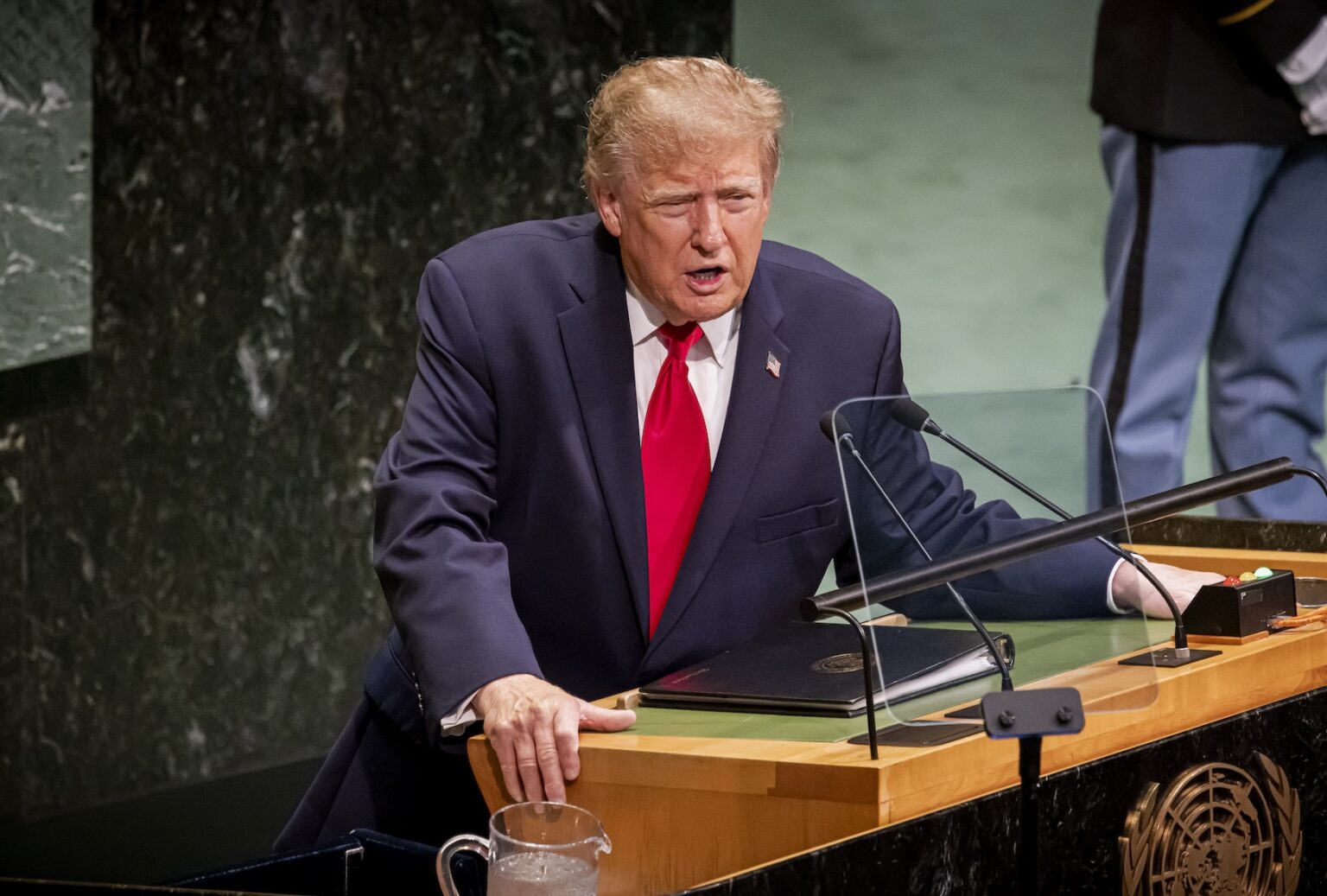
Salon, Heather Digby Parton, today: Donald Trump abdicates as leader of the free world, subtitled “The president’s UN address showed he has ceded that position to Canada’s Mark Carney”

On Tuesday, Donald Trump stood before the United Nations General Assembly to give a speech in which he made it clear that the United States has now fully abandoned its last remaining fig leaf of decency and morality on the world stage, and has embarked on an imperialist model not seen since the 19th century. Since this was a Trump speech, filled with his usual bombast and braggadocio, it didn’t have quite the shock value it might have carried in the past. But there was a new atmosphere in the room. The world sees America as a threat now, and countries are making new arrangements.

The speech was the worst he’s given, and that’s saying something. Delivered with a bored, desultory tone, the obviously tired president spent 40 minutes rambling on and on with his usual litany of grievances and lies. He made it clear that he sees no limits on his power. Looking directly at the Iranian president, he mused aloud, “I have a big decision to make. Will a deal be made with Iran that lets them rebuild? Or do I annihilate the Islamic Republic? Do I drive them into hell with no chance of survival, and no hope of future greatness for generations?” It was outrageously provocative and insulting…

\

Or is he abdicating to China? (Not just the free world, but the whole world.)

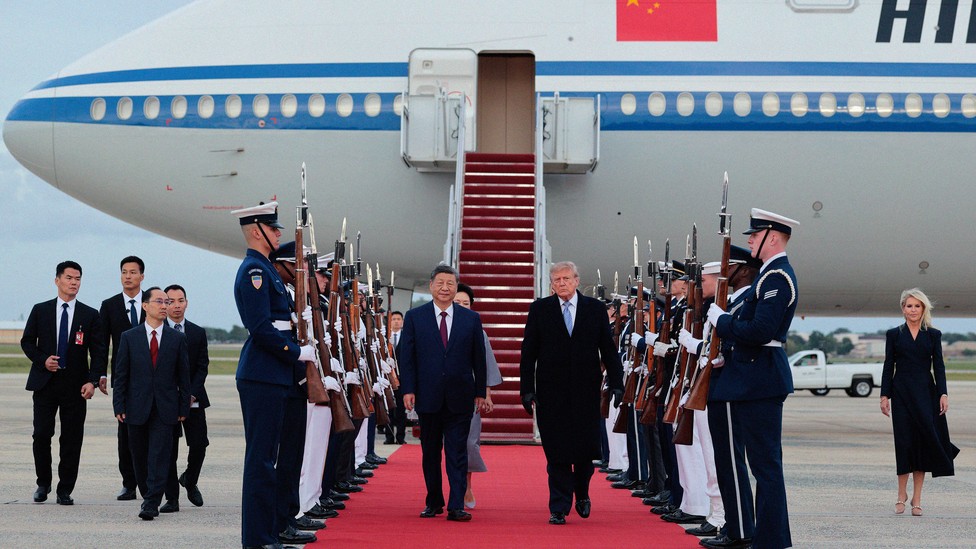
The Atlantic, Jonathan Lemire, today: The Deferential President, subtitled “Not long ago, President Trump could claim that he ran the world. Now he’s waiting at the bottom of a set of airline steps for the Chinese president.’ [gift link]

The 747 slowly wheeled to a stop last night on the tarmac of Joint Base Andrews, just outside Washington. Portable stairs were put in position, while a red carpet was unfurled and lined by both American and Chinese soldiers in dress uniforms. After a few minutes, Chinese President Xi Jinping appeared at the aircraft door. He paused and waved. Waiting below, staring up expectantly, was President Trump.

It was a remarkable act of deference. By tradition, American presidents don’t make the 12-mile trip to the base to greet a foreign leader. They instead wait at the White House, backed by the grandeur and power of the executive mansion. But not this time.

…

It was not that long ago when Trump, a self-styled international bully, could credibly claim to “run the country and the world.” But he seems far smaller on the global stage now. His speech this week to the United Nations General Assembly, usually a signature moment on any president’s foreign-policy calendar, generated few headlines other than those about his threat to “annihilate” Iran. But even that bluster felt familiar and tired; Trump is stuck in a war he is desperate to leave, and leaders in Tehran seem to believe that he doesn’t have the political will—or the defensive munitions—to authorize a full-fledged return to the conflict.

\

And more. As I keep saying, the world is facing existential threats that can only be solved through international cooperation by the entire human race.

NY Times, Editorial Board, today: Trump’s Failure to Lead Is Costing America and the World [gift link]

The world is facing at least three crises today that cannot be resolved by any one country. Two are longer-term and arguably existential: the threat of uncontrolled artificial intelligence and the growing impact of climate change. One is shorter-term and damaging the global economy: the disruption of shipping lanes in the Middle East. All three require the kind of high-level international cooperation that helped manage other challenges, like the threat of nuclear warfare during the Cold War and the damage to the ozone layer.

Yet almost nobody expects meaningful progress during this week’s meetings in Washington between the leaders of the two most powerful countries, President Xi Jinping of China and President Donald Trump. …

The low expectations for the visit underline the damage that Mr. Trump is doing to American influence and global well-being. He is an undisciplined politician who puts his personal interests above the nation’s, running an administration that has no coherent strategy for solving major problems. He is instead often exacerbating the world’s biggest problems.

As I’ve said before, what continues to boggle my mind is how many people still support Trump, and say he is the best president ever. This is a factor in my conclusions about cognitive limitations of the human race, which cannot seem to escape its tribalist nature. So much for interstellar federations.

\\\

Brief items.

I wish I could see this sentiment elsewhere. It’s a response to the notion, by conservatives, that the government should be run like a business. Do they understand what that means? Not to mention that Trump drove several businesses into bankruptcy.

Seen several times now on Facebook:

I think the argument about business is an expression of American ambition, at the expense of others.

\

\

  • The Atlantic, Yvonne Wingett Sanchez and Michael Scherer, yesterday: The Supporters Urging Trump to Declare Martial Law for the Midterms
  • Subtitled: “Trump’s advisers have been working for months to move his focus away from baseless theories of election fraud. A group of outsiders is making that difficult.”
  • I take this as: they know they cannot win on their merits.

\\

This is sorta like, not all Republicans are racists, but most racists are Republicans.

\\\

I continue to check in on Jim Palmer who writes lengthy posts every day about… well I’ll quote his opening page: “existential health, meaning, and self-trust in a post-religious world”

Here’s an item I’ll get back to, and will only note today.

Jim Palmer, yesterday: There Is No Cure for Being Human, subtitled “The Six Existential Realities We Spend Our Lives Trying to Escape”

At a glance, this seems to me about the human condition that we *can’t* escape. The question is how we deal with these realities. The fact that we *can* think about these realities outside our daily perceptions is progress, perhaps. Though the human race will never escape its tribalistic past.

Posted in Human Nature, Politics | Leave a comment

Ian Stewart: NATURE’S NUMBERS

Subtitled: The Unreal Reality of Mathematics
(Basic Books, 1995, x + 164pp, including 14pp of further reading and index)

One more in this series for now. Despite the title, this books’ topic is not that that of Martin Rees in JUST SIX NUMBERS. This is rather an introduction to various basic ideas of mathematics, and how math is about more than numbers.

Moreover, it builds to an introduction of the new concepts of math and physics that began to emerge in the 1980s and continued for a couple decades. Chaos, fractals, Fibonacci numbers, complexity, emergence, and so on. Stewart also co-wrote two larger books with Jack Cohen exploring these concepts in greater detail: THE COLLAPSE OF CHAOS in 1994, and FIGMENTS OF REALITY in 1997. Stewart and Cohen later teamed up with fantasy writer Terry Pratchett to write a series of four books called THE MAGIC OF DISCWORLD, contrasting how physics supposedly works in that universe with the new ideas about our own universe. I reviewed the first of them way back in 2015, here.

I have a bookshelf of a couple dozen titles on these various concepts, including James Gleick’s relatively well-known CHAOS (1987) and others by John L. Casti, Stuart A. Kauffman, Murray Gell-Mann, et al.

Key Ideas

Continue reading →

Posted in Book Notes, Mathematics | Leave a comment

What Is It Conservatives Want to Conserve?

  • The worst of the past? The protocols of primitive human nature? That’s what it seems like. Are they aware of this?
  • Trump wants to make America 1988 again;
  • Trump got played on the Greenland deal;
  • The superficiality of Fox news hosts;
  • A Republican who supports science and medical research (!);
  • David French on Vance’s ideas about Heritage Americans;
  • Links about Trump’s claimed victories for people of faith; Russian election interference; how conservatives argue for yes/no answers; how right-wing media promised gas and diesel prices wouldn’t soar.
– – –

Washington Post, opinion by Theodore R. Johnson, today: Trump wants to make America 1988 again, subtitled “Four decades after Willie Horton, the president still invokes the politics of the past.”

On a North Carolina tarmac last week, President Donald Trump reminded the country that MAGA’s preferred version of America is one from a bygone era.

… Rather than outline a vision for tomorrow, Trump’s pitch leaned on the party’s most shopworn frameworks: law and order’s tough-on-crime posturing, the Southern strategy’s exploitation of racial division, and the infamous intersection of the two — the Willie Horton ad, which first aired 38 years ago this week.

Continue reading →

Posted in Conservative Resistance, conservatives, Politics | Leave a comment

Richard Dawkins: RIVER OUT OF EDEN

Subtitled: A Darwinian View of Life
(Basic Books, March 1995, xiii + 172pp, including 11pp Bibliography and further reading, and index.)

By the time Dawkins wrote this short book for the publisher’s Science Masters series, he had already published three foundational books: THE SELFISH GENE, THE EXTENDED PHENOTYPE, and THE BLIND WATCHMAKER. (The first one I reviewed here; the second I haven’t yet read; the third I reviewed here.) This book doesn’t try to replicate the breadth or depth of those books. Rather, it could be described as ‘topics in evolution,’ especially topics of interest to general readers, including how science is not faith, creationism, and purpose.

Key Themes

Continue reading →

Posted in Book Notes, Evolution | Leave a comment

Cognitive Abilities and Limitations

  • How AI is being used to solve math problems that humans have been unable to;
  • How anti-vaxxers are at core angry, fearful, and despairing;
  • NYT’s Brett Stephens complains that none of the National Book Award finalists are by or about people like him.
  • Beck’s new album Ride Lonesome.
– – –

On the general theme of humanity’s cognitive ability. I’ve mentioned before that, as with morality, there’s a wide range of positions. At the high end, we know of prodigies like Srinivasa Ramanujan, who had preternatural mathematical skills; we know of Savants who can tell you what day of the week a particular date falls (and oddly these are associated with autistic people); and so on.

The AI revolution is revealing that there are things that can be known that even smart humans figure can’t out.

Scientific American, Lyndie Chiou, today: Mathematicians use AI to find mysterious symmetries, solving decades-old problem

Subtitled: In parallel, a race by amateurs and mathematicians has found all 25,000 cases of one “inverse Galois problem”

Continue reading →

Posted in Mathematics, Music, Technology | Leave a comment

Martin Rees: JUST SIX NUMBERS

Subtitle: The Deep Forces That Shape the Universe
(UK 1999; this US edition: Basic Books, 2000, x + 173pp, including 12pp notes and index)

This is a book from a series of short science books (~200p each) published in the 1990s and 2000s by Basic Books. Rees is an astrophysicist whose early books were in his field, and whose later books (beginning after this one, and including ON THE FUTURE, 2018, reviewed here) became big picture in a different way, with musings on humanity’s future and the future of science.

This book is ostensibly focused on six key physical constants (actually ratios) and how they determine that the cosmos we exist in is possible. If they were a bit different, we wouldn’t be here. This is a topic familiar to creationists who thus argue for a creator who set those ratios, though of course that doesn’t follow at all, as Rees explains. In fact, the book is also a clear, efficient overview of all the basic topics of cosmology. Black holes, gravity, the creation of heavier elements in supernova, the idea of a multiverse, etc.
Continue reading →

Posted in Book Notes, Cosmology, Meaning, Physics | Leave a comment

It’s Not Just MAGA

  • There’s right-wing rejection of modern values in Europe, too;
  • The end of American exceptionalism, which has been going on for some time;
  • Who does Trump want to shoot with snipers on his Triumphal Arch?
  • A study about children exposed to religion.
– – –

NY Times, news analysis by Steve Erlanger, today: The Fuel That Feeds Europe’s Far Right: Nostalgia and Lost Pride, subtitled “The populist emphasis on national identity and threats to it, real and imagined, finds a deep response in voters adrift in a world they no longer understand.”

The rise of a far-right party in Germany, the Alternative for Germany, represents a skewing of history, fueled by its own, sometimes imaginary vision of the past. It feeds, analysts say, on widespread alienation from a liberal, multicultural, united Germany committed to the memory of the Holocaust and Nazi crimes.

Continue reading →

Posted in Epistemology, Human Nature, Religion | Leave a comment

Science, Ultimate Questions, and Belief

  • Scientific American on whether some questions may never be answered, with my thoughts on humanity’s cognitive limitations;
  • David Brooks interviews astrophysicist Priyamvada Natarajan about humanity’s place in the cosmos: we’re significant because we can shape our realm, even though we may not.
– – –

Science is asymptotic.

Scientific American, Sarah Scholes: 15 Sep 2026: The questions science may never answer, subtitled “Will some of the biggest mysteries in science remain forever unsolved?”

Science, at its best, is a striving toward truth. It is not, although we often think of it as such, the search for absolute truth. It’s more a process of systematically gathering and interpreting data about the universe to understand its past and present and predict its future. What results is the best approximation we can access at any given time with the information, methods and instruments we have.

Continue reading →

Posted in Cosmology, Human Nature, Meaning, Science | Leave a comment