
Gray Heron Ardea cinerea Scientific name definitions
- LC Least Concern
- Names (76)
- Subspecies (4)
Revision Notes
Sign in to see your badges
Species names in eBird-supported languages
| Language | Common name |
|---|---|
| Afrikaans | Bloureier |
| Albanian | Ҫafka e përhime |
| Arabic | بَلَشُونٌ أَرْمَدُ |
| Armenian | Մոխրագույն տառեղ |
| Asturian | Garcia real |
| Azerbaijani | Boz vağ |
| Bangla | ধুপনী বক |
| Bangla (Bangladesh) | ধুপনী বক |
| Bangla (India) | সাদাকাঁক |
| Basque | Koartza hauskara |
| Bulgarian | Сива чапла |
| Catalan | bernat pescaire |
| Chinese | 蒼鷺 |
| Chinese (Hong Kong SAR China) | 蒼鷺 |
| Chinese (SIM) | 苍鹭 |
| Croatian | siva čaplja |
| Czech | volavka popelavá |
| Danish | Fiskehejre |
| Dutch | Blauwe reiger |
| English | Gray Heron |
| English (AVI) | Grey Heron |
| English (United States) | Gray Heron |
| Estonian | hallhaigur |
| Faroese | Gráhegri |
| Finnish | harmaahaikara |
| French | Héron cendré |
| Galician | Garza real |
| Georgian | რუხი ყანჩა |
| German | Graureiher |
| Greek | Σταχτοτσικνιάς |
| Gujarati | કબૂત બગલો |
| Hebrew | אנפה אפורה |
| Hindi | अंजन |
| Hungarian | Szürke gém |
| Icelandic | Gráhegri |
| Indonesian | Cangak abu |
| Italian | Airone cenerino |
| Japanese | アオサギ |
| Kannada | ಬೂದು ಬಕ |
| Kazakh | Көкқұтан |
| Konkani | बगळें |
| Korean | 왜가리 |
| Kyrgyz | Боз көк кытан |
| Ladakhi | བིའང་ལོང་། |
| Latvian | Zivju gārnis |
| Lithuanian | Pilkasis garnys |
| Malayalam | ചാരമുണ്ടി |
| Manipuri | Usai-ngou |
| Marathi | राखी बगळा |
| Mongolian | Хөх дэглий |
| Nepali (India) | फुस्रो बकुल्ला |
| Nepali (Nepal) | फुस्रो बकुल्ला |
| Norwegian | gråhegre |
| Odia | ଅଞ୍ଜନା |
| Persian | حواصیل خاکستری |
| Polish | czapla siwa |
| Portuguese (Angola) | Garça-real |
| Portuguese (Brazil) | garça-moura-europeia |
| Portuguese (Portugal) | Garça-real |
| Punjabi (India) | ਨੜੀ ਅੰਞਨ |
| Romanian | Stârc cenușiu |
| Russian | Серая цапля |
| Serbian | Siva čaplja |
| Slovak | volavka popolavá |
| Slovenian | Siva čaplja |
| Spanish | Garza Real |
| Spanish (Spain) | Garza real |
| Swedish | gråhäger |
| Tajik | Қуланги хокистаранг |
| Tamil (India) | சாம்பல் நாரை (சாம்பல் கொக்கு) |
| Telugu | నారాయణ పక్షి |
| Thai | นกกระสานวล |
| Turkish | Gri Balıkçıl |
| Ukrainian | Чапля сіра |
| Welsh | crëyr glas |
| Zulu | unokilonkojwayelekile |
Revision Notes
Glen Hancocks wrote the Introduction and revised the Systematics sections. Maria G. Smith wrote the Distribution section and made minor updates to the Conservation Status section.
Ardea cinerea Linnaeus, 1758
Definitions
- ARDEA
- cinerea
The Key to Scientific Names
Legend Overview
Full content is available exclusively to Birds of the World subscribers. Sign in Learn more
Introduction
The Gray Heron is an unmistakable bird, recognized by its iconic, statuesque profile. Its elongated neck, angular posture, and deliberate movements evoke a striking resemblance to its theropod ancestors—particularly in its chicks, which appear notably primitive and were described by Hartert (1: 1230) as “one of the strangest creatures in the bird world.” This resemblance offers a living glimpse into the evolutionary lineage from which modern birds emerged. The morphology and behavior of the Gray Heron are reminiscent of early avian forms, which are still present in this modern species—effectively bridging the evolutionary gap between ancient dinosaurs and contemporary birds.
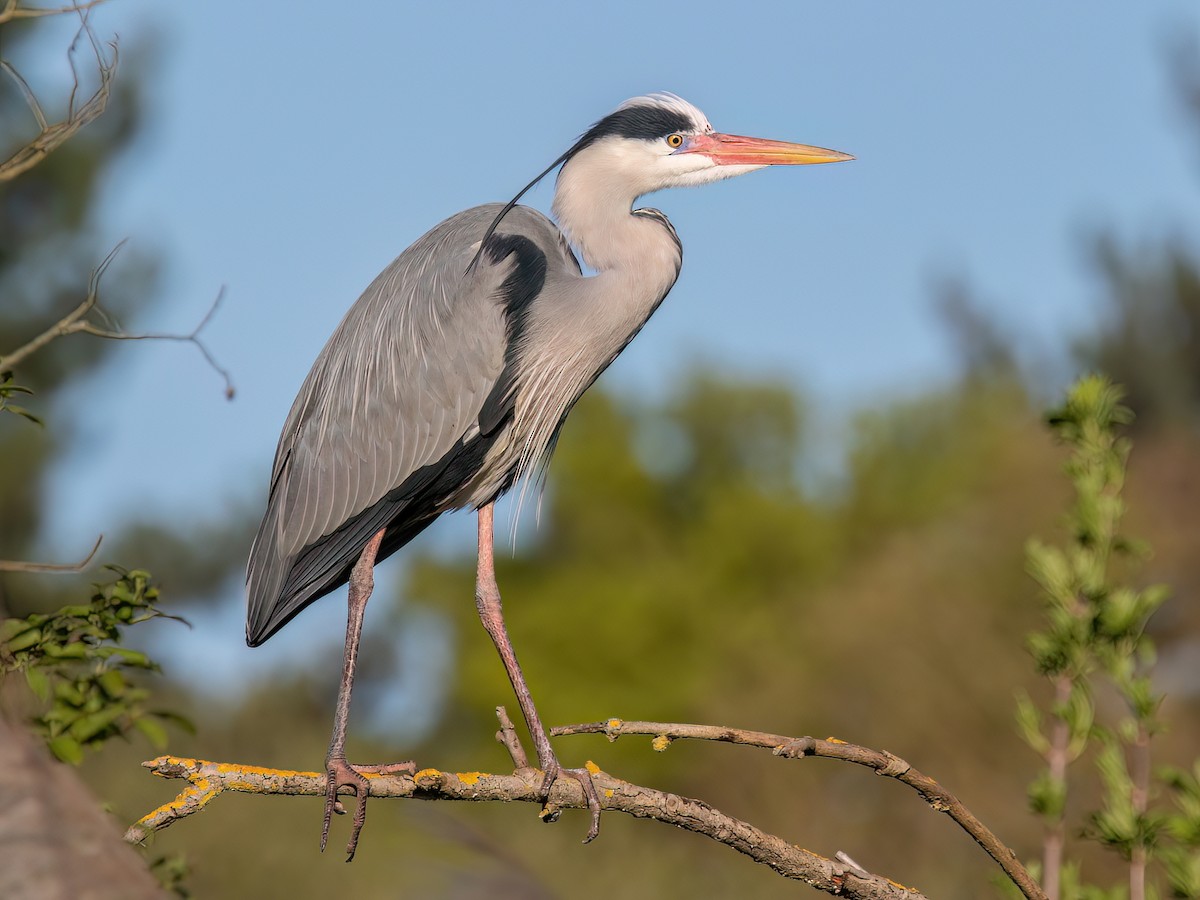
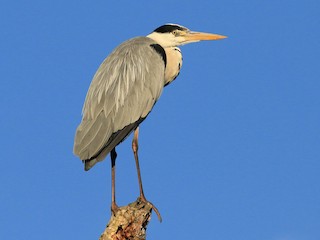
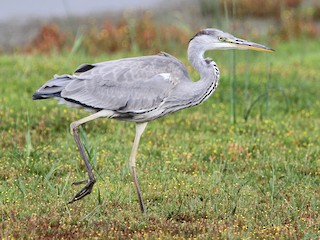
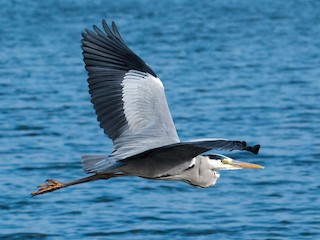
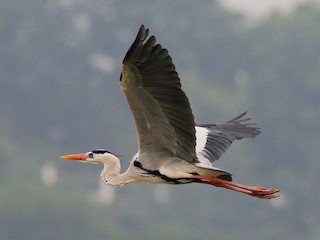
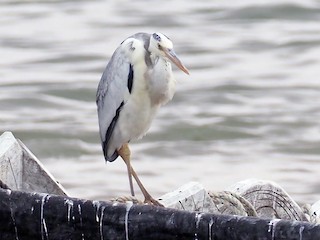
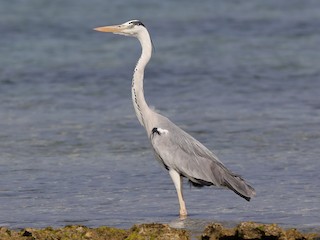
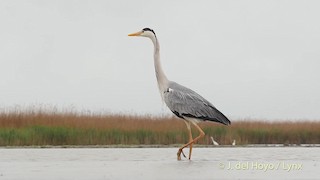
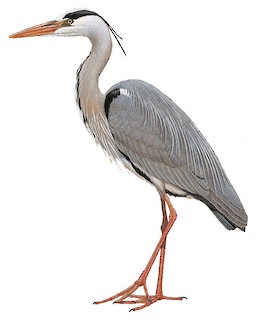
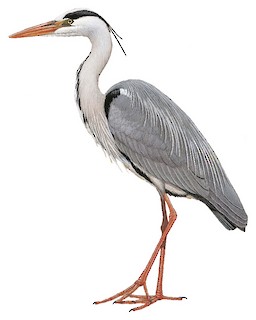
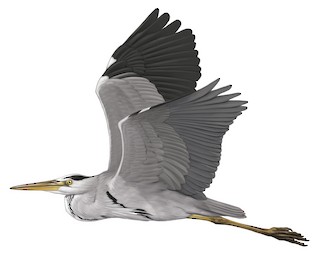
Appearance in both sexes is very similar; sexual dimorphism is minimal and limited to slightly larger body size in males and more pronounced plumes during the breeding season. Its plumage exhibits countershading, appearing slate gray to blue dorsally and light gray to white ventrally, likely facilitating prey capture through enhanced camouflage. The head and neck are white, with a broad black stripe (supercilium) that extends from above the eye down the back of the crown, where it forms elegant plumes—fully developed only during the breeding season. The eye and the deep, dagger-like bill are yellow. The upperwing and underwing coverts are consistent with the overall countershaded appearance, contrasting with the dark gray to black flight feathers. Legs and feet vary in color, ranging from yellow to brownish pink (see Identification for further details). Its expansive wingspan and slow, powerful wingbeats give it a commanding presence in flight. Possible misidentifications may include the Great Blue Heron (Ardea herodias), Cocoi Heron (Ardea cocoi), Purple Heron (Ardea purpurea), Great Egret (Ardea alba), and Western Reef-Heron (Egretta gularis). The latter three species are sympatric with the Gray Heron in at least part of its range, and the occurrence of hybrid forms (see Hybridization) may further complicate identification.
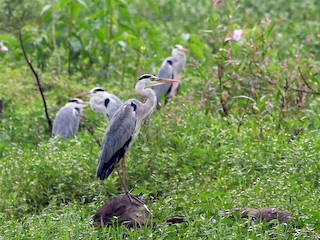
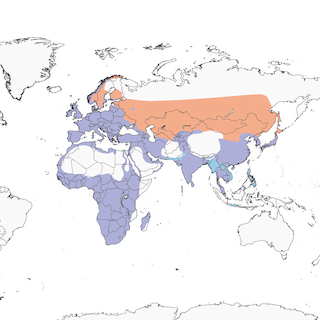
A widespread Old World species, the Gray Heron has an Afro-Palearctic distribution, breeding across Europe, Asia, and North Africa. Many individuals are resident, although some—particularly those in the northern part of their range (e.g., boreal Europe)—migrate south and spend the nonbreeding season in sub-Saharan Africa as well as parts of South and Southeast Asia. This species makes use of a variety of habitats, ranging from mixed woodlands and urban areas to marine and intertidal zones, wetlands, inland freshwater bodies such as rivers and lakes, farmland, and grasslands. It prefers to breed in tall, mature trees—typically in mixed woodlands comprised of coniferous and broad-leaved species in Europe—located near large bodies of water such as lakes. These sites provide close access to nesting materials (e.g., branches and reeds) and prey. Nests are constructed as untidy platforms of branches and grasses woven together. The typical clutch size is 3–5 eggs. Chicks are altricial and usually fledge at around 7–8 weeks, depending on factors such as food availability. The Gray Heron often nests in mixed-species colonies, known as heronries; in the United Kingdom, this is usually alongside the Great Cormorant (Phalacrocorax carbo).
An opportunistic feeder, it has a diet mainly comprising fish and amphibians, although the young of waterbirds (e.g., Mallard (Anas platyrhynchos) ducklings and Eurasian Coot (Fulica atra) chicks) and water voles are also often taken. In rural areas, the Gray Heron also takes advantage of recently harvested areas, where it hunts a variety of rodents; small reptiles are also taken on occasion. Some individuals have even been documented capturing prey as large as small rabbits and weasels. Primarily an ambush predator, the Gray Heron usually captures prey by standing motionless at the water's edge and waiting until prey is in range before rapidly stabbing it with its beak; it will also employ active pursuit, characterized by slow walking and, on occasion, running at speed. In Amsterdam, the Netherlands, the Gray Heron exhibits a similar urban ecology to gulls (Larus spp.), scavenging for scraps and sometimes being actively fed by humans. It is also a common sight in zoo enclosures, where it is often seen stealing food intended for captive animals.
The species is not globally threatened; it is listed as Least Concern on the Global IUCN Red List. However, the global population trend is unknown, although data from a number of countries (see Conservation Status) suggest a general increase. The global population is estimated to exceed 2 million mature individuals. The species' success is likely due to its ability to thrive and reproduce in a wide range of habitats. Coupled with its opportunistic diet, this adaptability appears to support the upward trend observed in regional data. Phylogenetically, it appears most closely related to the Great Blue Heron (Ardea herodias) and the Cocoi Heron (Ardea cocoi) (see Systematics History).
Subspecies
Gray Heron (Gray) Ardea cinerea cinerea/jouyi
Ardea cinerea cinerea Scientific name definitions
Systematics History
Ardea cinerea Linnaeus, 1758, Systema naturae per regna tria naturae, ed. 10, vol. 1, p. 143.—Europe [restricted to Sweden by Hartert (1: 1229)]. (5)
No original holotype specimen was designated or is known to exist.
Distribution
Most of the Palearctic and thinly through Africa, India, and Sri Lanka.
Field Identification
As described by Linnaeus (5), A. c. cinerea features a long hanging crest on the back of the head, bluish-black dorsally and whitish underneath. The chest features oblong black spots (see Identification for a more detailed description).
Ardea cinerea cinerea Linnaeus, 1758
Definitions
- ARDEA
- cinerea
The Key to Scientific Names
Legend Overview
Ardea cinerea jouyi Scientific name definitions
Systematics History
Ardea cinerea jouyi Clark, 1907, Proceedings of the United States National Museum 32:468.—Seoul, Korea. (26)
The holotype, a male, was collected by Pierre L. Jouy on 4 July 1883 and is housed at the Smithsonian National Museum of Natural History, Washington, D.C., U.S. (USNM 114429).
Distribution
Much of China (except northwest), Russian Far East, and Japan south to northern Myanmar, Indochina, Greater Sundas, and western Lesser Sundas. More widespread in nonbreeding season in Southeast Asia; also in the Philippines.
Field Identification
Very similar in appearance to the nominate subspecies. Clark (26) describes A. c. jouyi as differing from the nominate in having lighter dorsal plumage, particularly on the neck and the upper wing coverts (particularly the distal lesser, the median, and the greater), which he describes as almost ashy white. This is also a feature of the back plumes, according to Vaurie (27). The black shoulder patch is also reduced (see Macaulay Library images). The presence of sympatric populations of subspecies jouyi and the nominate form in parts of their range likely results in hybridization and subsequent introgression, which may contribute to the observed morphological similarities and the likelihood of intermediate forms.
Ardea cinerea jouyi Clark, 1907
Definitions
- ARDEA
- cinerea
- jouyi
The Key to Scientific Names
Legend Overview
Gray Heron (Madagascar) Ardea cinerea firasa Scientific name definitions
Systematics History
Ardea cinerea firasa Hartert, 1917, Bulletin of the British Ornithologists' Club 38:6.—Antinosy Country, southwestern Madagascar. (28)
The holotype, believed to be a female, was collected by James Last and is housed at the American Museum of Natural History, New York, U.S. (AMNH Skin-529016).
Distribution
Insular population, restricted to the islands of Madagascar, Comoros, and Aldabra (28).
Field Identification
Hartert (28) describes subspecies A. c. firasa as similar to the nominate but with a thicker, longer bill and considerably longer legs, which could be an adaptation to its distribution in coastal and mangrove habitats. These environments are characterized by dense vegetation and, at times, deeper water, where longer legs would facilitate wading. Compared to the nominate, subspecies firasa also typically has brighter bare-parts coloration during courtship (24).
Ardea cinerea firasa Hartert, 1917
Definitions
- ARDEA
- cinerea
- firasa
The Key to Scientific Names
Legend Overview
Gray Heron (Mauritanian) Ardea cinerea monicae Scientific name definitions
Systematics History
Ardea cinerea monicae Jouanin and Roux, 1963, L'Oiseau et la Revue Française d'Ornithologie (n.s.) 33:104.—Isle Ariel, Banc d'Arguin, Mauritania. (29)
The holotype, designated as a breeding adult (sex unknown), was collected by Jean Dragesco on 20 June 1960 and is housed at the Muséum national d’Histoire naturell, Paris, France (MNHN C.G. 1961 no. 4).
Distribution
Islands off Banc d’Arguin, Mauritania.
Field Identification
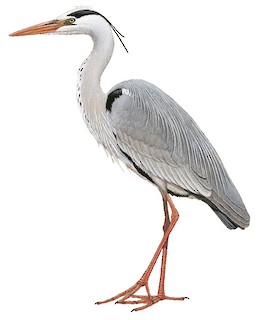
According to Jouanin and Roux (29), A. c. monicae—which they note more closely resembles the subspecies A. c. jouyi than the nominate, and which they therefore used for comparison—is distinguished by its smaller size, shorter bill and legs, and notably paler plumage. It features a pure white head and neck with minimal black throat markings, pale ash-gray upperparts, and wing coverts that transition from gray to pure white, all indicative of a general depigmentation trend. The smaller size and reduction in leg length may represent an adaptation to its habitat, which is dominated by shallow tidal flats, sandbanks, and mudflats, where its diminutive form would be advantageous.
Ardea cinerea monicae Jouanin & Roux, 1963
Definitions
- ARDEA
- cinerea
- monicae
The Key to Scientific Names
Legend Overview
- Year-round
- Migration
- Breeding
- Non-Breeding
Map last updated 24 June 2026.