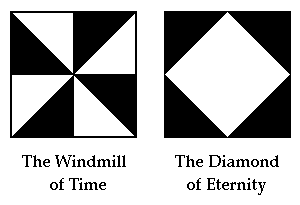
As the black moon
of some divine eclipse,
As the black sun
of the Apocalypse,
As the black flower
that blessed Odysseus back
From witchcraft; and
he saw again the ships.
In all thy thousand images
we salute thee.
Earlier in the poem....
Clothed with the sun
or standing on the moon
Crowned with the stars
or single, a morning star,
Sunlight and moonlight
are thy luminous shadows,
Starlight and twilight
thy refractions are,
Lights and half-lights and
all lights turn about thee.
"Harish, who was of a
spiritual, even religious, cast
and who liked to express himself in
metaphors, vivid and compelling,
did see, I believe, mathematics
as mediating between man and
what one can only call God."
-- R. P. Langlands From a link of Jan. 17, 2008--
Time and Eternity:
Jean Simmons (l.) and Deborah Kerr (r.)
in "Black
Narcissus" (1947)
Recent events in world financial markets suggest
a return to this topic, considered here on October 13, 2007. That day's entry, on
mathematics and theology, may be of use to those who are considering,
as their next financial move, prayer.
Some related material:
The review in the Jan. 22 New York Times of a
book by mathematics vulgarizer John Allen Paulos refuting
arguments for the existence of God.
Arguments in a less controversial area-- for and against
the consistency of elementary number theory:
FOR: Kurt Gödel, Steven H. Cullinane,
and John Dawson (See Log24-- Nov. 30 and Dec.
2, 2005-- and "Gödel, Inconsistency, Provability, and
Truth: An Exchange of Letters" (pdf), in the American Mathematical Society Notices
of April 2006.)
AGAINST: E. B. Davies, King's College London (See above.)
André Weil: "God exists since mathematics is
consistent, and the Devil exists since we cannot prove it."
Edward Rothstein has a piece on Bobby Fischer in today's New York Times. The Rothstein opening:
"There may be only three human activities in which miraculous
accomplishment is possible before adulthood: mathematics, music and
chess."
This echoes the opening of a classic George Steiner essay (The New
Yorker, Sept. 7, 1968):
"There are three intellectual pursuits, and, so far as I am aware, only
three, in which human beings have performed major feats before the age
of puberty. They are music, mathematics, and chess."
Despite its promising (if unoriginal) opening, the New York Times
piece is mainly an attack on Fischer's anti-Jewish stance.
Rothstein
actually has little of interest to say about what he calls the "glass-bead games" of music, mathematics, and chess.
For a better-written piece on chess and madness, see Charles
Krauthammer's 2005 essay in TIME. The feuilletons of Rothstein and Krauthammer do
not, of course, come close to the genuinely bead-game-like writing of Steiner.
Related material on
chess and religion: Magical
Thinking
(December 7th, 2005)
"Mazur introduced the topic of prime numbers with a story from Don
Quixote
in which Quixote asked a poet to write a poem with 17 lines. Because 17
is prime, the poet couldn't find a length for the poem's stanzas and
was thus stymied."
"saw
abstract painting... as 'still the primary visual challenge of our
time. It might get harder and harder to make an abstract image that's
believable, but I think that just makes the challenge greater.'"
The Times says that Goldberg was a veteran of Merrill's
Marauders in World War II (as well as of the last century's art
wars).
From a review of
A Certain Ambiguity
(A Mathematical Novel)
by Gaurav Suri and Hartosh Singh Bal Princeton
University Press
Hardcover, US$27.95, 281 pages --
"From
the Habermas-Lyotard debate (see [1] for an introduction) to the Sokal
hoax ([4]), to recent atheist manifestos on the bestseller lists (e.g.,
[2]) the question of foundations for intellectual thought and
especially for intellectual debate has never been more critical or
urgent."
Also in the February Notices--a
review of a book, Superior Beings: If They Exist, How Would We
Know?, in which the author
"..
uses elementary ideas from game theory to create situations between a
Person (P) and God (Supreme Being, SB) and discusses how each reacts to
the other in these model scenarios....
In the 'Revelation Game,' for example,
the Person (P) has two options:
1) P can believe in SB’s existence
2) P can not believe in SB’s existence
The Supreme Being also has two options:
1) SB can reveal Himself
2) SB can not reveal Himself....
...
[and] goals allow us to rank all the outcomes for each player from
best... to worst.... The question we must answer is: what is the Nash
equilibrium in this case?"
The answer is what one might expect from the American Mathematical
Society:
"... the dominant strategy for both is when SB does not reveal
Himself and P does not believe in His existence."